What a NEMA 14-50 actually is
NEMA is the North American standard that defines plug and receptacle shapes so the right cord always fits the right circuit. “14-50” identifies this specific one: a 125/250V, 3-pole, 4-wire grounding configuration rated for 50 amps. In practice that means a dedicated 240V circuit on its own breaker, wired by an electrician, with the receptacle itself doing nothing more than presenting that circuit through a standard plug. It’s the same outlet you’ll see specified for an electric range or a travel-trailer pad, which is part of why it’s so widely available to reuse or add.
The neutral in that four-wire configuration is worth one sentence, because an EV charger never touches it: Level 2 charging runs at 240 volts across the two hot legs and uses the ground purely for safety. That is why the three-slot NEMA 6-50 welder outletcharges at exactly the same speed with one conductor fewer — and why, if you are choosing which receptacle to have installed, the decision comes down to install cost and resale rather than to charging performance.
The code question: does it need GFCI protection?
This is worth raising with your electrician specifically, because it trips people up. Depending on the install — outdoor receptacles in particular — local code may call for the 14-50 circuit to sit on a GFCI-protected breaker. Most EV chargers already carry their own internal ground-fault protection as part of their UL 2594 safety listing, so stacking a second GFCI device on the circuit can occasionally cause nuisance tripping. There’s no universal answer here that overrides your local code, which is exactly why this is a conversation to have with your electrician before the outlet goes in, not a detail to discover afterward.
Why a 48A charger still tops out at 40A here
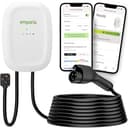
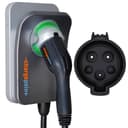
The National Electrical Code treats EV charging as a continuous load, which means a circuit can only be loaded to 80% of its rating for charging that runs three hours or more — and a 14-50’s 50-amp rating puts that ceiling at 40 amps. That’s why the Emporia below, rated 48A when hardwired, reads 40A on this same plug, and why even the 50A-capable ChargePoint Home Flex settles at 40A in its plug-in form. It’s not a flaw in any of these chargers; it’s the outlet’s ceiling, and it applies the same way no matter which brand you buy. The same rule caps a four-prong dryer outlet — a NEMA 14-30 on a 30-amp circuit — at 24 amps, and our NEMA 14-30 picks cover the chargers built for that plug rather than adapted to it. A three-slot NEMA 6-50 welder outletis the happier case — same 50 amps, same 40-amp ceiling, and the only obstacle is the plug shape.
Plug-in vs hardwire: what you’re actually trading
A 14-50 plug-in buys you two things a hardwired install doesn’t: you can take the charger with you if you move, and in many areas a licensed electrician can add the outlet without the extra step of connecting the charger itself to the panel. What you give up is that last 8-10 amps some of these chargers could otherwise deliver hardwired on a bigger circuit — not a large difference in overnight charging time, but a real one if you’re chasing every minute. Our tethered vs untethered guide covers the other big install decision, and if you find you want the full amperage after all, the Level 2 roundup covers the hardwired field.