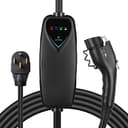
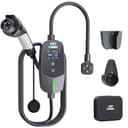
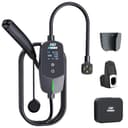
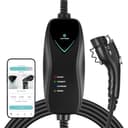
The published specs, side by side
| | EVDANCE 24A (EV-ACS2405U) | Lectron 40A portable |
|---|
| Plug | NEMA 14-30 (four-prong dryer) | NEMA 14-50 (range / RV) |
|---|
| Max output | 24 A / 5.76 kW | 40 A / 9.6 kW |
|---|
| Current steps | 10 / 12 / 16 / 20 / 24 A, set on the unit | None — fixed 40 A |
|---|
| Range added (3.5 mi/kWh) | ~20 miles an hour | ~34 miles an hour |
|---|
| Cable | 25 ft total (~21.9 ft box to car) | 16 ft |
|---|
| Enclosure | Type 4, −22 to 122 °F | Not published |
|---|
| Display / timer | 1.77 in display, 1–12 h delayed start | Not published (the Wi-Fi model is a separate SKU) |
|---|
| Safety listing | Intertek ETL 5034626 — UL 2594, UL 2231-2, CSA C22.2 | ETL listed to UL 2594 / UL 2231 |
|---|
| Warranty | 1 year | 2 years |
|---|
| Connector options | J1772 or native NACS (separate SKU) | J1772 |
|---|
Why the EVDANCE’s limitation is its best feature
A 24-amp ceiling sounds like a compromise and is the opposite. A four-prong NEMA 14-30 dryer receptacle sits on a 30-amp circuit, and NEC Article 625 treats EV charging as a continuous load, so the maximum legal charging current on it is 80% of 30 — 24 amps. The EVDANCE cannot exceed that figure because its hardware stops there, which means the single most common dryer-outlet error, running a 40-amp charger through an adapter onto a 30-amp circuit, is not available to you.
Compare that with the alternative. Put a 14-50-to-14-30 adapter on a Lectron 40A and you now have a fixed 40-amp charger drawing 40 amps through a 30-amp circuit, with nothing anywhere in the chain to object. The charger does not know what it is plugged into — United Chargers states that outright about its own portable: it “can not detect the circuit amperage limit”. Our adapter guideis entirely about this failure mode, and the reason we accept the Grizzl-E Mini’s adapter setup and not a fixed-output charger’s is that the Mini has a DIP switch to cap the current in hardware. The Lectron 40A has no setting at all.
The EVDANCE also gives you five steps below24 amps — 10, 12, 16, 20 and 24, chosen on the unit before the connector goes into the car — which is the right shape for an old receptacle you are not confident about. See our NEMA 14-30 roundup for the whole dryer-outlet field, and the full EVDANCE review for the detail.
Why the Lectron is still the one to buy on a 14-50
On a proper 50-amp circuit the EVDANCE’s virtue becomes a ceiling. Twenty-four amps is about 20 miles of range an hour at our 3.5 miles-per-kWh reference; 40 amps is about 34. Over a ten-hour night that is roughly 200 miles against 340, and if the circuit can carry 40 amps there is no reason to take 24.
The Lectron 40A is the cheapest honest route to a real 40 amps that we cover. It is ETL listed to the UL 2594 / UL 2231 standards, it is a portable you can unplug and throw in the trunk, and it does not ask you to configure anything. The trade-offs are real and we would not hide them: a 16 ft cable, which is the shortest in this comparison by nine feet; no published enclosure rating or operating temperature range at all, which is a blank field and therefore a finding; and no app on the base model, since Lectron sells the Wi-Fi build as a separate SKU. Our Lectron 40A review covers it in full, and our NEMA 14-50 roundup ranks it against the rest of that field.
The documentation problem, named
EVDANCE’s own paperwork contradicts itself in four places, and we think you should know before you buy rather than after. Taking the user manual for the exact model number as authoritative:
- The manual specifies a “32A breaker”. EVDANCE’s store page for the same product says a “Dedicated 20A Circuit”. Neither matches the 30-amp receptacle the charger’s own plug is built for.
- The store page advertises a “6-32A” adjustable range. The manual gives five steps topping out at 24 A.
- The store page lists a three-year warranty on a banner. The manual, the product page body and the Amazon listing all say one year.
- On the NACS version, the store-page description tells buyers that a Tesla needs a J1772 adapter — text evidently carried over from the J1772 model, and wrong for a charger with a native Tesla connector on it.
We record the manual in every case and the conflicts alongside it. None of these is a safety finding on its own — the ETL mark and control number are real and the hardware ceiling is real — but a brand whose documents disagree about the warranty term is a brand whose warranty you should expect to argue about. Lectron’s documentation, for what it is worth, is terse and consistent: it publishes less, and what it publishes agrees with itself.
If there is no 240-volt outlet at all
Worth saying, because a lot of people arrive at this comparison and discover the answer is neither. If there is no 240-volt receptacle anywhere useful, you have two options: pay an electrician to fit one, or charge at Level 1 from an ordinary 120-volt socket. Lectron is the stronger brand for the second, and the Wi-Fi version of its Level 1 charger is the one we would pick — 12 amps at 120 volts is about 1.44 kW, or roughly 5 miles of range an hour, and an overnight trickle is going to run for most of the night anyway, so the app’s scheduling and kWh cap are worth more than the three amps it trades away against the plain 15-amp model. Our Level 1 roundup and our “do you need Level 2?” guide cover whether that is enough for your driving.
The verdict
NEMA 14-50 on the wall: the Lectron 40A. A real 40 amps, ETL listed, portable, and the least money in this comparison. Measure from the receptacle to the charge port first, because 16 ft is genuinely short, and do not use it with an adapter onto a smaller outlet — it has no way to be turned down.
Four-prong NEMA 14-30 dryer outlet: the EVDANCE 24A. A native plug, a hardware ceiling at exactly the right number, five steps below it, a 25 ft total length, a Type 4 body published at −22°F to 122°F, an on-unit display and a delay timer, and an ETL mark with a control number you can check. Accept the one-year warranty and the inconsistent store copy as the price.
A Tesla on a dryer outlet: the EVDANCE 24A NACS version. The same charger with a native NACS connector, so there is no adapter at either end, and a button on the handle that opens the charge-port door. Not the right buy for a household that also has a J1772 car — that household wants the J1772 version and the adapter that came with the Tesla.