What a NEMA 6-50 actually is, and why it is good news
A NEMA 6-50 receptacle is the three-slot 240-volt outlet you find next to a welder, a plasma cutter or a large shop compressor. Two hot legs and a ground, 50 amps, no neutral. The absence of a neutral is why a 14-50 charger cannot physically go into it — the 14-50 has four pins and expects a neutral slot that a 6-50 does not have — but it is not an electrical problem for EV charging at all. An EV charger draws its power across the two hot legs at 240 volts and does not use a neutral. On the charging side, a 6-50 and a 14-50 are the same outlet.
That means the capacity conversation is simple. Fifty amps of circuit, derated to 80% for a continuous load under NEC Article 625, gives you 40 amps of charging. Forty amps at 240 volts is 9.6 kW. Our how many amps do I need guide walks through the arithmetic, and our NEMA 14-50 roundupis the same page for the four-prong outlet — the picks there are chargers whose factory plug is a 14-50, which is the majority of the market.
Two things to confirm before you plug anything in, both of which apply specifically to a welder circuit rather than to a receptacle installed for a car:
- Is the breaker really 50 amps, and is the wire sized for it? Shop circuits get added to over the years. A 6-50 receptacle on a 40-amp breaker is a 32-amp charging circuit, not a 40-amp one, and the charger has to be set accordingly. Read the breaker, not the outlet.
- Is the receptacle in good condition? Welding is intermittent duty — minutes of current with long gaps. Charging is the opposite: hours of steady current, every night. Heat is the failure mode, and it shows up at the connections first. If the receptacle is old, discoloured, loose in its box or the plug feels sloppy in it, replace the receptacle before you use it. Our extension cord guide explains the same duty-cycle problem in more detail, because it is the reason that guide exists.
The adapter question, answered honestly
Most buyers arrive here with a 14-50 charger already in hand and a 6-50 on the wall, and the internet is full of $25 adapters that make them fit. Here is our position, and it is the same one our cheap chargers guide takes: the adapter itself is not the problem. The sourcing is.
An adapter adds a plug-and-socket joint to a circuit that will carry 40 amps continuously for hours. That joint is now the hottest, weakest point in the chain, and nothing about the charger's own safety listing covers it. When the adapter comes from the charger's manufacturer, it was designed and tested as part of that charger's system — United Chargers' four Mini adapters are named in the Mini manual, under the same UL file (E510712) as the charger. When it comes from an unbranded listing that names no lab, you have taken the one connection carrying the most heat and sourced it from whoever is cheapest this week.
So the order of preference is: a charger whose factory plug is a 6-50 (nobody in our registry sells one), then a charger whose manufacturersupplies the 6-50 adapter (the Grizzl-E Mini), then a manufacturer-supplied adapter from a named brand for a charger you already own, then — if none of that is available — have an electrician swap the 6-50 receptacle for a 14-50 and buy any charger you like. That last option is usually a one-hour job on an existing circuit, because the wire and the breaker are already correct. It is often the cheapest honest answer, and it is worth getting a quote before you spend money on adapters.
Why each pick is here
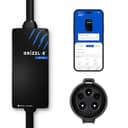
Grizzl-E Mini — the only one that solves this from the box. Forty amps and 9.6 kW on a NEMA 14-50 plug, with 14-30P, 6-50P, TT-30P and 5-15P adapters included by the manufacturer. A UL Type 4 indoor/outdoor rating, a published -22°F to 122°F range, a three-year warranty and UL file E510712. On a verified 50-amp circuit you run it at its full 40 amps, which is the whole point of having found a 6-50.
There is one setting you must change, and it is the same warning we lead the full Mini review with: United Chargers' current Mini manual states that the charger “can not detect the circuit amperage limit”and ships with a factory default maximum of 40 amps. On a true 50-amp circuit, 40 amps is correct and you can leave it. On a 40-amp breaker behind that 6-50 receptacle, it is not — set the internal DIP switch to 32 amps before the first session. The switch offers 40, 32, 24 or 16 amps, it is a hardware cap no Wi-Fi setting can exceed, and reaching it means removing the front cover with the charger unplugged.
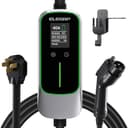
ELEGRP 40A — the value pick, and the most adjustable. The cheapest charger in our registry that still publishes everything worth checking: 9.6 kW, five current levels at 16, 20, 24, 32 and 40 amps, a 25 ft cable, an IP67 body with a published -21°F to 121°F range, ETL certification and a two-year warranty. The five levels are what earn it second place here specifically — if you find a 40-amp breaker behind the welder outlet, or the receptacle is old enough that you want to run it gently at 24 amps for a while, this is the pick that lets you. Its plug is a NEMA 14-50, so it needs an adapter to reach a 6-50; our ELEGRP review covers the rest of the unit.
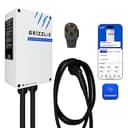
Grizzl-E Classic Connect — if the charger is staying put. The Mini is a cord you can throw in the trunk. The Classic Connect is the same company's wall unit: a 40-amp plug-in with a metal case rated UL Type 4 indoor/outdoor, the same -22°F to 122°F range, a 25 ft cable, 2.4 GHz Wi-Fi with the Grizzl-E Connect app, and current adjustable from 40 amps down to 16. If the welder outlet is in the place the car parks and the charger will live on that wall for years, this is the better buy of the two — the scheduling and the longer cable matter more than portability, and United Chargers lists the warranty as a purchase choice between three and five years. It also plugs into a 14-50, so the adapter note applies. We put the Mini vs Classic question side by side in our Mini vs Classic comparison.
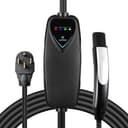
Lectron Level 2 Tesla 40A — for a NACS car. Everything above has a J1772 connector, which fits every non-Tesla EV. If your car takes a Tesla/NACS plug, this is the same 40-amp, 9.6 kW portable with the NACS connector moulded on, so there is no adapter at the carend either. An IP65 control box, an IP55 handle, ETL listing to UL 2594 and UL 2231 with a UL 2251 handle. Two honest limitations: Lectron publishes no warranty term for this SKU, and there is no adjustable current — it is 40 amps or nothing, so it needs a circuit you have actually verified. Our portable Tesla roundup has the alternatives, our adapters and accessories hub covers the car-side connector question in both directions, and our full charger reviews go through each of these units on its own terms.
What we would do
If you are buying the charger and the welder outlet now: buy the Grizzl-E Mini. The manufacturer-supplied 6-50P adapter removes the only genuinely awkward part of this situation, and the unit is UL certified with a three-year warranty behind it. Set the DIP switch to match the breaker you read, not the receptacle you see.
If you already own a 14-50 charger:price a receptacle swap before you buy an adapter. The circuit behind that 6-50 is already sized and breakered for 50 amps, so changing the receptacle to a 14-50 is a short job on existing wiring, and it leaves you with a standard outlet that every charger on the market fits — no extra joint, no adapter to lose. If the swap is not possible, a named-brand adapter from your charger's own manufacturer is the next best thing, and an unbranded one that names no safety lab is where we stop.
And if the breaker turns out to be 40 amps rather than 50, buy the ELEGRP and set it to 32. That is still 7.7 kW, still about 27 miles of range an hour at our reference efficiency, and still more charging than most households use overnight. The number on the breaker decides this, which is the same conclusion our outlet types guide reaches from every other direction.