How slow is Level 1, really?
Let us put a number on it rather than an adjective. A 15-amp Level 1 charger on a 120-volt outlet delivers about 1.8 kW. At our standard reference of roughly 3.5 miles of range per kWh, that is about 6 miles of range per hour before charging losses. A 12-amp unit is about 1.44 kW, or roughly 5 miles an hour. If a plug-in hybrid has outgrown that, our Level 2 picks for plug-in hybrids size the charger to the car.
The number that matters is not the hourly rate, though — it is the overnight total. Plug in at 7pm and unplug at 7am and you have had twelve hours, which at 6 miles an hour is roughly 70 miles of range added. Plug in when you get home on a Friday and leave it until Monday morning and the arithmetic gets genuinely generous.
So the honest test is: do you drive more than about 60 miles on a typical day?If the answer is no — and for a great many drivers it is — Level 1 quietly keeps up, and you never think about it. If the answer is yes, or if it is yes several days a week, Level 1 will fall behind and keep falling behind, and no amount of patience fixes it. Our do you need Level 2 guide works that test through in more detail, and our how long to charge guide puts the rates against real battery sizes.
One more group for whom Level 1 is simply correct: plug-in hybrid drivers. A PHEV battery is a fraction of the size of a full EV pack, so an overnight Level 1 charge often fills it completely. Buying a Level 2 charger for a plug-in hybrid is usually money spent on capability the car cannot use.
Who Level 1 is actually for
Renters and anyone who cannot install anything.This is the biggest group. If you cannot put a 240V circuit into a building you do not own, Level 1 is not a compromise — it is the only option, and a good Level 1 charger is a much better version of it than the cable that came in the trunk.
Plug-in hybrid drivers. Small battery, overnight window, done.
Short-commute drivers. If your daily driving is well under the overnight replacement rate, Level 2 buys you speed you will never notice.
Second cars and occasional-use cars. A car that does 40 miles a week does not need 40 miles an hour of charging.
Anyone who wants a backup. Even with a Level 2 charger at home, a Level 1 unit in the trunk means any outlet anywhere is a charger. That is the case for owning one as a second charger rather than a primary.
What to look for in a Level 1 charger
The field is small, which makes the criteria short.
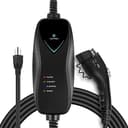
Amps: 15 beats 12. A standard North American household circuit is 15 or 20 amps, and continuous-load rules mean a 15-amp charger is at the practical ceiling for Level 1. Between a 15-amp and a 12-amp unit, the 15 gives you about 20% more range per hour for what is usually a small price difference. That is the single biggest spec difference on this page.
Certification, without exception.Look for a real ETL or UL listing against UL 2594 and UL 2231 — the EV supply equipment and personnel-protection standards. This matters more on Level 1 than anywhere else, because a Level 1 charger gets plugged into ordinary household outlets that were never installed with EV charging in mind. Our guide to reading certifications covers how to tell a real listing from marketing language.
Cable length.Sixteen feet is standard here and is usually enough, because Level 1 charging happens wherever there is an outlet rather than at a purpose-mounted box. Still measure — our guide to measuring cable reach applies just as well.
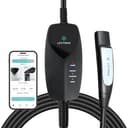
The right connector for your car. Most Level 1 chargers terminate in a J1772 plug, which suits every non-Tesla EV. If you drive a Tesla or another NACS car, the Lectron Level 1 Tesla is the same proposition with the native plug already fitted, at 12 amps rather than 15, which saves carrying an adapter for a charger that otherwise lives in the boot untouched.
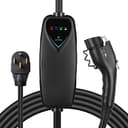
Dual-level units: worth knowing they have thinned out.Some chargers ship with interchangeable plug heads — a NEMA 5-15 for 120V and a NEMA 14-50 for 240V — so one box works as a Level 1 charger today and a 40-amp Level 2 charger the day an outlet appears. It is a genuinely neat idea, but the unit we used to recommend for it is no longer sold on Amazon, and we have not found a replacement at the same amperage we are willing to put our name to. Until we do, the honest advice is to buy the Level 1 unit you need now and add a separate 40-amp charger if the outlet ever arrives.
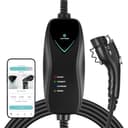
Scheduling, maybe.A Wi-Fi Level 1 charger lets you start the session when your off-peak rate does. On a charge that runs most of the night anyway, that can be worth real money — though most modern EVs schedule from the car for free, which is usually the simpler route.
The safety rules that actually matter on Level 1
Level 1 feels casual because it uses a household outlet, and that is exactly why it deserves a short list of hard rules.
No extension cords.An EV charger draws its rated current continuously for many hours — the National Electrical Code treats EV charging as a continuous load for precisely this reason. A household extension cord is not built for that duty, and every extra joint is a place to heat up. Plug the charger directly into the wall.
No power strips, no multi-outlet adapters, no timers. Same reason, more so.
Prefer a dedicated outlet. Ideally the charger has the circuit to itself. Sharing a circuit with a space heater or a freezer is how you find out where the breaker is at 3am.
Check the outlet itself.Old, loose or discolored receptacles are not up to a continuous 12 to 15 amps for eight hours. If the plug feels warm to the touch after an hour, stop and have an electrician look at the outlet — the charger is usually not the problem. Our troubleshooting guide covers what to check and in what order.
When to stop reading and install a 240V outlet
We would rather send you away than sell you the wrong thing, so here is the line. If you regularly drive more than the overnight replacement rate, if you own the property, and if a 240V outlet is within reach of a reasonable electrical job, then a NEMA 14-50 outlet plus a plug-in Level 2 charger is the better purchase — roughly 34 miles of range an hour instead of 6, from equipment that is still portable and still comes with you when you move.
That is why the Lectron 40A sits on this page as the step-up pick. It is the cheapest honest route into real Level 2 charging, and if the outlet is achievable it makes every argument above moot. Our portable Level 2 roundup covers that tier, and our installation guide covers what the outlet costs to put in. Note too that the federal 30C credit that used to offset part of that job has expired, so budget the install at full cost.
How to choose in one paragraph
If Level 1 is your only option, buy the 15-amp unit — it is the fastest version of the slow answer. Add the app version only if you are on a time-of-use rate and your car will not schedule for you. If there is any prospect of a 240V outlet appearing, budget for a separate 40-amp plug-in charger when it does rather than waiting for a dual-level unit we can currently recommend. And if you drive a Tesla or another NACS car, buy the native NACS Level 1 unit rather than a J1772 charger plus an adapter — our portable Tesla charger guide covers why that is the one case where native NACS is clearly simpler.