First, do the arithmetic — you may need one charger
Start with how much range each car actually loses in a day rather than how big the batteries are. A Level 2 charger at 40 amps replaces about 34 miles of range per hour at our standard reference of roughly 3.5 miles per kWh; at 48 amps, about 40. If the two cars between them cover 80 miles on a typical day, that is somewhere around two to two and a half hours of charging — total, for both cars — against an overnight window that is usually ten hours or more.
That is why the most common honest answer to “we have two EVs” is one charger and a habit: plug in whichever car needs it most, alternate nights, or swap the cable when you go to bed. It costs one circuit instead of two, one charger instead of two, and no service upgrade. Our how long to charge guide runs this math against real battery sizes, and our do you need Level 2 guide is the same exercise one level further down.
Two things genuinely break that logic. If both cars regularly run near empty — long commutes, frequent road trips — the overnight window stops being generous. And if the two drivers leave at very different times, a shared cable becomes a daily negotiation rather than a habit. If either applies, two chargers is the right call, and the question becomes how to feed them.
The panel is the real constraint
Under the National Electrical Code’s Article 625, EV charging is a continuous load, so each charger’s circuit is sized to 125% of its continuous draw. Two 48-amp chargers means two 60-amp circuits: 120 amps of dedicated capacity, before the house has cooked anything. On a 200-amp service with a modest load that can be workable. On a 100-amp service it is not, and the quote comes back with a service upgrade on it.
There are three ways out of that, in ascending order of cost.
1. Dynamic load management
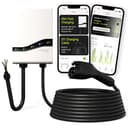
The best answer, and the reason the Emporia Proleads this page. Emporia publishes PowerSmart as dynamically adjusting charging speed to prevent overloading the panel — the charger watches whole-house demand and reduces its own draw rather than requiring headroom that is permanently reserved. Emporia states PowerSmart requires their Vue energy monitor, a separate device installed in the panel, so budget for both. The Wallbox Pulsar Plusoffers its own Power Boost load balancing toward the same end, in one of the smallest 48A bodies made — useful when two chargers have to fit on one wall.
2. Fixed lower amperage
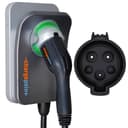
Cruder and cheaper. The ChargePoint Home Flexsets its output anywhere from 16 to 50 amps in software, so two chargers can be dialed to a number your panel can carry — two 32-amp chargers on 40-amp circuits, say, instead of two 48-amp chargers on 60-amp ones. You lose some miles per hour and gain a circuit you can actually get. Our how many amps guide covers working out where that line falls for your panel, and our 100-amp panel roundup ranks every charger here on the range it publishes. The chargers that publish real load managementare ranked separately — including the one that shares a budget between two chargers with no extra hardware at all, which is the version this page cares about.
3. A service upgrade
The expensive route, and sometimes the correct one — particularly if the panel is old, already full, or you have other electrification plans. Our Level 2 installation guide covers what that job involves and the published cost ranges a utility puts on it. Do not treat it as the default; price load management first.
Two chargers, or one charger and a schedule?
If you decide on two, a practical note that saves money: they do not have to match. There is no benefit to a matched pair beyond aesthetics. A sensible pattern is one capable smart charger for the car that needs the most range and the most scheduling, plus a simpler, cheaper unit for the second car — the Emporia Level 2 as the value workhorse, or the EVIQO 48A if the second charger has to reach further than the first. If the second charger will live outside with no shelter, our outdoor roundup is the narrower list to pick from.
If you decide on one, the charger to buy is the one with the longest cable you can get, because reach is what makes a shared charger tolerable. Twenty-five feet can often serve two parking spots from a single mount point where 16 feet cannot serve one. Our long-cable roundup ranks specifically on that, and it is the single most useful spec for a two-car household running one charger.
One thing we would not do: run two chargers off a single circuit with an improvised splitter. Purpose-built power-sharing systems exist and are wired by an electrician as a designed system with load management built in; a homemade arrangement is not that, and it is exactly the situation the continuous-load rules are written to prevent. There isa legitimate splitting device — a certified automatic switch that powers one outlet at a time — but it shares a circuit rather than dividing it, so the second car waits. Our splitter guide explains which of the three products sold under that name is which.
Scheduling: the free half of the solution
Whether you end up with one charger or two, scheduling does real work here. Every modern EV can be told when to start charging, and most utilities price overnight power below daytime power. Staggering two cars — one starting at 11pm, the other at 2am — means their peaks never overlap, which reduces both your bill and the demand your panel ever sees at once.
You can do this from the cars, from the chargers, or both. Doing it from the cars is usually simpler, because the schedule travels with the vehicle rather than with the parking spot. Our cost-to-charge guide has a calculator you can put your own rate into to see what off-peak scheduling is worth on two cars, which for many households is the difference that pays for the second charger over a few years.
How to choose in one paragraph
Work out the daily miles for both cars first; if the total is comfortably inside an overnight window, buy one good charger with the longest cable you can get and revisit later. If you need two and your panel is tight, buy load management — the Emporia Pro if you are happy to add the energy monitor, the Wallbox if space is the constraint. If your panel is generous, two straightforward 48A chargers is the simplest thing that works, and they do not need to be the same model. And if either car is a Tesla, settle the connector question before anything else — our Tesla charger guide covers whether to buy native NACS or use a J1772 charger with an adapter, which in a mixed household is usually the more flexible answer.