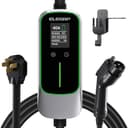
Plug & Range

Best EV Chargers Under $500

Five hundred dollars buys a real, certified Level 2 charger with room to spare — including 48-amp units and a native Tesla plug. What it does not buy is the premium-brand polish, and we say exactly where that shows.

By Stephen V.Last updated How we pick

The good news first: under $500 is not a compromise bracket for home charging any more. Most of the chargers we rank highest anywhere on this site sit inside it, including full 48-amp hardwired units with Wi-Fi, ENERGY STAR listings and 25-foot cables. The premium brands still charge more for a more polished app, a longer track record or a design flourish, but the electricity arrives at the same speed. A 48-amp charger adds roughly 40 miles of range an hour at our standard 3.5 miles-per-kWh reference whichever logo is on the front.

This list is built differently from most “under $X” pages. Every price on this site comes from a daily retailer check, and this page filters on it: a charger only appears here if that check put it under $500 on the day the page was last built. If a price creeps over the line, the charger drops off automatically instead of sitting here with a number that is no longer true. If a price could not be verified that day, only chargers we class as budget or mid-tier stay, and the button reads “Check price on Amazon”.

We rank on four things, in this order: whether the charger publishes a safety listing from a recognized lab, whether it can run at the current your circuit allows, what it does outdoors, and what the warranty and app are like. We have not bench-tested any of these units; the specs come from each manufacturer’s own sheet, and the charging-speed figures are our own arithmetic.

How this is funded:we earn a commission if you buy through our links, at no extra cost to you. It never changes which product we recommend, and we’ll tell you when we’d skip one. Full disclosure.

Quick picks

Ranked on published specs, charging speed, electrical fit and value. Select a row to jump to the full write-up. We have not bench-tested these chargers — here is exactly what we do instead.

#ProductBest forPrice
1
Emporia Level 2 EV Charger

Emporia Level 2 EV Charger

The value pick that never feels like one. You get the full 48 amps, an ENERGY STAR listing, real Wi-Fi energy tracking and a 25 ft cable for well under what the marquee brands charge. When someone asks us where to start, this is usually the first name out of our mouths.

Best overall under $500
$449.00 · View on Amazon

Price as of September 18, 2026. #ad How we’re funded

2
WOLFBOX E48 Level 2 Charger, 48A

WOLFBOX E48 Level 2 Charger, 48A

The 48-amp WOLFBOX you can actually buy, and the more forthcoming of the two: unlike the WE48 it replaces, the E-series spec table publishes 11.5 kW, the five current steps, the enclosure rating, the Wi-Fi band and a 36-month EV-charger warranty. You also get a 4.3-inch screen on the unit itself, which reports voltage, temperature and session totals without reaching for the app. The one number still missing is an operating-temperature range, and the one claim we could not confirm is ENERGY STAR.

Best 48-amp value with a display
$327.59 · View on Amazon

$389.9916% off

Price as of September 18, 2026. #ad How we’re funded

3
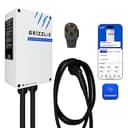
Grizzl-E Classic Connect

Grizzl-E Classic Connect

Grizzl-E retired the old no-app Classic and replaced it with this, and it kept the part that mattered: a metal case rated UL Type 4 for a spot with no shelter, published to keep operating down to -22F. What changed is that the electronics caught up — Wi-Fi, an app, and current you can dial from 40A down to 16A to fit a circuit you already have. It's the rugged pick that no longer asks you to give up scheduling to get it.

Best rugged plug-in
$349.99 · View on Amazon

Price as of September 18, 2026. #ad How we’re funded

4
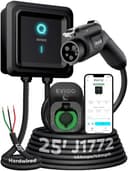
EVIQO 48A Level 2 Charger

EVIQO 48A Level 2 Charger

A lot of charger for the money. You get 48 amps, Wi-Fi scheduling, ENERGY STAR, and the longest usable reach in this group thanks to a 25 ft cable plus a 40-inch input lead. If Emporia is sold out or you want maximum cable, this is the value alternative to have in mind.

Best cable reach
$429.99 · View on Amazon

$479.0010% off

Price as of September 18, 2026. #ad How we’re funded

5
Lectron Nexus NACS (Tesla) Charger

Lectron Nexus NACS (Tesla) Charger

For a Tesla owner who doesn't want to babysit an adapter. The native NACS (J3400) connector goes straight into the car at a full 48 amps, with the safety listings you want to see. There's no app — but a Tesla schedules charging in the car anyway, so you're not really missing one.

Best for a Tesla
$429.99 · View on Amazon

$459.997% off

Price as of September 18, 2026. #ad How we’re funded

6
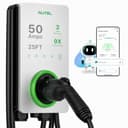
Autel MaxiCharger Home

Autel MaxiCharger Home

Built for the driveway that takes the full brunt of the weather. The NEMA 4X shell is rated to keep charging through brutal cold and heat, it delivers a full 50 amps, and the app is genuinely capable. If your charger will live fully exposed, this is the one to shortlist.

Best for a fully exposed wall
$499.00 · View on Amazon

$568.0012% off

Price as of September 18, 2026. #ad How we’re funded

7
ELEGRP 40A Portable Level 2 Charger (ECP24-40A0-01)

ELEGRP 40A Portable Level 2 Charger (ECP24-40A0-01)

The cheapest charger in this registry that still publishes everything you would want to check: 9.6 kW, five current levels from 16 to 40 amps, an IP67 body with a stated -21°F floor, ETL certification and a 2-year warranty. There is no Wi-Fi and no app — you get a 1-to-12-hour delay timer on the unit instead — and for a lot of households that is the correct amount of charger.

Best with no electrician
$209.99 · View on Amazon

Price as of September 18, 2026. #ad How we’re funded

The picks in full

#1Best overall under $500

Emporia Level 2 EV Charger

The value pick that never feels like one. You get the full 48 amps, an ENERGY STAR listing, real Wi-Fi energy tracking and a 25 ft cable for well under what the marquee brands charge. When someone asks us where to start, this is usually the first name out of our mouths.

Strengths

  • 48A and ENERGY STAR at a genuinely value price
  • The app tracks energy use, not just an on/off toggle
  • Long 25 ft cable and a remote holster in the box

Trade-offs

  • 48A hardwired needs a 60A circuit; on a NEMA 14-50 plug it's capped at 40A
  • The app is less polished than ChargePoint's, and support is a smaller operation
Max output48 A
Power11.5 kW
ConnectorJ1772
InstallHardwired or NEMA 14-50 plug
Cable length25 ft
Warranty3 years
WiFi + appYes
CertificationsUL listed, ENERGY STAR

Our charging-speed math. Hardwired at 48A (11.5 kW), figure about 40 miles of range an hour at 3.5 mi/kWh. Drop to a 40A plug-in circuit and it's closer to 34.

Build note. Runs 48A hardwired, or 40A on a NEMA 14-50 outlet, with a 25 ft cable and a wall holster included.

Specs read from the manufacturer spec sheet, on July 19, 2026. “Not published” means the brand does not state that figure.

#2Best 48-amp value with a display

WOLFBOX E48 Level 2 Charger, 48A

The 48-amp WOLFBOX you can actually buy, and the more forthcoming of the two: unlike the WE48 it replaces, the E-series spec table publishes 11.5 kW, the five current steps, the enclosure rating, the Wi-Fi band and a 36-month EV-charger warranty. You also get a 4.3-inch screen on the unit itself, which reports voltage, temperature and session totals without reaching for the app. The one number still missing is an operating-temperature range, and the one claim we could not confirm is ENERGY STAR.

Strengths

  • Publishes what the WE48 did not: 11.5 kW, five current steps from 16 to 48 amps, and a warranty term
  • 4.3-inch LCD on the unit reports voltage, temperature and session totals with no app open
  • IP66 / NEMA 4 housing, 25 ft cable, OTA firmware updates, RFID card and plug-and-charge

Trade-offs

  • WOLFBOX's spec table claims ENERGY STAR, but the ENERGY STAR certified-EVSE database lists only the E40 and E50 — not this 48-amp configuration
  • Its 36-month warranty is published as the wolfbox.com default; WOLFBOX's own policy says coverage on other platforms may vary, so confirm the term with the Amazon seller
  • Still no operating-temperature range, which is the spec that decides a cold-climate install
  • Hardwired only on a 60-amp circuit, so it needs an electrician and stays with the house
Max output48 A
Power11.5 kW
ConnectorJ1772
InstallHardwired
Cable length25 ft
Warranty3 years
WiFi + appYes
CertificationsCSA certified, FCC, stated to meet UL 2594 (WOLFBOX also prints ENERGY STAR, but no 48A model is on the ENERGY STAR certified list)

Our charging-speed math. WOLFBOX publishes up to 11.5 kW, and 48 amps at 240V is about 11.5 kW, so the arithmetic agrees for once: at our 3.5 miles-per-kWh reference that is roughly 40 miles of range an hour, or about 400 miles across a ten-hour overnight window. WOLFBOX's Amazon listing claims 46 miles an hour, which assumes a more efficient car than our reference — plan around 40.

Build note. WOLFBOX publishes up to 11.5 kW at 200-240 V AC, current output selectable at 16, 24, 32, 40 and 48 amps, a 60A-or-greater circuit breaker, hardwired connection with a 23-inch input cord, a J1772 connector on a 25-foot cable, an IP66 / NEMA 4 protection rating, a 12.68 x 7.46 x 4.76 in wall-mount body, 2.4 GHz 802.11 b/g/n Wi-Fi with over-the-air firmware updates, a 4.3-inch LCD showing charge rate, time, voltage and energy, RFID card or app start, Alexa and Google Assistant control, and a 36-month manufacturer warranty for EV chargers. One inconsistency worth flagging: the Amazon bullet copy says "NEMA 4X", while both the Amazon title and WOLFBOX's own spec table say NEMA 4 / IP66 for this 48-amp model — we record the spec table's figure.

Specs read from the manufacturer spec sheet, on September 4, 2026. “Not published” means the brand does not state that figure.

#3Best rugged plug-in

Grizzl-E Classic Connect

Grizzl-E retired the old no-app Classic and replaced it with this, and it kept the part that mattered: a metal case rated UL Type 4 for a spot with no shelter, published to keep operating down to -22F. What changed is that the electronics caught up — Wi-Fi, an app, and current you can dial from 40A down to 16A to fit a circuit you already have. It's the rugged pick that no longer asks you to give up scheduling to get it.

Strengths

  • Metal case rated UL Type 4 indoor/outdoor, published from -22F to 122F
  • Current adjusts from 40A down to 16A, so it fits the circuit you already have
  • 25 ft cable — among the longest here — on a simple plug-in NEMA 14-50 install

Trade-offs

  • 40A caps its charging speed below the 48A units
  • Scheduling now runs through Wi-Fi and an account — the old Classic's nothing-to-update simplicity is gone
  • Grizzl-E publishes UL/cUL only for this model, not the ENERGY STAR listing the discontinued Classic carried
Max output40 A
Power9.6 kW
ConnectorJ1772
InstallNEMA 14-50 plug
Cable length25 ft
Warranty3 years
WiFi + appYes
CertificationsUL/cUL listed (file E510712)

Our charging-speed math. At 40A (9.6 kW) and 3.5 mi/kWh it adds roughly 34 miles of range an hour — more than enough to refill a daily commute overnight. Dial it down to 16A and you're at about 13.

Build note. A metal case rated UL Type 4 indoor/outdoor and published for -30C to +50C (-22F to 122F), with 2.4 GHz Wi-Fi and current adjustable from 40A down to 16A.

Specs read from the manufacturer spec sheet, on August 11, 2026. “Not published” means the brand does not state that figure.

#4Best cable reach

EVIQO 48A Level 2 Charger

A lot of charger for the money. You get 48 amps, Wi-Fi scheduling, ENERGY STAR, and the longest usable reach in this group thanks to a 25 ft cable plus a 40-inch input lead. If Emporia is sold out or you want maximum cable, this is the value alternative to have in mind.

Strengths

  • 48A output with Wi-Fi scheduling at a value price
  • 25 ft charging cable plus a 40 in input lead — excellent reach
  • UL, ETL, FCC and ENERGY STAR listings

Trade-offs

  • The hardwired version needs a 60A circuit and an electrician
  • A smaller brand with a shorter track record than ChargePoint or Wallbox
Max output48 A
Power11.5 kW
ConnectorJ1772
InstallHardwired
Cable length25 ft
Warranty3 years
WiFi + appYes
CertificationsUL, ETL, FCC, ENERGY STAR

Our charging-speed math. At 48A (11.5 kW) and 3.5 mi/kWh, about 40 miles of range an hour.

Build note. Ships with a 25 ft charging cable plus a 40 in input cable — among the longest total reach in class.

Specs read from the manufacturer spec sheet, on July 19, 2026. “Not published” means the brand does not state that figure.

#5Best for a Tesla

Lectron Nexus NACS (Tesla) Charger

For a Tesla owner who doesn't want to babysit an adapter. The native NACS (J3400) connector goes straight into the car at a full 48 amps, with the safety listings you want to see. There's no app — but a Tesla schedules charging in the car anyway, so you're not really missing one.

Strengths

  • Native NACS connector — no J1772-to-Tesla adapter to keep track of
  • Full 48A output and a weather-rated IP66 body
  • UL/ETL safety listings plus ENERGY STAR

Trade-offs

  • No Wi-Fi app — you schedule in the Tesla app instead
  • Best for Tesla/NACS cars; other EVs need a NACS-to-J1772 adapter
Max output48 A
Power11.5 kW
ConnectorNACS
InstallHardwired
Cable length23 ft
Warranty3 years
WiFi + appNo
CertificationsUL 2594/2231/2251 (ETL listed), ENERGY STAR, FCC

Our charging-speed math. At 48A (11.5 kW) and 3.5 mi/kWh, about 40 miles of range an hour into a Tesla.

Build note. A native NACS (J3400) connector plugs straight into a Tesla with no adapter; a holster is included.

Specs read from the manufacturer spec sheet, on July 19, 2026. “Not published” means the brand does not state that figure.

#6Best for a fully exposed wall

Autel MaxiCharger Home

Built for the driveway that takes the full brunt of the weather. The NEMA 4X shell is rated to keep charging through brutal cold and heat, it delivers a full 50 amps, and the app is genuinely capable. If your charger will live fully exposed, this is the one to shortlist.

Strengths

  • NEMA 4X enclosure rated for very cold and very hot conditions
  • Full 50A output paired with a 25 ft cable
  • Wi-Fi, Bluetooth and a capable app

Trade-offs

  • 50A means a 60A circuit and, usually, a hardwired install
  • The app and ecosystem are younger than ChargePoint's
Max output50 A
Power12 kW
ConnectorJ1772
InstallHardwired
Cable length25 ft
Warranty3 years
WiFi + appYes
CertificationsCSA certified, ENERGY STAR

Our charging-speed math. At its 50A ceiling (about 12 kW) and 3.5 mi/kWh, roughly 42 miles of range an hour.

Build note. A NEMA 4X weatherproof enclosure rated for operation down to around -40 degrees F.

Specs read from the manufacturer spec sheet, on July 19, 2026. “Not published” means the brand does not state that figure.

#7Best with no electrician

ELEGRP 40A Portable Level 2 Charger (ECP24-40A0-01)

The cheapest charger in this registry that still publishes everything you would want to check: 9.6 kW, five current levels from 16 to 40 amps, an IP67 body with a stated -21°F floor, ETL certification and a 2-year warranty. There is no Wi-Fi and no app — you get a 1-to-12-hour delay timer on the unit instead — and for a lot of households that is the correct amount of charger.

Strengths

  • Five current levels (16/20/24/32/40A) — it fits whatever circuit you have
  • IP67 with a published -21°F to 121°F range, and a carrying case in the box
  • 2-year warranty and full ETL certification at the bottom of the price band

Trade-offs

  • No Wi-Fi, no app and no energy monitoring — just an on-unit delay timer
  • Not ENERGY STAR listed, so it may not qualify for some utility rebates
  • 40 amps is the plug-in ceiling; a 48-amp unit needs hardwiring
Max output40 A
Power9.6 kW
ConnectorJ1772
InstallNEMA 14-50 plug
Cable length25 ft
Warranty2 years
WiFi + appNo
CertificationsETL certified

Our charging-speed math. Forty amps at 240V is 9.6 kW, and at 3.5 miles per kWh that is roughly 34 miles of range an hour. ELEGRP's own figure is 37 miles an hour, which assumes a slightly more efficient car than our reference.

Build note. ELEGRP publishes 240V, up to 9.6 kW, five selectable current levels of 16, 20, 24, 32 and 40 amps, a NEMA 14-50 plug, a 25 ft cable measured plug-end to connector, a J1772 connector, ETL certification with its PBE overheat protection, an IP67 rating with a -21°F to 121°F range, a 1-12 hour delayed start, a carrying case and a 2-year warranty.

Specs read from the manufacturer spec sheet, on August 19, 2026. “Not published” means the brand does not state that figure.

What you give up under $500 — and what you don’t

You don’t give up speed. Charging speed is set by amps, and amps are cheap. The Emporia, WOLFBOX and EVIQO picks here all publish 48 amps hardwired, which is the practical ceiling for a home charger on a 60-amp circuit. The 40-amp picks are 40 amps because they are plug-in units on a NEMA 14-50 receptacle, where 40 is the most any charger may draw, not because they are cheaper hardware.

You don’t give up safety. Every charger we list carries a safety listing from a nationally recognized testing laboratory. Price is not the safety signal; the listing is. Our guide to cheap charger safety explains how to read one in a minute and which phrases only sound like certification.

You sometimes give up the app. The ELEGRP here has no Wi-Fi at all, just an on-unit delay timer. For a lot of households that is the right amount of charger, because the car already schedules charging on its own. Our smart versus basic comparison works through when an app earns its keep.

You sometimes give up the rebate listing. Plenty of utility rebates require an ENERGY STAR-certified charger. The Emporia, EVIQO, Lectron NACS and Autel carry that listing; Grizzl-E publishes UL/cUL for the Classic Connect but no ENERGY STAR listing; the ELEGRP is not ENERGY STAR listed; and WOLFBOX prints ENERGY STAR on its spec table for a 48-amp configuration the ENERGY STAR database does not list, so we treat that one as unconfirmed. If a rebate is part of your budget, check the certified list for the exact model before you count on it.

The install usually costs more than the charger

If you are shopping by price, look at the whole job. PG&E, a large California utility, publishes an average installation cost of $400 to $1,200 on top of the charger itself, and a long wire run, a full panel or a service upgrade sits above that range. A $100 difference between two chargers is noise next to that, which is why the cheapest route to Level 2 is often a plug-in unit on an outlet you already have, rather than the cheapest hardwired box.

That is also why the plug-in picks are here at all. If a four-prong NEMA 14-50 outlet already exists within reach of your parking spot, the Grizzl-E and the ELEGRP need no electrician on the day. If your only 240-volt outlet is a dryer receptacle, see our NEMA 14-30 dryer outlet picks instead — that is a 30-amp circuit, and the chargers above are not built for it. Our installation cost guidecovers the five things that move an electrician’s quote.

How to choose between the picks

Most households:the Emporia. It is the site’s most-used recommendation for a reason — 48 amps, ENERGY STAR, a 25-foot cable and an app that tracks what charging actually costs. Its one gap is that Emporia does not publish an adjustable current range below 40 amps, so on a panel with little spare capacity look at the WOLFBOX, which publishes five current steps down to 16 amps.

A driveway with no roof:the Grizzl-E, whose metal case is rated UL Type 4 and published down to -22°F, or the Autel when the daily check has it under the line — its NEMA 4X shell is the toughest enclosure rating on this page.

A charger a long way from the car: the EVIQO, whose 25-foot cable plus a 40-inch input lead gives the longest total reach here.

A Tesla: the Lectron NACS, a native Tesla plug at 48 amps with no adapter to carry. If you also have a non-Tesla car, buy a J1772 charger and a cheap adapter instead; our NACS home charger roundup explains why.

Just over the line

A few chargers we rate highly sit near $500, and the daily check moves them across it. The ChargePoint Home Flex — our pick for the widest adjustable range, from 16 to 50 amps in the app — has been on both sides of the line in our own price history, and so has the Leviton EV40P. When they dip under, they do not appear here automatically, because this list only ranks the candidates above; see our Level 2 roundup for how they compare with everything else.
Frequently asked questions

Can you get a good Level 2 EV charger for under $500?

Yes. Most of the chargers we rank highest anywhere on this site sit under $500 on a typical day, including full 48-amp hardwired units with Wi-Fi, ENERGY STAR listings and 25-foot cables. What the premium brands add above that line is mostly app polish, brand track record and design, not charging speed — a 48-amp charger adds roughly 40 miles of range an hour at our 3.5 miles-per-kWh reference regardless of brand.

Is a cheaper EV charger less safe?

Not if it carries a real safety listing. A charger listed by UL, Intertek (ETL) or CSA against UL 2594 has been tested against the same standard whatever it costs. Every charger on this page publishes such a listing. The risk is in unlisted chargers and in listings that only name components — 'UL-listed cable' is not a listing of the charger.

Why do chargers appear and disappear from this list?

Because the list filters on live prices. Each day the site checks the retailer price for every product, and when the page is built, any charger the check put at or above $500 is left off. A charger that dips back under the line reappears the next time the page is built. We would rather drop a charger than show a price that is no longer true.

Should I buy a 40-amp or a 48-amp charger under $500?

Let your circuit decide. A 48-amp charger needs a hardwired 60-amp circuit; a 40-amp charger runs on a 50-amp circuit, including a NEMA 14-50 outlet. The speed gap is about six miles of range an hour, which rarely matters overnight. If you already have a 14-50 outlet, a 40-amp plug-in unit often saves more on installation than it costs in speed.

Does the installation cost more than the charger?

Often, yes. PG&E publishes an average installation cost of $400 to $1,200 on top of the charger, and a long wire run or a panel upgrade can push it higher. That is why the cheapest total route to Level 2 is frequently a plug-in charger on an outlet that already exists, not the cheapest hardwired unit.

Sources

Keep reading