Plug & Range

Best Level 2 Chargers for Plug-In Hybrids

A plug-in hybrid has a small battery and a small onboard charger, so the big 48-amp units most roundups rank first are mostly wasted on one. These are the chargers sized for the car you actually have.

By Stephen V.Last updated How we pick

Most EV charger advice is written for full battery-electric cars, and it goes wrong for a plug-in hybrid in a predictable way. It points you at a 48-amp hardwired charger on a 60-amp circuit — an install that can cost more than the charger — for a car that may not be able to accept a third of that power. The charger does not decide how fast a car charges. The car’s onboard charger does, and on plug-in hybrids it is typically the smallest of any plug-in vehicle.

So we ranked this page on fit rather than on headline amps. The questions are: can the charger be set to a current your car can actually use, does it run on a smaller circuit or an outlet you already have, and does it carry a real safety listing at a price that makes sense for a smaller car. We also include one pick for the household that expects a full EV next, because buying twice is the most expensive outcome of all.

Before any of this, check whether you need Level 2 at all. For many plug-in hybrids an ordinary 120-volt outlet refills the battery overnight, and our guide to charging a plug-in hybrid walks through that test. This page is for the owners who have done it and want faster turnarounds, more than one charge a day, or a larger-battery hybrid that Level 1 cannot keep up with.

How this is funded:we earn a commission if you buy through our links, at no extra cost to you. It never changes which product we recommend, and we’ll tell you when we’d skip one. Full disclosure.

Quick picks

Ranked on published specs, charging speed, electrical fit and value. Select a row to jump to the full write-up. We have not bench-tested these chargers — here is exactly what we do instead.

#ProductBest forPrice
1
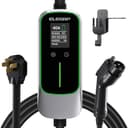
ELEGRP 40A Portable Level 2 Charger (ECP24-40A0-01)

ELEGRP 40A Portable Level 2 Charger (ECP24-40A0-01)

The cheapest charger in this registry that still publishes everything you would want to check: 9.6 kW, five current levels from 16 to 40 amps, an IP67 body with a stated -21°F floor, ETL certification and a 2-year warranty. There is no Wi-Fi and no app — you get a 1-to-12-hour delay timer on the unit instead — and for a lot of households that is the correct amount of charger.

Best overall for a plug-in hybrid
$209.99 · View on Amazon

Price as of September 18, 2026. #ad How we’re funded

2
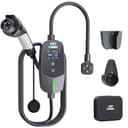
EVDANCE 24A NEMA 14-30 Portable Charger (EV-ACS2405U)

EVDANCE 24A NEMA 14-30 Portable Charger (EV-ACS2405U)

The charger a dryer outlet actually wants. The plug on the end is a NEMA 14-30, so it goes straight into a four-prong dryer receptacle with no adapter, and its maximum is 24 amps — exactly what a 30-amp circuit allows — so there is no setting that can ask that circuit for more. Its manual carries an Intertek ETL mark to UL 2594, and it steps down to 10 amps for a circuit you are unsure of. What the low price costs you is a one-year warranty and documentation that disagrees with itself in places worth reading carefully.

Best on a dryer outlet
$269.99 · View on Amazon

Price as of September 18, 2026. #ad How we’re funded

3
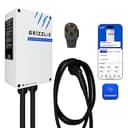
Grizzl-E Classic Connect

Grizzl-E Classic Connect

Grizzl-E retired the old no-app Classic and replaced it with this, and it kept the part that mattered: a metal case rated UL Type 4 for a spot with no shelter, published to keep operating down to -22F. What changed is that the electronics caught up — Wi-Fi, an app, and current you can dial from 40A down to 16A to fit a circuit you already have. It's the rugged pick that no longer asks you to give up scheduling to get it.

Best for a charger that lives outside
$349.99 · View on Amazon

Price as of September 18, 2026. #ad How we’re funded

4
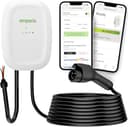
Emporia Level 2 EV Charger

Emporia Level 2 EV Charger

The value pick that never feels like one. You get the full 48 amps, an ENERGY STAR listing, real Wi-Fi energy tracking and a 25 ft cable for well under what the marquee brands charge. When someone asks us where to start, this is usually the first name out of our mouths.

Best if a full EV is next
$449.00 · View on Amazon

Price as of September 18, 2026. #ad How we’re funded

The picks in full

#1Best overall for a plug-in hybrid

ELEGRP 40A Portable Level 2 Charger (ECP24-40A0-01)

The cheapest charger in this registry that still publishes everything you would want to check: 9.6 kW, five current levels from 16 to 40 amps, an IP67 body with a stated -21°F floor, ETL certification and a 2-year warranty. There is no Wi-Fi and no app — you get a 1-to-12-hour delay timer on the unit instead — and for a lot of households that is the correct amount of charger.

Strengths

  • Five current levels (16/20/24/32/40A) — it fits whatever circuit you have
  • IP67 with a published -21°F to 121°F range, and a carrying case in the box
  • 2-year warranty and full ETL certification at the bottom of the price band

Trade-offs

  • No Wi-Fi, no app and no energy monitoring — just an on-unit delay timer
  • Not ENERGY STAR listed, so it may not qualify for some utility rebates
  • 40 amps is the plug-in ceiling; a 48-amp unit needs hardwiring
Max output40 A
Power9.6 kW
ConnectorJ1772
InstallNEMA 14-50 plug
Cable length25 ft
Warranty2 years
WiFi + appNo
CertificationsETL certified

Our charging-speed math. Forty amps at 240V is 9.6 kW, and at 3.5 miles per kWh that is roughly 34 miles of range an hour. ELEGRP's own figure is 37 miles an hour, which assumes a slightly more efficient car than our reference.

Build note. ELEGRP publishes 240V, up to 9.6 kW, five selectable current levels of 16, 20, 24, 32 and 40 amps, a NEMA 14-50 plug, a 25 ft cable measured plug-end to connector, a J1772 connector, ETL certification with its PBE overheat protection, an IP67 rating with a -21°F to 121°F range, a 1-12 hour delayed start, a carrying case and a 2-year warranty.

Specs read from the manufacturer spec sheet, on August 19, 2026. “Not published” means the brand does not state that figure.

#2Best on a dryer outlet

EVDANCE 24A NEMA 14-30 Portable Charger (EV-ACS2405U)

The charger a dryer outlet actually wants. The plug on the end is a NEMA 14-30, so it goes straight into a four-prong dryer receptacle with no adapter, and its maximum is 24 amps — exactly what a 30-amp circuit allows — so there is no setting that can ask that circuit for more. Its manual carries an Intertek ETL mark to UL 2594, and it steps down to 10 amps for a circuit you are unsure of. What the low price costs you is a one-year warranty and documentation that disagrees with itself in places worth reading carefully.

Strengths

  • Native NEMA 14-30 plug with a 24-amp maximum — it cannot be set above what the circuit allows
  • ETL listed (Intertek control number 5034626) to UL 2594 and UL 2231-2, per its user manual
  • Five current steps (10/12/16/20/24A) for an older or unverified dryer circuit
  • On-unit display of current, voltage, kWh and session time, plus a 1-12 hour delay timer

Trade-offs

  • One-year warranty, the shortest of the picks on our dryer-outlet page
  • EVDANCE's own pages disagree on the circuit it needs (a "20A circuit" on the store page, a "32A breaker" in the manual) — a 14-30 is a 30-amp receptacle
  • The 25 ft is total length: about 21.9 ft from control box to car and 3.1 ft from box to outlet, per the Amazon listing
  • EVDANCE says the plug-and-socket joint is not waterproof, and the connector needs its cap when stored
Max output24 A
Power5.76 kW
ConnectorJ1772
InstallNEMA 14-30 plug (four-prong dryer outlet)
Cable length25 ft
Warranty1 year
WiFi + appNot published
CertificationsETL listed (Intertek 5034626) to UL 2594, UL 2231-2 and CSA C22.2

Our charging-speed math. At its 24-amp maximum and 240V it delivers 5.76 kW, roughly 20 miles of range an hour at our 3.5 miles-per-kWh reference, or about 200 miles across a ten-hour overnight window. Dropped to 16 amps for an older circuit, it is about 13 miles an hour.

Build note. From EVDANCE's user manual for model EV-ACS2405U: 24A maximum at 240V (5.76 kW); current chosen before plugging into the car by holding the A button and stepping through 10, 12, 16, 20 or 24A; a 1.77-inch display showing real-time current, voltage, power, kWh, session time and temperature; a 1-12 hour delayed start; a Type 4 enclosure; a -22°F to 122°F operating range; 25 ft total length; an SAE J1772 connector; certification to UL 2231-2, UL 2594 and CSA C22.2 under an Intertek ETL mark (control number 5034626); and a 12-month warranty. The documentation is inconsistent, and we record the manual over the store page: the evdances.com spec table for this same product lists a "6-32A" adjustable range, a "Dedicated 20A Circuit" and a "J1772/CCS" connector, and the site banner advertises a 3-year warranty that the product page, the manual and the Amazon listing all put at one year. The manual pictures Wi-Fi and Bluetooth icons and EVDANCE sells a Wi-Fi version on its own store, but the Amazon listing we link does not state an app, so Wi-Fi is recorded as not published.

Specs read from the manufacturer spec sheet, on September 15, 2026. “Not published” means the brand does not state that figure.

#3Best for a charger that lives outside

Grizzl-E Classic Connect

Grizzl-E retired the old no-app Classic and replaced it with this, and it kept the part that mattered: a metal case rated UL Type 4 for a spot with no shelter, published to keep operating down to -22F. What changed is that the electronics caught up — Wi-Fi, an app, and current you can dial from 40A down to 16A to fit a circuit you already have. It's the rugged pick that no longer asks you to give up scheduling to get it.

Strengths

  • Metal case rated UL Type 4 indoor/outdoor, published from -22F to 122F
  • Current adjusts from 40A down to 16A, so it fits the circuit you already have
  • 25 ft cable — among the longest here — on a simple plug-in NEMA 14-50 install

Trade-offs

  • 40A caps its charging speed below the 48A units
  • Scheduling now runs through Wi-Fi and an account — the old Classic's nothing-to-update simplicity is gone
  • Grizzl-E publishes UL/cUL only for this model, not the ENERGY STAR listing the discontinued Classic carried
Max output40 A
Power9.6 kW
ConnectorJ1772
InstallNEMA 14-50 plug
Cable length25 ft
Warranty3 years
WiFi + appYes
CertificationsUL/cUL listed (file E510712)

Our charging-speed math. At 40A (9.6 kW) and 3.5 mi/kWh it adds roughly 34 miles of range an hour — more than enough to refill a daily commute overnight. Dial it down to 16A and you're at about 13.

Build note. A metal case rated UL Type 4 indoor/outdoor and published for -30C to +50C (-22F to 122F), with 2.4 GHz Wi-Fi and current adjustable from 40A down to 16A.

Specs read from the manufacturer spec sheet, on August 11, 2026. “Not published” means the brand does not state that figure.

#4Best if a full EV is next

Emporia Level 2 EV Charger

The value pick that never feels like one. You get the full 48 amps, an ENERGY STAR listing, real Wi-Fi energy tracking and a 25 ft cable for well under what the marquee brands charge. When someone asks us where to start, this is usually the first name out of our mouths.

Strengths

  • 48A and ENERGY STAR at a genuinely value price
  • The app tracks energy use, not just an on/off toggle
  • Long 25 ft cable and a remote holster in the box

Trade-offs

  • 48A hardwired needs a 60A circuit; on a NEMA 14-50 plug it's capped at 40A
  • The app is less polished than ChargePoint's, and support is a smaller operation
Max output48 A
Power11.5 kW
ConnectorJ1772
InstallHardwired or NEMA 14-50 plug
Cable length25 ft
Warranty3 years
WiFi + appYes
CertificationsUL listed, ENERGY STAR

Our charging-speed math. Hardwired at 48A (11.5 kW), figure about 40 miles of range an hour at 3.5 mi/kWh. Drop to a 40A plug-in circuit and it's closer to 34.

Build note. Runs 48A hardwired, or 40A on a NEMA 14-50 outlet, with a 25 ft cable and a wall holster included.

Specs read from the manufacturer spec sheet, on July 19, 2026. “Not published” means the brand does not state that figure.

Size the charger to the car, not the car to the charger

Find your car’s maximum AC charging rate in the owner’s manual or on the manufacturer’s spec sheet. It is quoted in kilowatts, and dividing by 240 volts converts it to amps. The arithmetic makes the point quickly:

  • If a car accepts 3.3 kW, it can use about 14 amps at 240 volts. Any charger above that simply waits for the car.
  • If a car accepts 7.2 kW, it can use 30 amps. A 32-amp setting covers it, and a 48-amp charger adds nothing.

Those two figures are examples to show the method, not a claim about any model — read your own number. Our onboard charger limits guide shows where to find it. Whatever it turns out to be, the charger only has to meet it, and the circuit only has to carry the charger: under the National Electrical Code a charger may use 80% of its circuit, so a 16-amp setting needs a 20-amp circuit, 24 amps needs 30, and 32 amps needs 40.

That is the real saving. A smaller circuit is cheaper to run, more likely to fit a panel with little spare capacity, and sometimes already exists — a four-prong dryer outlet is a 30-amp circuit good for 24 amps, and a NEMA 14-50 range or RV outlet is good for 40.

Why these four

The ELEGRP 40Ais the best fit for most plug-in hybrids because it publishes five current levels — 16, 20, 24, 32 and 40 amps — so it can be set to match both the car and the circuit, and it plugs into a NEMA 14-50 outlet with no electrician on the day if the outlet already exists. It is ETL certified, IP67 rated with a published -21°F to 121°F range, and carries a 2-year warranty. It has no app, just a 1-to-12-hour delay timer on the unit, which is all a hybrid on an off-peak rate needs.

The EVDANCE 24Ais for the house whose only 240-volt receptacle is the dryer’s. It has a native NEMA 14-30 plug and a 24-amp maximum, which is exactly what a 30-amp dryer circuit allows, and its manual carries an Intertek ETL mark to UL 2594. Twenty-four amps is more than many plug-in hybrids can use, which makes it a good match rather than a compromise. The warranty is one year, and our dryer outlet roundupcovers the conflicts in EVDANCE’s own documentation that you should read first.

The Grizzl-E Classic Connectis the pick when the charger has to live outside: a metal case rated UL Type 4 and published down to -22°F, on a NEMA 14-50 plug, with current that turns down from 40 to 16 amps. It costs more than the ELEGRP for the enclosure and the app.

The Emporiais here for one household: the one that drives a plug-in hybrid now and expects a full EV within a few years. It runs 48 amps hardwired or 40 on a plug, is ENERGY STAR certified and tracks energy in its app. Emporia does not publish an adjustable range below 40 amps, so it needs a circuit sized for a full EV from day one — which is exactly why it only makes sense if that EV is coming.

When Level 1 is still the right answer

A small battery refills slowly on Level 1 but it refills. If the car sits at home overnight and you do not need more than one full charge a day, a 120-volt charger on an ordinary outlet costs a fraction of any Level 2 install and needs no electrician. Our Level 1 charger roundup covers the chargers that make that work, and our Level 1 versus Level 2 comparison has the mileage test for your own driving.

Where Level 2 earns its place on a hybrid is the midday top-up: charging after the morning run and again before the evening one can double the electric miles in a day. If that is how you drive, even a 16-amp setting refills a small pack more than twice as fast as a wall socket, provided the car can accept it.
Frequently asked questions

Do plug-in hybrids need a Level 2 charger?

Often not. Plug-in hybrids have small batteries and small onboard chargers, so an ordinary 120-volt outlet can frequently refill the battery overnight. Level 2 becomes worth it if you want to charge more than once a day, have a larger-battery hybrid that Level 1 cannot keep up with, or want a quick top-up between trips.

What size Level 2 charger does a plug-in hybrid need?

One that matches your car's maximum AC charging rate, which you divide by 240 volts to get amps. A car that accepts 3.3 kW can use about 14 amps; one that accepts 7.2 kW can use 30. Anything above that is wasted, so an adjustable charger set to 16, 24 or 32 amps on a correspondingly smaller circuit is usually the best value.

Will a 48-amp charger charge my plug-in hybrid faster?

Not beyond the car's own limit. The onboard charger decides how much AC power the car accepts, and plug-in hybrids typically have the smallest onboard chargers of any plug-in vehicle. Once the charger offers more than that, the extra amps sit unused — and you have paid for a 60-amp circuit you did not need.

Can I charge a plug-in hybrid from a dryer outlet?

Yes, if it is a four-prong NEMA 14-30 on a dedicated 30-amp circuit and the charger is limited to 24 amps. A charger with a native 14-30 plug, like the EVDANCE 24A here, cannot draw more than that circuit allows. Twenty-four amps is more than many plug-in hybrids can use.

Do plug-in hybrids use the same charger plug as EVs?

For AC charging, yes: plug-in hybrids sold in North America use the J1772 connector, the same one on every non-Tesla EV, so every charger on this page fits. Most plug-in hybrids cannot use DC fast charging at all.

Sources

Keep reading