Route one: a native NACS portable charger
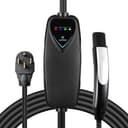
The NACS connector — Tesla’s plug, now published by SAE as the J3400 standard — goes straight into the car with nothing in between. The Lectron Level 2 Tesla is that plug on the end of an ordinary 40-amp portable charger: a NEMA 14-50 on the wall end, 9.6 kW into the car, and a 16 ft cable, with no adapter anywhere in the chain.
Read the current setting carefully before you buy, though, because it is the difference between a charger that adapts to a strange outlet and one that does not. Lectron publishes no adjustable range on this unit: it draws its full 40 amps or it does not charge. When you are plugging into an outlet whose circuit you did not install and cannot inspect, that leaves you with no conservative 24-amp option to fall back on. An unknown 14-50 in an old garage may be on wiring that was fine for an occasional welder and is not fine for 40 amps continuous for eight hours — and on this charger the honest answer there is to find another outlet.
One thing this route used to offer and no longer does: a single box that also covered Level 1. The dual-level NACS portable we recommended here until August 2026 is no longer carried on Amazon, and nothing has replaced it at 40 amps. If you want household-socket charging on a NACS car as well, that is now a second, cheaper unit — the Lectron Level 1 Tesla at 12 amps.
What you give up: there is no Wi-Fi or app, and Lectron does not publish a warranty term for this unit (it does publish an IP65 control box, an IP55 handle and the UL 2594 / UL 2231 listings). The missing app matters less on a Tesla than it would elsewhere, since the car schedules charging natively and does it well — the same argument we make in our Lectron Nexus review for the hardwired version.
Route two: a J1772 portable charger plus an adapter
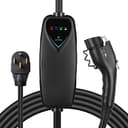
The J1772 charger market is much larger and much more competitive than the NACS one, so a J1772 portable unit plus a certified adapter is usually the cheaper path to the same charge. The Lectron 40A is the value anchor: a true 40-amp, 9.6 kW Level 2 charger, ETL listed to UL 2594 and UL 2231, that plugs into a NEMA 14-50 outlet. Add a J1772-to-Tesla adapter and it plugs into a Tesla.
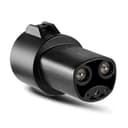
The adapter is not a compromise on speed. Lectron rates it to 80 amps at 240V, roughly double anything a home circuit will ever deliver, and it carries UL 2252 certification and an IP67 rating. It passes through whatever the charger provides; it never becomes the limit. Our adapter roundup covers both directions of this problem.
Route two has a second advantage that decides it for a lot of households: a J1772 charger with an adapter charges botha Tesla and a non-Tesla EV. Take the adapter off and it serves the Ford, the Hyundai, the friend who visits. A native-NACS charger can only do that in reverse, with a NACS-to-J1772 adapter — and now you own two adapters instead of one.
What you give up: one more object to seat, and one more object to lose. A partially seated adapter is a common cause of a charge that silently never starts, which our troubleshooting guide covers.
The amperage math, and why portable does not mean slow
Forty amps at 240 volts is about 9.6 kW. At our standard reference of roughly 3.5 miles of range per kWh, that is about 34 miles of range per hour— roughly 340 miles across a ten-hour overnight window. A portable charger is not a slower class of equipment; it is the same Level 2 charging as a wall box, just plugged in rather than wired in.
The reason portable units stop at 40 amps is code, not capability. Under NEC Article 625, EV charging is a continuous load, so the circuit is sized to 125% of the draw: 40 × 1.25 = 50, and the NEMA 14-50 receptacle is a 50-amp device. To go to 48 amps you need a 60-amp circuit, and there is no common household receptacle for that — which is why every 48A charger is hardwired. Our hardwired vs plug-in comparison covers this properly, and the gap you are accepting is about six miles of range per hour.
On a 120V household socket — which is what a Level 1 unit like the Lectron Level 1 Teslaruns on — you are down to roughly 5 to 6 miles of range an hour. That is not a flaw; it is what a household outlet can provide. Our Level 1 roundup covers when that is enough on its own.
Travel safety: the rules that matter away from home
Charging at your own house means charging on a circuit you had installed. Charging somewhere else means charging on a circuit nobody has vouched for, and that is where a short list of habits earns its keep.
Dial the current down on an unknown outlet. Selectable amperage exists for this. Starting at 16 or 24 amps on an unfamiliar 14-50 costs you a few hours and removes almost all of the risk.
Never use an extension cord or a plug adapter you improvised. The charger pulls its rated current continuously for hours. Generic cords are not built for that duty and every extra joint is a place to heat up.
Check the plug by hand after the first hour. A plug that is warm is a warning about the receptacle, not usually about the charger. Unplug and reduce the current, or stop.
Ask before you plug in.Eight hours at 9.6 kW is a real amount of electricity on someone else’s bill. Our cost-to-charge guide will tell you roughly what to offer.
How to choose in one paragraph
If every car in your household is a Tesla or NACS vehicle and you want the simplest possible object in the trunk, take the native NACS charger — one box, the right plug already on it, nothing to seat. If your household has a non-Tesla EV too, or you want the lowest total cost, take the J1772 charger plus the certified adapter: it does everything the NACS unit does, charges the other car as well, and usually costs less. If the charger is going to live on a wall at home rather than in the trunk, you are on the wrong page — our home chargers for Tesla guide covers the permanent install, and the ChargePoint Home Flex NACS is the pick there if you want a native NACS plug with a real app.