The honest catch: a NACS charger picks a side
Every roundup of these units sells you the adapter you get to throw away. Almost none mention the one you have to buy.
A J1772 charger is the universal option. It fits every non-Tesla EV directly, and it fits a Tesla using the adapter Tesla ships with the car. A native NACS charger inverts that: it fits Teslas and other NACS cars directly, and it fits a J1772 car only with a NACS-to-J1772 adapter that you have to source yourself. You have not eliminated the adapter problem; you have moved it onto whichever car in the household is not a Tesla.
So the first question is not which NACS charger to buy. It is whether the wall should be NACS at all:
Buy NACS ifevery EV in the household uses the NACS plug today and you expect that to stay true through the life of the charger — realistically eight to ten years. A one-car Tesla household is the clean case.
Buy J1772 if there is any chance of a second, non-Tesla car, or you want a charger a visitor can use, or you are installing on a property you might sell or rent. J1772 plus the Tesla-supplied adapter covers literally every EV on sale. Our J1772 versus NACS explainer works through the connector question properly, and our main home charger roundup is the J1772-first version of this page.
The industry is moving toward NACS, which makes it tempting to treat this as a future-proofing decision. Be careful with that logic: what is converging is the plug on cars, and adapters in both directions are cheap and widely available. Neither choice strands you. Pick for the cars in your driveway, not the ones in the press releases.
What actually separates these five
Once you have decided the wall should be NACS, the field is small and the differences are concrete.
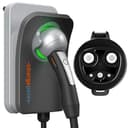
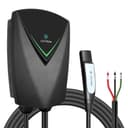
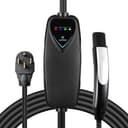
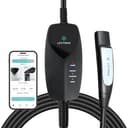
How it attaches to the house. This is the biggest fork on the page. The top three picks are hardwired— a licensed electrician wires them into a dedicated circuit, and there is no plug in the middle. That is the only way to run 48 amps or more, because NEC Article 625 treats EV charging as a continuous load and caps a plug-in unit at 80% of its receptacle’s circuit. The bottom two plug into an outlet you may already have, need no electrician at all, and come off the wall when you move. Our hardwired versus plug-in comparison covers that trade in full.
Whether the current can be turned down.A 48-amp charger needs a 60-amp circuit, and that is the requirement that stops most 48-amp installs — not the price of the charger. Of the three hardwired picks, the EVIQO publishes an adjustable 6–48A range and ChargePointpublishes 16–50A, so both can be commissioned on a smaller circuit and turned up later if the panel is ever upgraded. That flexibility is worth more than the top-end number to anyone whose service is tight. Our panel capacity guide shows how to work out what yours can carry, and our load management guide covers the alternatives to a service upgrade.
Whether there is an app — and whether you need one. This is the spec that looks decisive and mostly is not, specifically because these are NACS cars. A Tesla schedules its own charging in the car, by location, and does it well. A charger app duplicates that. What an app adds that the car cannot is wall-side measurement: kWh as billed at the meter rather than as received at the battery, which is the number that matches your utility statement. If you want that, ChargePoint and EVIQO have it and the Lectron Nexus does not. If you do not, the Nexus is not missing anything you will use. Our smart versus basic comparison makes that case at length, and our energy monitoring guide explains the battery-side versus wall-side gap.
Cable reach.Twenty-five feet on the EVIQO, twenty-three on the Lectron Nexus and the ChargePoint, sixteen on both portables. Reach is the spec buyers regret most often, and the usual fix — an extension cord— is the one thing you must not do with an EV charger. Measure the real route from the proposed charger position to the car’s charge port, around obstacles, before you choose. Our long-cable roundup covers what each length actually reaches.
ENERGY STAR.Four of the five carry it; Lectron does not publish it for the Level 1 unit. The direct energy saving is small, but some utility rebate programs name the certification as an eligibility condition, which can be worth considerably more than the difference in sticker price. Check your own utility before deciding the premium is not worth it — our rebates guide covers what to look for.
How fast a NACS charger actually fills a Tesla
The arithmetic is the same as for any Level 2 charger, and it is worth doing before you pay for amps you cannot use.
Forty-eight amps at 240 volts is about 11.5 kW. At our standing reference of roughly 3.5 miles per kWh, that is about 40 miles of range per hour — around 400 miles across a ten-hour overnight window. Forty amps is 9.6 kW, or about 34 miles per hour. Fifteen amps at 120 volts is 1.8 kW, or roughly 6 miles per hour, which sounds hopeless until you notice it is still around 70 miles across a long overnight.
Two caveats we would rather state than let you discover. First, the ceiling is set by the car, not the wall: the onboard charger inside the vehicle decides how much of that 11.5 kW it will accept, and above that limit extra amps on the wall do nothing at all. Our onboard charger limits guideshows how to find your own figure and it is the first thing to check. Second, a charger only has to replace the miles you actually drove — our how many amps guide works that back from your own mileage, and for a great many households the answer is less than they expected.
The matchup at the top of this list
Two of the picks above are closer than anything else here — both 48 amps, both native NACS, both ENERGY STAR, both IP66, about fifty dollars apart — and they separate on a single published spec. The EVIQO publishes internal DIP switches at 16, 32, 40 and 48 amps plus an app slider in 1-amp steps; Lectron publishes no adjustable range for the NEXUS NACS at all, which makes it a fixed 48-amp unit needing a 60-amp circuit. Our EVIQO NACS vs Lectron NEXUS NACS comparison settles it on exactly that, and our full EVIQO NACS 48A reviewgoes through the rest of that charger — including the cable reach and the published cold-weather floor that Lectron does not state.
One non-Tesla car now ships with this connector and gets its own page. Hyundai publishes a native NACS port on the current IONIQ 5 along with a 10.9-kW onboard charger, and our best home chargers for the IONIQ 5 works from both figures — which is why its picks stop at 48 amps rather than reaching for the 50-amp units on this page.
What we left out, and why
The Grizzl-E Ultimate is a 48-amp hardwired unit that Grizzl-E now supplies with a NACS output cable, and on specs it belongs on this page. It is not a pick because when we checked on 25 August 2026 Amazon returned no buyable offer for it — the listing was live but marked currently unavailable, so there was no live price and nothing to link you to. We do not feature a product we cannot send you to buy. The review stays up, and if Amazon restocks it the unit is a legitimate alternative to the three hardwired picks here.
The Tesla Wall Connector is the obvious absence. Tesla sells it directly and does not list it on Amazon, and every buy link on this site resolves to Amazon — so we have nothing honest to say about a price or availability, and we would rather leave it off than write a page around a product we cannot check. If you are cross-shopping it, our Lectron Nexus versus ChargePoint Home Flex NACS comparison covers the two units most people end up choosing between instead.
We have also left out the adapter route deliberately, because it is not a charger. If your conclusion after reading this is that a J1772 charger plus an adapter is the smarter buy — which for a mixed-car household it usually is — our Tesla accessories picks cover the adapters worth owning, and our portable Tesla charger roundup covers the travel case.