Plug & Range

Best EV Chargers for Road Trips

The spec that matters in a driveway you have never seen before is not amperage. It is whether you can turn the amperage down.

By Stephen V.Last updated How we pick

A home charger has one job at one outlet on one circuit that somebody sized for it. A travel charger has to work at a friend’s garage, a holiday rental, a campground pedestal and a relative’s kitchen socket — none of which you installed and none of which you can inspect. That changes which specs matter, and it changes them in a direction most roundups miss.

The three that count are adjustable current, so you can draw conservatively when you cannot verify the wiring; a published enclosure rating, because the charger will spend time on wet ground and in a boot; and which plugs it accepts, because the outlet you find is often not the one you wanted. Everything else — apps, kW, brand — is secondary on the road.

How this is funded:we earn a commission if you buy through our links, at no extra cost to you. It never changes which product we recommend, and we’ll tell you when we’d skip one. Full disclosure.

Quick picks

Ranked on published specs, charging speed, electrical fit and value. Select a row to jump to the full write-up. We have not bench-tested these chargers — here is exactly what we do instead.

#ProductBest forPrice
1
ELEGRP 40A Portable Level 2 Charger (ECP24-40A0-01)

ELEGRP 40A Portable Level 2 Charger (ECP24-40A0-01)

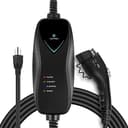
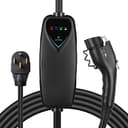
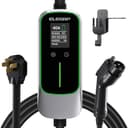
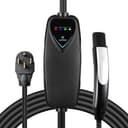
The cheapest charger in this registry that still publishes everything you would want to check: 9.6 kW, five current levels from 16 to 40 amps, an IP67 body with a stated -21°F floor, ETL certification and a 2-year warranty. There is no Wi-Fi and no app — you get a 1-to-12-hour delay timer on the unit instead — and for a lot of households that is the correct amount of charger.

Best overall for travel
$209.99 · View on Amazon

Price as of September 2, 2026. #ad How we’re funded

2
Lectron Level 2 Tesla (NACS) Portable Charger, 40A

Lectron Level 2 Tesla (NACS) Portable Charger, 40A

The straightforward native-NACS answer for a Tesla owner who wants real Level 2 speed without hardwiring anything. Plug it into a NEMA 14-50, pull a full 40 amps, and unplug it when you move or travel. There is no app and no adjustable current — what you are buying is the Tesla plug on the end of a proper 40-amp portable charger, at a price well under a wall-mounted NACS station.

Best for a Tesla or NACS car
$279.89 · View on Amazon

Price as of September 2, 2026. #ad How we’re funded

3
Lectron Level 1 Charger, 15A

Lectron Level 1 Charger, 15A

The charger you buy when you can't install anything. It plugs into an ordinary 120V household outlet and pulls 15 amps — the top of what a standard circuit will give you — which makes it the fastest thing you can do with zero electrical work. It is genuinely slow next to a 240V unit, and we won't pretend otherwise. But for a plug-in hybrid, a short commute or a rented parking spot, slow-and-installed beats fast-and-impossible.

Best always-in-the-boot backup
$159.99 · View on Amazon

Price as of September 2, 2026. #ad How we’re funded

4
Lectron 40A Portable Level 2 Charger

Lectron 40A Portable Level 2 Charger

The least-expensive honest route into real Level 2 charging. Plug it into a NEMA 14-50 outlet, pull a true 40A / 9.6 kW, and unplug it to throw in the trunk for a trip. The trade-offs for the price are no app and a shorter warranty — both fair at this cost.

Best cheap 14-50 spare
$269.99 · View on Amazon

Price as of September 2, 2026. #ad How we’re funded

The picks in full

#1Best overall for travel

ELEGRP 40A Portable Level 2 Charger (ECP24-40A0-01)

The cheapest charger in this registry that still publishes everything you would want to check: 9.6 kW, five current levels from 16 to 40 amps, an IP67 body with a stated -21°F floor, ETL certification and a 2-year warranty. There is no Wi-Fi and no app — you get a 1-to-12-hour delay timer on the unit instead — and for a lot of households that is the correct amount of charger.

Strengths

  • Five current levels (16/20/24/32/40A) — it fits whatever circuit you have
  • IP67 with a published -21°F to 121°F range, and a carrying case in the box
  • 2-year warranty and full ETL certification at the bottom of the price band

Trade-offs

  • No Wi-Fi, no app and no energy monitoring — just an on-unit delay timer
  • Not ENERGY STAR listed, so it may not qualify for some utility rebates
  • 40 amps is the plug-in ceiling; a 48-amp unit needs hardwiring
Max output40 A
Power9.6 kW
ConnectorJ1772
InstallNEMA 14-50 plug
Cable length25 ft
Warranty2 years
WiFi + appNo
CertificationsETL certified

Our charging-speed math. Forty amps at 240V is 9.6 kW, and at 3.5 miles per kWh that is roughly 34 miles of range an hour. ELEGRP's own figure is 37 miles an hour, which assumes a slightly more efficient car than our reference.

Build note. ELEGRP publishes 240V, up to 9.6 kW, five selectable current levels of 16, 20, 24, 32 and 40 amps, a NEMA 14-50 plug, a 25 ft cable measured plug-end to connector, a J1772 connector, ETL certification with its PBE overheat protection, an IP67 rating with a -21°F to 121°F range, a 1-12 hour delayed start, a carrying case and a 2-year warranty.

Specs read from the manufacturer spec sheet, on August 19, 2026. “Not published” means the brand does not state that figure.

#2Best for a Tesla or NACS car

Lectron Level 2 Tesla (NACS) Portable Charger, 40A

The straightforward native-NACS answer for a Tesla owner who wants real Level 2 speed without hardwiring anything. Plug it into a NEMA 14-50, pull a full 40 amps, and unplug it when you move or travel. There is no app and no adjustable current — what you are buying is the Tesla plug on the end of a proper 40-amp portable charger, at a price well under a wall-mounted NACS station.

Strengths

  • Native NACS connector — nothing to seat, nothing to lose, no adapter
  • A real 40A / 9.6 kW from an ordinary NEMA 14-50 outlet
  • IP65 control box and IP55 handle, rated by Lectron for outdoor use
  • Plug-in and portable, so it moves with you and travels

Trade-offs

  • No Wi-Fi or app on this SKU — the smart version is a separate, dearer listing
  • No adjustable current, so it cannot be trimmed down for an unverified outlet
  • A J1772 car needs a NACS-to-J1772 adapter — buy a J1772 charger instead
  • Lectron does not publish a warranty term for this model
Max output40 A
Power9.6 kW
ConnectorNACS
InstallNEMA 14-50 plug
Cable length16 ft
WarrantyNot published
WiFi + appNo
CertificationsETL listed (UL 2594 / UL 2231), UL 2251 handle, FCC

Our charging-speed math. At 40A on 240V (9.6 kW) and our 3.5 mi/kWh reference, roughly 34 miles of range an hour. Lectron's own figure is up to 36 miles an hour, which assumes a slightly more efficient car than our reference.

Build note. Lectron publishes 240V, 40 A and 9.6 kW through a NEMA 14-50 plug on a 16 ft cable, a native Tesla (NACS) connector, an IP65-rated control box with an IP55-rated handle tested to 10,000-plus insertions, protection against overvoltage, overcurrent and short circuits, and ETL/FCC certification against UL 2594 and UL 2231 with a UL 2251 handle. This SKU has no Wi-Fi or app.

Specs read from the manufacturer spec sheet, on August 21, 2026. “Not published” means the brand does not state that figure.

#3Best always-in-the-boot backup

Lectron Level 1 Charger, 15A

The charger you buy when you can't install anything. It plugs into an ordinary 120V household outlet and pulls 15 amps — the top of what a standard circuit will give you — which makes it the fastest thing you can do with zero electrical work. It is genuinely slow next to a 240V unit, and we won't pretend otherwise. But for a plug-in hybrid, a short commute or a rented parking spot, slow-and-installed beats fast-and-impossible.

Strengths

  • Works from any standard 120V outlet — no electrician, no install
  • 15A is the practical ceiling for Level 1, so it's the fastest version of the slow option
  • IP65 weather resistance and a 16 ft cable at a budget price

Trade-offs

  • Level 1 is genuinely slow — plan in overnights, not hours
  • No app or scheduling on this version
  • Lectron doesn't publish a warranty term for it
Max output15 A
Power1.8 kW
ConnectorJ1772
InstallNEMA 5-15 plug (standard 120V outlet)
Cable length16 ft
WarrantyNot published
WiFi + appNo
CertificationsETL listed (UL 2594 / UL 2231)

Our charging-speed math. 15A at 120V is about 1.8 kW, so at 3.5 mi/kWh it adds roughly 6 miles of range an hour — call it 60-plus miles across a 10-hour overnight, before charging losses.

Build note. Lectron publishes 120V / 15A / 1.8 kW through a NEMA 5-15 plug, a 16 ft cable and an IP65-rated body with over-voltage, over-current and short-circuit protection.

Specs read from the manufacturer spec sheet, on August 11, 2026. “Not published” means the brand does not state that figure.

#4Best cheap 14-50 spare

Lectron 40A Portable Level 2 Charger

The least-expensive honest route into real Level 2 charging. Plug it into a NEMA 14-50 outlet, pull a true 40A / 9.6 kW, and unplug it to throw in the trunk for a trip. The trade-offs for the price are no app and a shorter warranty — both fair at this cost.

Strengths

  • A real 40A / 9.6 kW at a budget price
  • Plug-in and portable — no hardwiring, and it travels
  • ETL listed to the UL 2594 / UL 2231 safety standards

Trade-offs

  • No Wi-Fi or app on the base model — the smart version is a separate SKU
  • Shorter 16 ft cable and a 2-year warranty
  • The brand doesn't publish an outdoor/IP enclosure rating
Max output40 A
Power9.6 kW
ConnectorJ1772
InstallNEMA 14-50 plug
Cable length16 ft
Warranty2 years
WiFi + appNo
CertificationsETL listed (UL 2594 / UL 2231)

Our charging-speed math. At 40A (9.6 kW) and 3.5 mi/kWh it adds roughly 34 miles of range an hour.

Build note. A portable plug-in unit — no hardwiring — and the base model carries no Wi-Fi or app.

Specs read from the manufacturer spec sheet, on July 19, 2026. “Not published” means the brand does not state that figure.

Why adjustable current is the whole argument

A plug tells you the shape of a receptacle. It tells you nothing about the circuit behind it, the age of the wiring, or whether anything has ever asked it for sustained current before.

NEC Article 625 treats EV charging as a continuous load and sizes circuits to 125% of the draw — but that governs how a circuit should have been installed, not what is behind the wall of a twenty-year-old holiday cottage. Plenty of NEMA 14-50 outlets were put in for an occasional welder or dryer cycle and have never carried 40 amps for six hours straight. That is a different duty entirely, and it is the duty EV charging imposes.

A charger you can set to 16 or 24 amps lets you charge conservatively when you cannot confirm the breaker size, or when the receptacle looks old, loose or discolored. You lose some speed on a stay that is going to last all night anyway, and you do not stress wiring you cannot see. That is why the ELEGRP 40Aheads this list: five published levels — 16, 20, 24, 32, 40 — plus IP67 and a carrying case in the box.

It is also why we are explicit about the limits of the Lectron Level 2 Tesla: the native NACS plug is genuinely convenient, but Lectron publishes no adjustable current range for it, so it draws its full 40 amps or nothing. At an outlet you cannot verify, that means finding a different outlet rather than dialing down to 24. Read our outlet types guide before you travel; it is the page that turns a strange receptacle into a decision.

Coverage: the two-plug question

The second thing a travel charger has to solve is that the outlet you find is often not the outlet you wanted.

A 14-50-only charger is excellent when there is a 14-50 and useless when there is not. A Level 1 charger works at literally any household socket and adds about five to six miles of range an hour — roughly fifty to seventy miles overnight, which is more useful than it sounds when the alternative is nothing.

There used to be a tidier answer than owning both: a dual-level charger with interchangeable plug heads that covered 120V and 240V from one box. As of August 2026 we no longer have one to recommend — the Lectron dual-level NACS we used to pick here is no longer carried on Amazon, and nothing has replaced it at the same amperage. So the practical answer for every car, J1772 or NACS, is now two chargers: a 40-amp plug-in for real Level 2 when a 14-50 exists, and a Level 1 unit that lives permanently in the boot for everywhere else. For a J1772 car that is the Lectron 40A plus the Lectron Level 1; for a Tesla or NACS car it is the Lectron Level 2 Tesla plus the Lectron Level 1 Tesla. Between them they cost less than most single premium chargers, and they cover every socket in the country. Our Level 1 roundup covers that half of the pair.

On adapters: a plug adapter that lets a 14-50 charger use a 14-30 or 10-30 outlet is legitimate hardware, but only if you also turn the charger downto what the smaller circuit supports — a 30-amp circuit carries 24 amps continuous, not 40. Which brings you back to adjustable current. A fixed-current charger plus an adapter is not a safe combination, and no amount of adapter quality changes that.

Sealing, and where the charger actually lives

A wall charger is mounted once, under an eave, and stays there. A travel charger gets put on wet gravel, coiled into a boot, taken out in the rain and plugged into a pedestal in a field.

That makes a published enclosure rating worth more here than at home. The ELEGRP publishes IP67 with a −21°F to 121°F range and ships a carrying case; the Lectron Level 2 Tesla publishes IP65 for its control box and IP55 for the handle; the Lectron Level 1 publishes IP65. The Lectron 40Apublishes no enclosure rating at all, which our spec table records as unpublished rather than guessing — it is a fine charger for a sheltered garage and the weakest of these four for a wet campsite.

The case matters more than people expect, too. A charging cable thrown loose into a boot gets crushed under luggage and dragged over the sill, and the failure that results is a damaged cable rather than a damaged box. If your charger does not come with one, coil it properly.

The specific places you will use it

Campgrounds and RV parks.The best travel charging in America, and the one with the most traps — TT-30 pedestals that will not take a 14-50 plug at all, and 30-amp circuits that need the charger set to 24. Our RV park guide covers reading a pedestal before you plug into it.

Holiday rentals and friends’ houses.Usually a 120V socket and nothing else, which is the Level 1 case. Ask before you assume there is a dryer outlet you can reach, and ask before you plug into anything — you are using someone else’s electricity for eight hours.

As a backup at home. Underrated. A portable charger in the boot is insurance against your wall unit failing, and it is what you reach for when the garage is unavailable. Our troubleshooting guide covers diagnosing a wall charger that has stopped, and having a second charger is how you rule out the car in five minutes.

What a travel charger is not for: long-distance fast charging. None of this replaces DC fast charging on a route; Level 2 is a destination technology. Our finding charging guide covers the public-network side, and our charging levels guide puts the speeds in context.
Frequently asked questions

What is the best EV charger to keep in the car?

One with adjustable current and a published enclosure rating. Adjustable current is what lets you use an outlet you cannot inspect safely, and sealing is what survives being kept in a boot and used on wet ground. Of our picks the ELEGRP 40A does both, with five current levels and an IP67 body — and it comes with a carrying case, which is not a trivial detail for something that lives in a car.

Can I use a Level 2 charger at a campground?

Often yes, if the pedestal has a NEMA 14-50 and you can confirm what it is rated for. The trap is the 30-amp pedestal: a TT-30 will not physically accept a 14-50 plug, and a 14-30 or 10-30 supports only 24 amps continuous — so a fixed-40-amp charger cannot be used on one safely even with an adapter. Ask the site office what the pedestal is rated for rather than assuming.

Should I take a Level 1 charger as well as a Level 2?

If you travel regularly, yes. A Level 1 unit works at any ordinary 120V socket and adds roughly five miles of range an hour — about fifty miles overnight. That is the difference between stranded and mobile at a house with no dryer outlet, and it costs a fraction of a Level 2 charger. Many people carry both and use the Level 1 more often.

Is it safe to plug an EV charger into an unfamiliar outlet?

It can be, with judgment. Confirm the breaker size if you can, look at the receptacle before you use it — scorching, cracks, looseness or heat are all reasons to stop — and set the charger below the circuit's continuous rating rather than at it. Check the plug by hand an hour in. And never bridge a reach problem with an extension cord; our guide explains exactly why that fails.

Do I need a different charger for a Tesla on a road trip?

Only in the sense of the connector. A Tesla or other NACS car can use any J1772 charger with a NACS adapter, or a native-NACS portable with no adapter at all. The Lectron Level 2 Tesla is the tidiest answer for a NACS car on a 14-50 — just note that Lectron publishes no adjustable current range for it, so it draws its full 40 amps or nothing. Pair it with the Lectron Level 1 Tesla if you also want to charge from household sockets.

Sources

Keep reading