How solar-following charging actually works
Your inverter feeds the house; the house feeds the charger. At any instant the home is either exporting power to the grid (the roof is making more than the house uses) or importing it. A solar-following charger watches that number through its companion meter and adjusts its own current to soak up the export, rather than charging at full speed and pulling the difference from the grid.
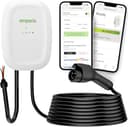
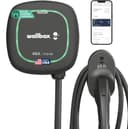
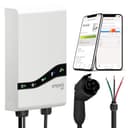
That is why the meter matters more than the charger. Emporia states that adding the Vue Home Energy Monitor lets its charger “automatically charge with your excess solar power”, and lists Solar Charging Integration on both its Classic and its Pro, each marked as requiring the Vue. Wallbox states that the Pulsar Plus can charge on 100% solar or a mix of solar and grid, and that its Power Meter is required to enable it. Without the meter, neither charger has a number to follow.
There is one limit worth knowing before you buy the Wallbox for this: Wallbox states that its solar charging is not compatible with installations of more than one charger, or with OCPP. If you plan a second charger for a second car, the Emporia route is the one that keeps both features.
The mismatch no charger fixes
Solar peaks around midday. Most cars are parked at home in the evening and overnight. A solar-following charger does nothing for a car that is at work when the sun is up, and our guide to charging from home solarworks through that timing problem in detail. The short version: solar-following charging pays off for households where a car is home during the day — a remote worker, a retiree, a second car that sits most weekdays. For a nine-to-five commuter, a schedule that runs overnight on a cheap time-of-use rate often saves more.
The other variable is how your utility credits exported solar. If exports are credited at close to the retail rate, using your own solar for the car and charging from the grid at night come out roughly the same on the bill. If exports earn much less than you pay for grid power, keeping that energy for the car is worth real money. That is a question for your utility statement, not for a charger spec sheet.
Why the fourth pick has no solar mode
The ChargePoint Home Flex publishes no solar-following feature. It is here for the households that will not install a second device: ChargePoint’s datasheet lists output settings from 16 up to 50 amps in the app, and a charger turned down to 16 amps draws about 3.8 kW, which is far more likely to sit under a midday surplus than the same charger running at 40 or 48 amps. Pair that with a daytime schedule and you get most of the benefit of solar charging with no meter, no extra app and no extra install. It is a blunter tool than true solar-following, and on a cloudy day it will pull from the grid, but it is honest about what it is.
What else to check before you buy
Panel space.A solar system and an EV charger both want room in the panel, and a meter adds another device beside it. If an electrician has already told you the panel is tight, the Emporia Pro’s PowerSmart load management — which also runs through the Vue — can keep the charger from tripping the main while the rest of the house is busy. Our panel capacity guide covers the load calculation.
Battery storage and bidirectional charging. Neither is the same thing as solar-following charging. A home battery stores daytime solar for the evening; a bidirectional setup lets the car power the house. Both are separate purchases with their own requirements, covered in our bidirectional charging guide.
Rebates. Some utilities that support solar also rebate EV chargers, and many require ENERGY STAR certification. All four picks here carry that listing; check your own utility before you buy.