Plug & Range

Best 40-Amp EV Chargers

The tier most people should actually buy — and the one where two chargers with identical charging speed can differ in price by a factor of two.

By Stephen V.Last updated How we pick

Forty amps is not a marketing tier, it is an electrical one. A NEMA 14-50 receptacle sits on a 50-amp circuit, and NEC Article 625 treats EV charging as a continuous load, so the usable continuous draw is 80% of that: 40 amps. Every plug-in charger in America therefore stops at 40, and everything faster has to be hardwired to a 60-amp circuit.

That makes 40 amps the default for most homes, and it makes this the tier with the widest price spread on the site — the five chargers below all deliver the same 9.6 kW and roughly 34 miles of range per hour, and the most expensive costs more than twice the cheapest. What separates them is the enclosure, the cable, whether the current can be turned down, and how much of that any of them will actually tell you.

How this is funded:we earn a commission if you buy through our links, at no extra cost to you. It never changes which product we recommend, and we’ll tell you when we’d skip one. Full disclosure.

Quick picks

Ranked on published specs, charging speed, electrical fit and value. Select a row to jump to the full write-up. We have not bench-tested these chargers — here is exactly what we do instead.

#ProductBest forPrice
1
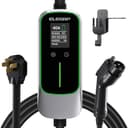
ELEGRP 40A Portable Level 2 Charger (ECP24-40A0-01)

ELEGRP 40A Portable Level 2 Charger (ECP24-40A0-01)

The cheapest charger in this registry that still publishes everything you would want to check: 9.6 kW, five current levels from 16 to 40 amps, an IP67 body with a stated -21°F floor, ETL certification and a 2-year warranty. There is no Wi-Fi and no app — you get a 1-to-12-hour delay timer on the unit instead — and for a lot of households that is the correct amount of charger.

Best overall value
$209.99 · View on Amazon

Price as of September 2, 2026. #ad How we’re funded

2
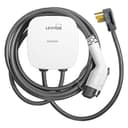
Leviton EV Series Smart Home Charger (EV40P)

Leviton EV Series Smart Home Charger (EV40P)

The one charger here from a brand your electrician already stocks. Forty amps, ENERGY STAR, a NEMA 3R shell, a 25-foot cable and a certification list longer than anything else in this registry — plus the My Leviton app, which is the same app that runs Leviton's load centers and switches. You pay a real premium for that, and what it buys is a company that will still be answering the phone in ten years.

Best name-brand pick
$499.85 · View on Amazon

Price as of September 2, 2026. #ad How we’re funded

3
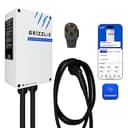
Grizzl-E Classic Connect

Grizzl-E Classic Connect

Grizzl-E retired the old no-app Classic and replaced it with this, and it kept the part that mattered: a metal case rated UL Type 4 for a spot with no shelter, published to keep operating down to -22F. What changed is that the electronics caught up — Wi-Fi, an app, and current you can dial from 40A down to 16A to fit a circuit you already have. It's the rugged pick that no longer asks you to give up scheduling to get it.

Best for weather and cold
$349.99 · View on Amazon

Price as of September 2, 2026. #ad How we’re funded

4
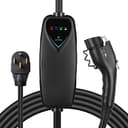
Lectron 40A Portable Level 2 Charger

Lectron 40A Portable Level 2 Charger

The least-expensive honest route into real Level 2 charging. Plug it into a NEMA 14-50 outlet, pull a true 40A / 9.6 kW, and unplug it to throw in the trunk for a trip. The trade-offs for the price are no app and a shorter warranty — both fair at this cost.

Best bare-minimum plug-in
$269.99 · View on Amazon

Price as of September 2, 2026. #ad How we’re funded

5
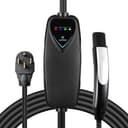
Lectron Level 2 Tesla (NACS) Portable Charger, 40A

Lectron Level 2 Tesla (NACS) Portable Charger, 40A

The straightforward native-NACS answer for a Tesla owner who wants real Level 2 speed without hardwiring anything. Plug it into a NEMA 14-50, pull a full 40 amps, and unplug it when you move or travel. There is no app and no adjustable current — what you are buying is the Tesla plug on the end of a proper 40-amp portable charger, at a price well under a wall-mounted NACS station.

Best for a Tesla or NACS car
$279.89 · View on Amazon

Price as of September 2, 2026. #ad How we’re funded

The picks in full

#1Best overall value

ELEGRP 40A Portable Level 2 Charger (ECP24-40A0-01)

The cheapest charger in this registry that still publishes everything you would want to check: 9.6 kW, five current levels from 16 to 40 amps, an IP67 body with a stated -21°F floor, ETL certification and a 2-year warranty. There is no Wi-Fi and no app — you get a 1-to-12-hour delay timer on the unit instead — and for a lot of households that is the correct amount of charger.

Strengths

  • Five current levels (16/20/24/32/40A) — it fits whatever circuit you have
  • IP67 with a published -21°F to 121°F range, and a carrying case in the box
  • 2-year warranty and full ETL certification at the bottom of the price band

Trade-offs

  • No Wi-Fi, no app and no energy monitoring — just an on-unit delay timer
  • Not ENERGY STAR listed, so it may not qualify for some utility rebates
  • 40 amps is the plug-in ceiling; a 48-amp unit needs hardwiring
Max output40 A
Power9.6 kW
ConnectorJ1772
InstallNEMA 14-50 plug
Cable length25 ft
Warranty2 years
WiFi + appNo
CertificationsETL certified

Our charging-speed math. Forty amps at 240V is 9.6 kW, and at 3.5 miles per kWh that is roughly 34 miles of range an hour. ELEGRP's own figure is 37 miles an hour, which assumes a slightly more efficient car than our reference.

Build note. ELEGRP publishes 240V, up to 9.6 kW, five selectable current levels of 16, 20, 24, 32 and 40 amps, a NEMA 14-50 plug, a 25 ft cable measured plug-end to connector, a J1772 connector, ETL certification with its PBE overheat protection, an IP67 rating with a -21°F to 121°F range, a 1-12 hour delayed start, a carrying case and a 2-year warranty.

Specs read from the manufacturer spec sheet, on August 19, 2026. “Not published” means the brand does not state that figure.

#2Best name-brand pick

Leviton EV Series Smart Home Charger (EV40P)

The one charger here from a brand your electrician already stocks. Forty amps, ENERGY STAR, a NEMA 3R shell, a 25-foot cable and a certification list longer than anything else in this registry — plus the My Leviton app, which is the same app that runs Leviton's load centers and switches. You pay a real premium for that, and what it buys is a company that will still be answering the phone in ten years.

Strengths

  • ENERGY STAR certified, with an unusually deep listing set (UL 2594, 2231, 2251, 62, 991, 1998, 840)
  • NEMA 3R enclosure and a cable rated to -30°C, so an outdoor install is in spec
  • 25 ft cable and a pre-attached NEMA 14-50 input lead — a genuinely quick install

Trade-offs

  • The most expensive 40-amp charger we cover, by a wide margin
  • Leviton does not publish an adjustable-amperage range for this model
  • 2-year warranty is shorter than ChargePoint's 3
Max output40 A
Power9.6 kW
ConnectorJ1772
InstallNEMA 14-50 plug (pre-attached 3 ft input cable)
Cable length25 ft
Warranty2 years
WiFi + appYes
CertificationsUL 2594, UL 2231-1, UL 2231-2, UL 2251, UL 62, UL 991, UL 1998, UL 840, CSA C22.2 #280, NFPA 70 Article 625, OCPP 1.6, ENERGY STAR

Our charging-speed math. Forty amps at 240V is 9.6 kW, and at a middle-of-the-road 3.5 miles per kWh that is roughly 34 miles of range an hour — about 340 miles across a ten-hour overnight window.

Build note. Leviton publishes 208/240 VAC, 40A, 9.6 kW, a 25 ft (7.6 m) J1772 cable, a NEMA Type 3R water-resistant enclosure, an operating range of -30°C to 50°C, altitude to 6,500 ft, Wi-Fi 802.11 b/g/n with the My Leviton app, optional RFID control, OCPP 1.6 compliance and a 2-year limited warranty.

Specs read from the manufacturer spec sheet, on August 19, 2026. “Not published” means the brand does not state that figure.

#3Best for weather and cold

Grizzl-E Classic Connect

Grizzl-E retired the old no-app Classic and replaced it with this, and it kept the part that mattered: a metal case rated UL Type 4 for a spot with no shelter, published to keep operating down to -22F. What changed is that the electronics caught up — Wi-Fi, an app, and current you can dial from 40A down to 16A to fit a circuit you already have. It's the rugged pick that no longer asks you to give up scheduling to get it.

Strengths

  • Metal case rated UL Type 4 indoor/outdoor, published from -22F to 122F
  • Current adjusts from 40A down to 16A, so it fits the circuit you already have
  • 25 ft cable — among the longest here — on a simple plug-in NEMA 14-50 install

Trade-offs

  • 40A caps its charging speed below the 48A units
  • Scheduling now runs through Wi-Fi and an account — the old Classic's nothing-to-update simplicity is gone
  • Grizzl-E publishes UL/cUL only for this model, not the ENERGY STAR listing the discontinued Classic carried
Max output40 A
Power9.6 kW
ConnectorJ1772
InstallNEMA 14-50 plug
Cable length25 ft
Warranty3 years
WiFi + appYes
CertificationsUL/cUL listed (file E510712)

Our charging-speed math. At 40A (9.6 kW) and 3.5 mi/kWh it adds roughly 34 miles of range an hour — more than enough to refill a daily commute overnight. Dial it down to 16A and you're at about 13.

Build note. A metal case rated UL Type 4 indoor/outdoor and published for -30C to +50C (-22F to 122F), with 2.4 GHz Wi-Fi and current adjustable from 40A down to 16A.

Specs read from the manufacturer spec sheet, on August 11, 2026. “Not published” means the brand does not state that figure.

#4Best bare-minimum plug-in

Lectron 40A Portable Level 2 Charger

The least-expensive honest route into real Level 2 charging. Plug it into a NEMA 14-50 outlet, pull a true 40A / 9.6 kW, and unplug it to throw in the trunk for a trip. The trade-offs for the price are no app and a shorter warranty — both fair at this cost.

Strengths

  • A real 40A / 9.6 kW at a budget price
  • Plug-in and portable — no hardwiring, and it travels
  • ETL listed to the UL 2594 / UL 2231 safety standards

Trade-offs

  • No Wi-Fi or app on the base model — the smart version is a separate SKU
  • Shorter 16 ft cable and a 2-year warranty
  • The brand doesn't publish an outdoor/IP enclosure rating
Max output40 A
Power9.6 kW
ConnectorJ1772
InstallNEMA 14-50 plug
Cable length16 ft
Warranty2 years
WiFi + appNo
CertificationsETL listed (UL 2594 / UL 2231)

Our charging-speed math. At 40A (9.6 kW) and 3.5 mi/kWh it adds roughly 34 miles of range an hour.

Build note. A portable plug-in unit — no hardwiring — and the base model carries no Wi-Fi or app.

Specs read from the manufacturer spec sheet, on July 19, 2026. “Not published” means the brand does not state that figure.

#5Best for a Tesla or NACS car

Lectron Level 2 Tesla (NACS) Portable Charger, 40A

The straightforward native-NACS answer for a Tesla owner who wants real Level 2 speed without hardwiring anything. Plug it into a NEMA 14-50, pull a full 40 amps, and unplug it when you move or travel. There is no app and no adjustable current — what you are buying is the Tesla plug on the end of a proper 40-amp portable charger, at a price well under a wall-mounted NACS station.

Strengths

  • Native NACS connector — nothing to seat, nothing to lose, no adapter
  • A real 40A / 9.6 kW from an ordinary NEMA 14-50 outlet
  • IP65 control box and IP55 handle, rated by Lectron for outdoor use
  • Plug-in and portable, so it moves with you and travels

Trade-offs

  • No Wi-Fi or app on this SKU — the smart version is a separate, dearer listing
  • No adjustable current, so it cannot be trimmed down for an unverified outlet
  • A J1772 car needs a NACS-to-J1772 adapter — buy a J1772 charger instead
  • Lectron does not publish a warranty term for this model
Max output40 A
Power9.6 kW
ConnectorNACS
InstallNEMA 14-50 plug
Cable length16 ft
WarrantyNot published
WiFi + appNo
CertificationsETL listed (UL 2594 / UL 2231), UL 2251 handle, FCC

Our charging-speed math. At 40A on 240V (9.6 kW) and our 3.5 mi/kWh reference, roughly 34 miles of range an hour. Lectron's own figure is up to 36 miles an hour, which assumes a slightly more efficient car than our reference.

Build note. Lectron publishes 240V, 40 A and 9.6 kW through a NEMA 14-50 plug on a 16 ft cable, a native Tesla (NACS) connector, an IP65-rated control box with an IP55-rated handle tested to 10,000-plus insertions, protection against overvoltage, overcurrent and short circuits, and ETL/FCC certification against UL 2594 and UL 2231 with a UL 2251 handle. This SKU has no Wi-Fi or app.

Specs read from the manufacturer spec sheet, on August 21, 2026. “Not published” means the brand does not state that figure.

Why 40 amps is the right answer for most people

The instinct is to buy the biggest number available. Two things argue against it here, and both are worth checking before you spend more.

Your car probably cannot use 48 amps.The onboard charger inside the vehicle sets the real ceiling, and on a great many EVs and essentially every plug-in hybrid that ceiling is at or below 9.6 kW. Above your car’s limit, extra amps on the wall do nothing at all. Our onboard charger limits guide explains how to find your own figure, and it is the first thing to check.

Forty amps is already faster than most people need.At 9.6 kW and our reference of roughly 3.5 miles per kWh, that is about 34 miles of range per hour — around 340 miles across a ten-hour overnight window. Very few households drive 340 miles in a day, and a charger only has to replace what you used. Our how many amps guide works that calculation from your own mileage.

The corollary is that if you have genuinely confirmed both that your car accepts more and that your panel can carry a 60-amp circuit, you should read our 48-amp roundup and our 40A versus 48A comparison instead. There is a real case for 48 amps; it just applies to fewer people than the marketing implies.

Adjustable current is the spec that actually separates them

All five of these charge at the same speed. The one that changes what you can do with the charger is whether the current can be set lower than 40.

The ELEGRPpublishes five levels — 16, 20, 24, 32, 40 — and the Grizzl-E Classic Connect publishes 40 down to 16. Those two can be installed on a smaller circuit when the panel is tight and turned up later; they can also be used safely at an outlet whose wiring you cannot inspect. The Lectron 40A is fixed at 40, so is the Lectron Level 2 Tesla, and Leviton does not publish an adjustable range for the EV40P at all.

If your panel is comfortable and the charger will never leave the garage, this does not matter. If your service is tight, or the charger will travel, it is the most consequential line on the spec sheet. Our panel capacity guide covers the first case and our road-trip guide the second.

What the price spread is actually buying

Between the cheapest and the most expensive charger here there is roughly a factor of two, and none of it is charging speed. Broken down honestly:

Certification depth and brand permanence. The Leviton publishes the longest listing set in this registry and comes from a company that has been supplying American electrical wholesalers for a century. Whether that is worth the premium is a judgment about risk over ten years, not about performance tonight.

ENERGY STAR.Of these five, only the Leviton carries it. The direct energy saving is small — ENERGY STAR reports certified units use about 40% less energy in standby — but some utility rebates name the certification as a condition, which can be worth more than the price gap. Check your own utility first; our ENERGY STAR roundup and rebates guide cover it.

Enclosure and cold rating.The Grizzl-E publishes a UL Type 4 metal case, the ELEGRP IP67 with a −21°F floor, and Leviton NEMA 3R with a cable rated to −30°C. Lectron publishes no enclosure rating for the 40A at all, which our spec table records as unpublished. If the charger lives outdoors, that difference is doing work every day — our outdoor roundup ranks specifically on it.

Cable length. Twenty-five feet on the ELEGRP, Grizzl-E and Leviton; sixteen on both Lectrons. That is a nine-foot difference in reach, and it is the most common reason people end up wanting an extension cord— which is the one solution that does not work. Measure the real route first; our long-cable roundup covers it.

Plug-in, and why that is a feature

Every charger here except the hardwire-capable Grizzl-E and the dual-mode Emporia family is a plug-in unit, and at this tier that is the point. A plug-in charger goes into an existing 14-50 receptacle in minutes, can be swapped without an electrician, and moves house with you — which matters a great deal if you rent. Our hardwired versus plug-in comparison covers the trade properly, and our renter picks lean on it heavily.

The thing to check is that the receptacle itself is sound and correctly installed on a 50-amp circuit. A 14-50 outlet put in years ago for an occasional dryer or welder cycle has never been asked to carry 40 amps for six hours straight, and that is a different duty. Our outlet types guide covers how to read one, and our permits guide covers getting a new one installed properly.
Frequently asked questions

Is a 40-amp EV charger enough?

For most households, comfortably. Forty amps at 240 volts is 9.6 kW, or roughly 34 miles of range per hour at our 3.5 miles-per-kWh reference — about 340 miles across a ten-hour overnight window. A charger only has to replace the miles you actually drove, and very few people drive more than that in a day.

Why do all plug-in EV chargers stop at 40 amps?

Because of the receptacle. A NEMA 14-50 outlet lives on a 50-amp circuit, and NEC Article 625 treats EV charging as a continuous load, so the maximum continuous draw is 80% of the circuit — 40 amps. Any charger offering more has to be hardwired to a larger circuit, which is why 48-amp units are hardwired without exception.

What circuit does a 40-amp EV charger need?

A dedicated 50-amp 240V circuit, sized at 125% of the 40-amp continuous load. If you already have a correctly-installed NEMA 14-50 receptacle on such a circuit, a plug-in charger needs no electrical work at all. If you do not, that install is the main cost of the project — our installation cost guide covers what drives the quote.

Which 40-amp charger should I buy if my panel is nearly full?

One with a published adjustable range, so it can be installed on a smaller circuit and turned up later. Of the picks here, the ELEGRP publishes five levels from 16 to 40 amps and the Grizzl-E Classic Connect publishes 40 down to 16. Before assuming you need a service upgrade, read our load management guide — it is frequently the cheaper answer.

Do I need an ENERGY STAR charger?

Only your utility can answer that. The standby-energy saving is real but small. What can be substantial is a rebate program that names the certification as an eligibility condition — in which case the certified charger may be cheaper overall despite a higher sticker price. Check the program before you decide the premium is not worth it.

Sources

Keep reading