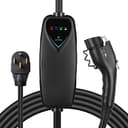
Why plug-in tops out at 40 amps
This is the one number that explains the whole category, so it is worth doing slowly.
NEC Article 625 classifies EV charging as a continuous load— three hours or more of uninterrupted current. Continuous loads are restricted to 80% of their circuit’s rating, or equivalently the circuit is sized at 125% of the load. ChargePoint states the same rule in its own Home Flex datasheet, with its own worked example: a 50-amp breaker for 40-amp output.
The largest receptacle in general household use is the 50-amp NEMA 14-50 (the range and RV socket) or its four-wire-free cousin the NEMA 6-50. Eighty percent of 50 amps is 40 amps, and that is where every plug-in charger stops. To get 48 amps you need a 60-amp circuit, and a 60-amp receptacle is not something your electrician will fit in a garage — so 48-amp chargers are hardwired. Our hardwired vs plug-in comparison works through the rest of that trade, and our hardwired roundup covers the other side of the fence.
In practice the gap is smaller than the spec sheets suggest. Forty amps at 240 volts is 9.6 kW, which at our reference 3.5 miles per kWh is roughly 34 miles of range an hour, or about 340 miles across a ten-hour night. Forty-eight amps is 11.5 kW, or about 40 miles an hour. If your car does not need 340 miles put back between dinner and breakfast, the eight amps buy you nothing you will ever notice.
What actually separates these five
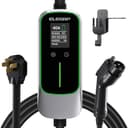
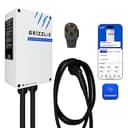
Whether the current adjusts, and in how many steps. This is the single most useful spec on a plug-in charger, because a 14-50 receptacle in an older house is not guaranteed to be on a 50-amp breaker. Somebody may have re-used a 40-amp circuit, in which case your limit is 32 amps and a fixed-40 charger is simply the wrong product. The ELEGRP publishes five levels on the unit. Grizzl-E publishes “40A – 16A” for the Classic Connect and a hardware DIP switch (40/32/24/16 A) for the Mini. The Leviton EV40P publishes no adjustable range at all — it is specified as a fixed 40-amp unit — and nor does the Lectron 40A. That is not disqualifying, but it means both need a genuine 50-amp circuit and cannot be fitted to anything smaller. Our amp-setting guide covers how to read the number off your own breaker.
Cable length, honestly stated. The published figures here span 16 ft to 25 ft, and that is a bigger practical difference than any amperage question on this page. The ELEGRP, the Grizzl-E Classic Connect and the Leviton all publish 25 ft. The Grizzl-E Mini is published at 25 ft on United Chargers’ own page and 24 ft on the Amazon listing we link, so we record the lower figure. The Lectron 40A is 16 ft, which is fine beside the car and not fine across a garage. Our long-cable roundup is the page to read if reach is your constraint.
The enclosure, and whether a temperature range is published at all. Grizzl-E publishes UL Type 4 and −22°F to 122°F for both the Classic Connect and the Mini. ELEGRP publishes IP67 for the station with an IP54 connector and a −21°F to 121°F range. Leviton publishes a NEMA Type 3R enclosure and −30 °C to 50 °C. Lectron publishes noenclosure rating and no temperature range for the 40A portable — a blank field, which is itself a finding. If the charger will hang outside, read the outdoor roundup before this one.
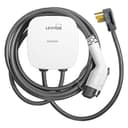
Whether the plug comes attached. A small thing that saves an afternoon. The Leviton EV40P ships with a pre-attached 3 ft input lead terminating in a NEMA 14-50P, so if the receptacle exists the install is hanging the bracket and pushing the plug in. The others are plug-ended too, but the Leviton is the one whose spec sheet makes a point of it.
What we deliberately left off
The ChargePoint Home Flex is the obvious omission, and it is an omission on a technicality worth stating: ChargePoint sells both a hardwired and a plug-in NEMA 14-50 build of the same charger, and the Amazon listing our buy link resolves to is the hardwired one. Its datasheet publishes 16, 24, 32, 40, 48 and 50-amp steps, which is the best adjustable range of anything we cover, so if you want the ChargePoint as a plug-in charger, buy the 14-50 SKU deliberately rather than assuming the listing you land on is the right one.
The Emporia Level 2 is also a plug-in-or-hardwired charger and a frequent top pick elsewhere on this site, but as of the date on this page its Amazon listing shows no buyable offer, so we are not ranking it here. The WOLFBOX E48, EVIQO 48A, Lectron NEXUS and Autel MaxiCharger are all hardwired-only by design and belong on the other list.
The verdict
If you have a 14-50 receptacle and you do not know for certain what breaker is behind it, buy the ELEGRP. Five current levels means you can set it to match whatever your electrician finds, the 25 ft cable reaches, the IP67 body and published cold floor mean the garage wall is in spec, and it is the cheapest honest 40 amps we can point at. The price of that is no app and no energy data — you get a 1-to-12-hour delay timer on the unit instead, which is most of what an app is used for anyway.
If you want the charger to outlive the car, buy the Grizzl-E Classic Connect. A cast case under UL file E510712, a 25 ft cable, a published −22°F floor, an adjustable 40-to-16-amp range and a warranty you can buy as three years or five. It also has Wi-Fi and the Grizzl-E Connect app, which the Mini shares. It is the pick for an exposed wall and a long ownership.
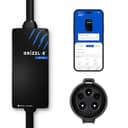
And if the outlet in your garage is not a 14-50, buy the Grizzl-E Mini. It is the only charger here whose manufacturer supplies the adapters — 5-15P, TT-30P, 14-30P and 6-50P, all under the charger’s own UL file — with a hardware DIP switch to cap the current where the smaller circuits require. Read the adapter guide first, because the manual is explicit that the charger cannot detect what circuit it is plugged into. That setting is your job, not its.