What a 100-amp panel actually rules out
Less than you think. The number that matters is not your service rating on its own, it is the spare capacity left after everything else in the house is accounted for — and the rule that converts a charger’s amps into a demand on that capacity.
EV charging is treated as a continuous load under the National Electrical Code, because a car can pull the same current for hours without pausing. Continuous loads are sized at 125% of the draw, which is the same thing as saying a charger may only use 80% of its circuit. So:
- 48 ampsneeds a 60-amp circuit — about 11.5 kW, or roughly 40 miles of range an hour at our standing reference of 3.5 miles per kWh.
- 40 ampsneeds a 50-amp circuit — 9.6 kW, about 34 miles an hour. This is also the ceiling of any plug-in charger on a NEMA 14-50 outlet.
- 32 ampsneeds a 40-amp circuit — 7.7 kW, about 27 miles an hour.
- 24 ampsneeds a 30-amp circuit — 5.8 kW, about 20 miles an hour, or roughly 200 miles across a ten-hour overnight window.
- 16 ampsneeds a 20-amp circuit — 3.8 kW, about 13 miles an hour, which is still more than double the fastest Level 1 setup.
Read that list again with a 100-amp service in mind and the shape of the problem changes. The step that is usually impossible is the 60-amp circuit at the top. The steps below it are frequently fine, and the drop from 48 amps to 32 costs you about thirteen miles of range per hour — which, across an overnight charge, is a difference most households will never notice. Our panel capacity guide walks through working out what yours can actually spare, and our how many amps do I need guide works the same question backward from your own mileage.
One thing this page cannot do for you: the spare-capacity figure has to come from a real load calculation on your real panel, done by someone who can see it. Two houses on identical 100-amp services can have completely different answers depending on whether the range, the dryer and the water heater are electric or gas. Treat the amperage you read here as the thing you ask your electrician about, not the thing you decide without them.
The four things we ranked on
1. A published adjustable range — not a vague “adjustable”
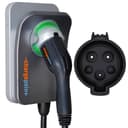
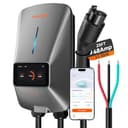
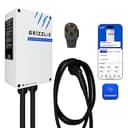
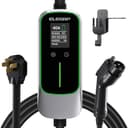
This is the whole page. A charger with a documented current range can be commissioned to whatever your panel allows today and turned up later if that ever changes, which makes it the only kind of purchase here that survives a service upgrade. The five picks publish theirs plainly: ChargePointgives 16–50A set in the app, WOLFBOX gives five fixed steps of 16, 24, 32, 40 and 48 amps, Grizzl-E goes from 40A down to 16A, and ELEGRP offers five levels of 16, 20, 24, 32 and 40 amps.
The distinction that matters is between a range and steps. A continuous range lets an electrician match the exact circuit they can give you. A fixed ladder means you take the nearest step below your limit, which occasionally leaves a couple of amps on the table. In practice that is a mile or two of range per hour, so we would not pay much for it — but it is worth knowing which kind you are buying before you assume any number between the endpoints is available.
2. Whether the charger can manage the load itself
Turning a charger down is a fixed decision: it draws that much whenever the car is plugged in, whether or not the dryer is running. Dynamic load management is the other approach — the charger watches what the rest of the house is drawing and backs off in real time, so it can be sized against a larger circuit than the static arithmetic would allow.
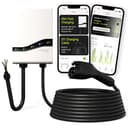
The Emporia Prois the pick here because Emporia publishes PowerSmart as doing exactly that. Be clear-eyed about the cost, though: PowerSmart needs Emporia’s own Vue energy monitor, which is a second device to buy and to have installed at the panel, and the Pro carries a clear premium over Emporia’s standard charger for the feature. That is two purchases and extra electrician time to solve a problem that turning a cheaper charger down solves for free. It earns its place when the load calculation says there is genuinely no room even for a 20 or 30-amp circuit, and not really before. Our load management roundup ranks the chargers that publish it and what each one costs in extra hardware, and our load management guide works through all three approaches in order of cost.
3. Plug-in or hardwired, when the panel is the constraint
A tight panel pushes gently toward plug-in. A hardwired install means a new dedicated circuit either way, so you are paying an electrician regardless — but if a suitable 240V outlet already exists, a plug-in charger may need no panel work at all, which sidesteps the entire question. That is why two of the five picks here plug in rather than wire in.
The trade is a hard ceiling. A plug-in unit on a NEMA 14-50 outlet cannot exceed 40 amps, because 40 is 80% of that receptacle’s 50-amp circuit. If you were never going to get above 40 amps on this panel anyway — and on a 100-amp service you very likely were not — that ceiling costs you nothing you were going to use. Our hardwired versus plug-in comparison covers the full trade, and our outlet types guide explains which existing socket is which.
4. ENERGY STAR, because a rebate can outweigh the price gap
A tight panel is an expensive situation, so anything that claws money back matters more here than usual. Plenty of utility rebate programs name ENERGY STAR certification as an eligibility condition, and the rebate is often worth more than the difference between two chargers on this page. Of our picks, the ChargePoint and the Emporia Pro are certified. Grizzl-E publishes UL/cUL for the Classic Connect but not an ENERGY STAR listing, ELEGRP is ETL certified and not ENERGY STAR, and WOLFBOX prints ENERGY STAR on its spec table even though the ENERGY STAR certified-EVSE database lists only its E40 and E50 models — not the 48-amp configuration sold here. We record that as unconfirmed rather than as a yes. Check your own utility before deciding the premium is not worth paying; our rebates and tax credits guide covers what to look for.
The order to try things in, cheapest first
If an electrician has told you a charger means a service upgrade, work down this list before you accept that quote. Each step is cheaper than the one after it.
First, ask what circuit the panel can carry.Not “can I have a charger” — ask for the largest circuit the existing service supports after a load calculation. A 30 or 40-amp answer is common, and it is a perfectly good charger.
Second, buy an adjustable charger and set it to that. This costs nothing extra. Four of the five picks here do it, and you keep the headroom for later.
Third, look at what else is on the panel.Sometimes capacity is being held by something that no longer exists — an old electric range in a kitchen that went gas, a spa circuit for a hot tub that left with the previous owner. Freeing that up is an hour of labor, not a service upgrade.
Fourth, consider dynamic load management. Now the Emporia Pro plus the Vue monitor starts to make sense, because you are comparing it against a four-figure upgrade rather than against a cheaper charger.
Fifth, and only now, price the service upgrade. It is a real answer, it permanently fixes the problem, and if you are also planning a heat pump or an induction range it may be the right call on its own merits. Our installation cost guide covers what moves that number.
If the answer comes back at 40 amps
The most common outcome of a load calculation on a 100-amp service is room for a 40-amp circuit, which means a charger set to 32 amps. That is a specific enough purchase to have its own page: our 32-amp roundup ranks the chargers that can be held at 32 amps, and ranks them on wherethe limit is enforced — a hardware DIP switch that nothing can override, against an app setting anyone with the account can raise. On a circuit-limited install that distinction matters more than any other spec.
What we left out, and why
The standard Emporia Level 2.It is the charger we recommend more often than any other on this site, and it is not on this page. Emporia publishes it as running 48 amps hardwired or 40 amps on a NEMA 14-50 plug; it does not publish an adjustable range below that, and the entire premise of this page is a range we can read off a spec sheet. If you have a 50-amp circuit available, the standard Emporia at 40 amps is an excellent buy — see our 40-amp roundup. If you need to go below 40, buy something on this page instead.
The Wallbox Pulsar Plus.Wallbox publishes Power Boost load balancing, which is the same idea as PowerSmart and can sidestep an upgrade the same way. It is not a pick because it is hardwired-only and sits at the premium end of the price band, which makes it a harder recommendation than the Emporia Pro for the specific job this page is about — but if wall space is tight as well as panel space, our Wallbox Pulsar Plus review is worth reading before you decide.
The Leviton EV40P.A genuinely good charger from a brand your electrician already stocks, left off for one reason: Leviton does not publish an adjustable amperage range for this model. That is a finding rather than a failing — it simply makes it the wrong tool for a panel where the current setting is the entire decision.
Level 1 charging.If the load calculation comes back with genuinely nothing to spare, a 120V charger on an ordinary household outlet needs no circuit, no permit and no electrician. It is slow and we will not pretend otherwise, but it is the honest floor of this category rather than a failure — our Level 1 roundup covers it, and our do you need Level 2 guide is worth reading before you spend anything at all.
How much charger a 100-amp house actually needs
The arithmetic that ends most of these conversations is embarrassingly simple, and almost nobody does it before shopping. A charger only has to replace the miles you drove that day, in the hours the car sits at home. Divide your daily driving by the hours between plugging in and leaving, and you have the miles per hour you actually need. For a lot of households that number lands in the teens — which is inside what a 16 or 24-amp setting already delivers.
There is a second ceiling worth checking before you pay for amps, and it is not in your panel. Every EV has an onboard charger that caps how much AC power it will accept, and above that limit extra amps on the wall do nothing whatsoever. If your car tops out at 7.7 kW, a 48-amp charger and a 32-amp charger fill it at exactly the same speed. Our onboard charger limits guideshows how to find your own figure, and it is genuinely the first thing to check — it occasionally makes the whole panel problem disappear.
Finally, if you are charging overnight anyway, look at whether your utility offers a time-of-use rate. A slower charger running from midnight to six in the morning on an off-peak rate costs less to run than a faster one finishing at nine in the evening, which turns the constraint into a saving. Our time-of-use charging guide covers the trap in those rates as well as the upside.