Plug & Range

Best Home EV Chargers

Most charger roundups rank by amperage and stop. The amperage is the easy part — your panel, your parking spot and your connector decide more. Here's the whole field, sorted by the situation you're actually in.

By Stephen V.Last updated How we pick

Almost every home charger sold today is a competent piece of hardware. The differences that actually change your life are narrower than the marketing suggests: how many amps your electrical panel can spare, whether the charger lives under a roof, whether your car takes a J1772 or a NACS plug, and whether you own the wall you’re drilling into. Get those four right and almost any certified charger will do the job for a decade.

So we’ve ranked this list by situationrather than by spec sheet. Every pick below is a real, currently-purchasable unit; every spec comes from the manufacturer’s own published sheet on a dated visit; and every charging-speed number is our own arithmetic with the assumption printed so you can re-run it for your car. We don’t bench-test chargers and we don’t pretend to. Below the picks, the buying guide walks through the four decisions in order.

How this is funded:we earn a commission if you buy through our links, at no extra cost to you. It never changes which product we recommend, and we’ll tell you when we’d skip one. Full disclosure.

Quick picks

Ranked on published specs, charging speed, electrical fit and value. Select a row to jump to the full write-up. We have not bench-tested these chargers — here is exactly what we do instead.

#ProductBest forPrice
1
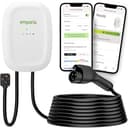
Emporia Level 2 EV Charger

Emporia Level 2 EV Charger

The value pick that never feels like one. You get the full 48 amps, an ENERGY STAR listing, real Wi-Fi energy tracking and a 25 ft cable for well under what the marquee brands charge. When someone asks us where to start, this is usually the first name out of our mouths.

Best overall
$449.00 · View on Amazon

Price as of September 2, 2026. #ad How we’re funded

2
ChargePoint Home Flex

ChargePoint Home Flex

If you'd rather buy a charger once and be done, this is the safe call. You set the current in the app anywhere from 16 to 50 amps, so it fits whatever your panel can spare today and still has room to grow if you upgrade the circuit later. The app is the most polished of the bunch and the warranty is long.

Best for an unsettled circuit
$494.00 · View on Amazon

Price as of September 2, 2026. #ad How we’re funded

3
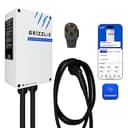
Grizzl-E Classic Connect

Grizzl-E Classic Connect

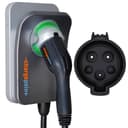
Grizzl-E retired the old no-app Classic and replaced it with this, and it kept the part that mattered: a metal case rated UL Type 4 for a spot with no shelter, published to keep operating down to -22F. What changed is that the electronics caught up — Wi-Fi, an app, and current you can dial from 40A down to 16A to fit a circuit you already have. It's the rugged pick that no longer asks you to give up scheduling to get it.

Best for exposed installs
$349.99 · View on Amazon

Price as of September 2, 2026. #ad How we’re funded

4
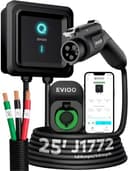
EVIQO 48A Level 2 Charger

EVIQO 48A Level 2 Charger

A lot of charger for the money. You get 48 amps, Wi-Fi scheduling, ENERGY STAR, and the longest usable reach in this group thanks to a 25 ft cable plus a 40-inch input lead. If Emporia is sold out or you want maximum cable, this is the value alternative to have in mind.

Best cable reach
$428.98 · View on Amazon

$479.0010% off

Price as of September 2, 2026. #ad How we’re funded

5
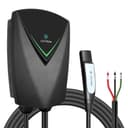
Lectron Nexus NACS (Tesla) Charger

Lectron Nexus NACS (Tesla) Charger

For a Tesla owner who doesn't want to babysit an adapter. The native NACS (J3400) connector goes straight into the car at a full 48 amps, with the safety listings you want to see. There's no app — but a Tesla schedules charging in the car anyway, so you're not really missing one.

Best for Tesla
$429.99 · View on Amazon

$459.997% off

Price as of September 2, 2026. #ad How we’re funded

6
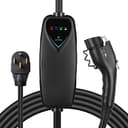
Lectron 40A Portable Level 2 Charger

Lectron 40A Portable Level 2 Charger

The least-expensive honest route into real Level 2 charging. Plug it into a NEMA 14-50 outlet, pull a true 40A / 9.6 kW, and unplug it to throw in the trunk for a trip. The trade-offs for the price are no app and a shorter warranty — both fair at this cost.

Best budget
$269.99 · View on Amazon

Price as of September 2, 2026. #ad How we’re funded

The picks in full

#1Best overall

Emporia Level 2 EV Charger

The value pick that never feels like one. You get the full 48 amps, an ENERGY STAR listing, real Wi-Fi energy tracking and a 25 ft cable for well under what the marquee brands charge. When someone asks us where to start, this is usually the first name out of our mouths.

Strengths

  • 48A and ENERGY STAR at a genuinely value price
  • The app tracks energy use, not just an on/off toggle
  • Long 25 ft cable and a remote holster in the box

Trade-offs

  • 48A hardwired needs a 60A circuit; on a NEMA 14-50 plug it's capped at 40A
  • The app is less polished than ChargePoint's, and support is a smaller operation
Max output48 A
Power11.5 kW
ConnectorJ1772
InstallHardwired or NEMA 14-50 plug
Cable length25 ft
Warranty3 years
WiFi + appYes
CertificationsUL listed, ENERGY STAR

Our charging-speed math. Hardwired at 48A (11.5 kW), figure about 40 miles of range an hour at 3.5 mi/kWh. Drop to a 40A plug-in circuit and it's closer to 34.

Build note. Runs 48A hardwired, or 40A on a NEMA 14-50 outlet, with a 25 ft cable and a wall holster included.

Specs read from the manufacturer spec sheet, on July 19, 2026. “Not published” means the brand does not state that figure.

#2Best for an unsettled circuit

ChargePoint Home Flex

If you'd rather buy a charger once and be done, this is the safe call. You set the current in the app anywhere from 16 to 50 amps, so it fits whatever your panel can spare today and still has room to grow if you upgrade the circuit later. The app is the most polished of the bunch and the warranty is long.

Strengths

  • Adjustable 16-50A fits a modest circuit now and a bigger one later
  • The most complete app here: scheduling, reminders and usage history
  • 3-year warranty and a generous 23 ft cable

Trade-offs

  • You pay a brand premium over value 48A units
  • Using the full 50A needs a 60A circuit most older panels can't spare
Max output50 A
Power12 kW
ConnectorJ1772
InstallHardwired (a plug-in NEMA 14-50 SKU is also sold)
Cable length23 ft
Warranty3 years
WiFi + appYes
CertificationsUL/cUL listed, ENERGY STAR

Our charging-speed math. Run it at the full 50 amps (about 12 kW) and, at a middle-of-the-road 3.5 miles per kWh, it puts back roughly 42 miles of range an hour. Turn it down to 40A to live on a 50A circuit and you're at about 34.

Build note. The headline feature is app-adjustable amperage — anywhere from 16A up to 50A, in software.

Specs read from the manufacturer spec sheet, on July 19, 2026. “Not published” means the brand does not state that figure.

#3Best for exposed installs

Grizzl-E Classic Connect

Grizzl-E retired the old no-app Classic and replaced it with this, and it kept the part that mattered: a metal case rated UL Type 4 for a spot with no shelter, published to keep operating down to -22F. What changed is that the electronics caught up — Wi-Fi, an app, and current you can dial from 40A down to 16A to fit a circuit you already have. It's the rugged pick that no longer asks you to give up scheduling to get it.

Strengths

  • Metal case rated UL Type 4 indoor/outdoor, published from -22F to 122F
  • Current adjusts from 40A down to 16A, so it fits the circuit you already have
  • 25 ft cable — among the longest here — on a simple plug-in NEMA 14-50 install

Trade-offs

  • 40A caps its charging speed below the 48A units
  • Scheduling now runs through Wi-Fi and an account — the old Classic's nothing-to-update simplicity is gone
  • Grizzl-E publishes UL/cUL only for this model, not the ENERGY STAR listing the discontinued Classic carried
Max output40 A
Power9.6 kW
ConnectorJ1772
InstallNEMA 14-50 plug
Cable length25 ft
Warranty3 years
WiFi + appYes
CertificationsUL/cUL listed (file E510712)

Our charging-speed math. At 40A (9.6 kW) and 3.5 mi/kWh it adds roughly 34 miles of range an hour — more than enough to refill a daily commute overnight. Dial it down to 16A and you're at about 13.

Build note. A metal case rated UL Type 4 indoor/outdoor and published for -30C to +50C (-22F to 122F), with 2.4 GHz Wi-Fi and current adjustable from 40A down to 16A.

Specs read from the manufacturer spec sheet, on August 11, 2026. “Not published” means the brand does not state that figure.

#4Best cable reach

EVIQO 48A Level 2 Charger

A lot of charger for the money. You get 48 amps, Wi-Fi scheduling, ENERGY STAR, and the longest usable reach in this group thanks to a 25 ft cable plus a 40-inch input lead. If Emporia is sold out or you want maximum cable, this is the value alternative to have in mind.

Strengths

  • 48A output with Wi-Fi scheduling at a value price
  • 25 ft charging cable plus a 40 in input lead — excellent reach
  • UL, ETL, FCC and ENERGY STAR listings

Trade-offs

  • The hardwired version needs a 60A circuit and an electrician
  • A smaller brand with a shorter track record than ChargePoint or Wallbox
Max output48 A
Power11.5 kW
ConnectorJ1772
InstallHardwired
Cable length25 ft
Warranty3 years
WiFi + appYes
CertificationsUL, ETL, FCC, ENERGY STAR

Our charging-speed math. At 48A (11.5 kW) and 3.5 mi/kWh, about 40 miles of range an hour.

Build note. Ships with a 25 ft charging cable plus a 40 in input cable — among the longest total reach in class.

Specs read from the manufacturer spec sheet, on July 19, 2026. “Not published” means the brand does not state that figure.

#5Best for Tesla

Lectron Nexus NACS (Tesla) Charger

For a Tesla owner who doesn't want to babysit an adapter. The native NACS (J3400) connector goes straight into the car at a full 48 amps, with the safety listings you want to see. There's no app — but a Tesla schedules charging in the car anyway, so you're not really missing one.

Strengths

  • Native NACS connector — no J1772-to-Tesla adapter to keep track of
  • Full 48A output and a weather-rated IP66 body
  • UL/ETL safety listings plus ENERGY STAR

Trade-offs

  • No Wi-Fi app — you schedule in the Tesla app instead
  • Best for Tesla/NACS cars; other EVs need a NACS-to-J1772 adapter
Max output48 A
Power11.5 kW
ConnectorNACS
InstallHardwired
Cable length23 ft
Warranty3 years
WiFi + appNo
CertificationsUL 2594/2231/2251 (ETL listed), ENERGY STAR, FCC

Our charging-speed math. At 48A (11.5 kW) and 3.5 mi/kWh, about 40 miles of range an hour into a Tesla.

Build note. A native NACS (J3400) connector plugs straight into a Tesla with no adapter; a holster is included.

Specs read from the manufacturer spec sheet, on July 19, 2026. “Not published” means the brand does not state that figure.

#6Best budget

Lectron 40A Portable Level 2 Charger

The least-expensive honest route into real Level 2 charging. Plug it into a NEMA 14-50 outlet, pull a true 40A / 9.6 kW, and unplug it to throw in the trunk for a trip. The trade-offs for the price are no app and a shorter warranty — both fair at this cost.

Strengths

  • A real 40A / 9.6 kW at a budget price
  • Plug-in and portable — no hardwiring, and it travels
  • ETL listed to the UL 2594 / UL 2231 safety standards

Trade-offs

  • No Wi-Fi or app on the base model — the smart version is a separate SKU
  • Shorter 16 ft cable and a 2-year warranty
  • The brand doesn't publish an outdoor/IP enclosure rating
Max output40 A
Power9.6 kW
ConnectorJ1772
InstallNEMA 14-50 plug
Cable length16 ft
Warranty2 years
WiFi + appNo
CertificationsETL listed (UL 2594 / UL 2231)

Our charging-speed math. At 40A (9.6 kW) and 3.5 mi/kWh it adds roughly 34 miles of range an hour.

Build note. A portable plug-in unit — no hardwiring — and the base model carries no Wi-Fi or app.

Specs read from the manufacturer spec sheet, on July 19, 2026. “Not published” means the brand does not state that figure.

How to choose, in the order the decisions actually happen

People shop for a charger by reading spec sheets and then discover the electrical constraints afterwards, which is backwards and expensive. Run it in this order instead.

1. Find out what your panel can spare — before you fall in love with a unit

This is the decision that quietly settles the other three. Under the National Electrical Code, EV charging counts as a continuous load, so the circuit has to be sized to 125% of what the charger draws. A 40-amp charger therefore needs a 50-amp circuit; a 48-amp charger needs a 60-amp one. That single step is why the jump from 40A to 48A is so often the difference between a straightforward install and a panel upgrade that costs more than the charger.

If nobody has run the numbers on your service yet, our panel capacity guide works through the same load calculation an electrician does, and our how many amps guide translates the answer into a charger to shortlist. The honest headline: most single-car households never use the extra amps they paid for.

2. Decide where it lives — that picks the enclosure

A charger inside a closed garage can be almost anything. A charger on an exterior wall with no overhang is a different purchase. NEMA 3R covers rain, sleet and ice forming on the outside. Type 4 adds windblown dust and hose-directed water. NEMA 4X adds corrosion resistance, which is what you want near salted roads or coastal air.

The spec we’d actually shop on for a cold climate, though, is a published operating temperature range, which is a separate qualification from the enclosure rating and far rarer on a spec sheet. Our outdoor and cold-weather roundup ranks purely on this, and our cold-weather guide explains why an IP number tells you nothing about January.

3. Match the connector to the car, not to the brand

Every non-Tesla EV sold in North America takes a J1772 plug for AC charging; Teslas and the newer NACS-native cars take the J3400/NACS plug. Both directions are bridged by a certified adapter for about the price of a tank of gas, which means the connector should almost never limit your shortlist. Buy the charger that fits your panel and your wall, then bridge the plug if you have to — our J1772 vs NACS explainer and adapters page cover which adapter goes which way, and which certifications matter.

4. Decide whether you own the wall

If you rent, a hardwired charger is the wrong shape: it becomes the landlord’s fixture the moment it’s installed and you cannot take it with you. A plug-in unit on a NEMA 14-50 outlet unplugs and moves house. If you can’t add a 240V outlet at all, Level 1 from an ordinary wall socket is genuinely viable for a lot of commutes — see our renter and apartment picks and hardwired vs plug-in comparison.

What separates these picks in practice

Speed barely varies.At our standard reference of roughly 3.5 miles of range per kWh, a 40-amp charger adds about 34 miles of range an hour, a 48-amp charger about 40, and a 50-amp charger about 42. Over a ten-hour overnight window that is 340 miles against 420 — both far more than a normal day’s driving. The gap only becomes real if you routinely refill from near-empty after a long trip, or you rotate two cars through one charger.

Price mostly buys enclosure, app maturity and cable. A value 48-amp unit and a premium one deliver identical current. What the extra money buys is a metal weatherproof body instead of molded plastic, an app that will still be maintained in five years, a few more feet of cable, and sometimes load management that can save you a panel upgrade. None of it makes the car fill faster.

Cable length is the spec people regret. Twenty-three to twenty-five feet is the top of this class and is worth paying for if the charge port ends up on the far side of the car from the wall. Sixteen feet is fine if the unit mounts close to the port and nothing is in the way. Our long-cable roundup has the reach numbers side by side.

Certification is not negotiable, and it is cheap.Every pick here carries a UL, cUL or ETL listing against the ANSI/UL 2594 standard for EV supply equipment. That is a third-party lab testing the unit, and budget chargers can and do carry it — price is not the safety signal, the mark is. Our guide on whether cheap EV chargers are safe explains how to read the marks and which “listings” mean nothing.

Who each pick is really for

The Emporia Level 2 takes the overall slot because it is the least-compromised charger at a value price: a genuine 48 amps, an ENERGY STAR listing, real energy tracking rather than an on/off toggle, and 25 feet of cable. If you have no unusual constraint, start here.

The ChargePoint Home Flex earns its premium in exactly one situation, and it is a common one: your circuit is not settled yet. Software-adjustable output from 16 to 50 amps means you can install it on whatever the panel can spare today and turn it up later. That is the single best hedge on the market if an electrician has not yet told you your number.

The Grizzl-E Classic Connectis the pick when the charger is going somewhere genuinely exposed. Grizzl-E publishes an operating range down to −22°F on a UL Type 4 metal case, which is a stated commitment rather than a vague weather claim.

The EVIQO 48Ais here for reach: 25 feet of charging cable plus a 40-inch input lead is the longest total run on this list, which matters more than people expect in a garage where the outlet and the parking spot don’t line up.

The Lectron Nexus NACSis the Tesla answer that skips the adapter entirely — a native NACS plug at a full 48 amps. There is no app, which matters far less on a Tesla, because the car already handles scheduled charging and charge limits better than most charger apps do.

The Lectron 40Ais the cheapest honest route into real Level 2 charging. It is a true 40 amps from a 14-50 outlet, it travels, and the trade-offs are specific and fair for the price: no app, a shorter 16-foot cable, a two-year warranty, and no published enclosure rating — so keep it sheltered.

What we did not include, and why

We only feature chargers that are currently purchasable and whose specs we can read from the manufacturer. Units get left off this list for two reasons: the brand publishes no real spec sheet, so we would be guessing at enclosure ratings and warranty terms; or the product is not reliably in stock, which makes a buy button a broken promise. Where a brand does not publish a figure, our spec tables say “Not published” rather than filling in a plausible number — what a brand withholds is information too.
Frequently asked questions

What is the best home EV charger overall?

For most homes, the Emporia Level 2 — a genuine 48 amps, ENERGY STAR listed, with real energy tracking and a 25-foot cable at a value price. It only stops being the answer when you have a specific constraint: an unsettled circuit favors the adjustable ChargePoint Home Flex, an exposed outdoor wall favors the Grizzl-E Classic Connect, and a rental favors a plug-in unit you can take with you.

How many amps do I actually need for a home EV charger?

For most single-car households, 40 amps is plenty: about 34 miles of range per hour, or roughly 340 miles across a ten-hour overnight window. Step up to 48 amps if you routinely refill from near-empty after long trips or share one charger between two EVs — but check your panel first, because 48 amps requires a 60-amp circuit under the NEC's continuous-load rule, and that is where the cost usually appears.

Do I need an electrician to install a home EV charger?

For the 240V circuit, yes — that work should be done by a licensed electrician to code, and in most jurisdictions it needs a permit and an inspection. Plugging a plug-in charger into an existing, correctly-rated NEMA 14-50 outlet is a homeowner job, the same as any large appliance. Level 1 charging from a standard 120V outlet needs no electrical work at all.

Is a more expensive EV charger faster?

No. At the same amperage, a budget charger and a premium one add range at exactly the same rate — amperage is set by the internal hardware, not by price. What extra money buys is a weatherproof enclosure, a more mature app, a longer cable, load management, or a longer warranty. Premium units tend to offer higher amp ceilings, but that is a different thing from being faster at the same setting.

Should I buy a J1772 or a NACS charger?

Buy for the car you have, but don't let the connector shrink your shortlist. Every non-Tesla EV in North America uses J1772; Teslas and newer NACS-native cars use the J3400/NACS plug. Certified adapters bridge both directions for a modest price, so it is often cheaper to buy the best-value J1772 charger plus an adapter than to buy a native NACS unit.

Can I take a home EV charger with me when I move?

Only if it is a plug-in unit. A charger on a NEMA 14-50 plug unplugs and leaves the outlet behind — that is why it is the standard answer for renters. A hardwired charger is terminated straight into the circuit and effectively becomes part of the property, so removing it is an electrician's job rather than a decision you make on moving day.

Sources

Keep reading