Plug & Range

NEMA 14-50 vs 6-50 for EV Charging

Two 50-amp, 240-volt receptacles that charge an electric car at identical speed. One has a fourth wire your charger will never touch — and that wire is the entire decision.

By Stephen V.Last updated How we pick

If you are having a new receptacle installed for EV charging, have a NEMA 14-50 fitted — not because it charges faster, but because it is the plug every charger on the market already has on the end of its cord. And if a 6-50 welder outlet already exists in your garage, do not rip it out: buy the Grizzl-E Mini, which is the only charger we cover that ships with a manufacturer-supplied NEMA 6-50P adapter under the charger’s own UL file. Both receptacles deliver 240 volts at 50 amps, which under NEC Article 625’s continuous-load rule means 40 amps of charging — 9.6 kW — from either one. There is no speed difference. There is no efficiency difference. The charging arithmetic is the same number twice.

The physical difference is one conductor. A NEMA 14-50 has four slots: two hot legs, a neutral and a ground. A NEMA 6-50has three: two hot legs and a ground. The 14-50 carries that neutral because the appliances it was designed for — electric ranges, RV shore power — run some 120-volt loads internally and need a return path for them. An EV charger does not. Level 2 charging puts 240 volts across the two hot legs and uses the ground as a safety conductor only. Plug a charger into a 14-50 and the neutral slot does nothing at all for the life of the installation.

Which is why this page is not about charging. It is about install cost, what the circuit is good for after you sell the car, and whether the plug on your charger matches the hole in your wall. The picks below are the three chargers that make each answer work.

How this is funded:we earn a commission if you buy through our links, at no extra cost to you. It never changes which product we recommend, and we’ll tell you when we’d skip one. Full disclosure.

Quick picks

Ranked on published specs, charging speed, electrical fit and value. Select a row to jump to the full write-up. We have not bench-tested these chargers — here is exactly what we do instead.

#ProductBest forPrice
1
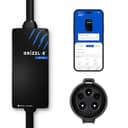
Grizzl-E Mini 40A Portable Charger (J1772)

Grizzl-E Mini 40A Portable Charger (J1772)

The only charger on our dryer-outlet page that can grow past one. It is a UL-certified 40-amp portable on a NEMA 14-50 plug, and United Chargers puts a NEMA 14-30P adapter in the box alongside 6-50P, TT-30P and 5-15P adapters — so it runs at 24 amps on your dryer outlet today and at 40 the day an electrician fits a 14-50. The catch is the one that matters most here: it ships set to 40 amps, United Chargers' current Mini manual says outright that the charger cannot detect a circuit's amperage limit, and turning it down before the first session is your job.

Best for a 6-50: adapter supplied by the maker
$479.99 · View on Amazon

Price as of October 10, 2026. #ad How we’re funded

2
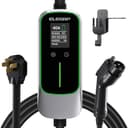
ELEGRP 40A Portable Level 2 Charger (ECP24-40A0-01)

ELEGRP 40A Portable Level 2 Charger (ECP24-40A0-01)

The cheapest charger in this registry that still publishes everything you would want to check: 9.6 kW, five current levels from 16 to 40 amps, an IP67 body with a stated -21°F floor, ETL certification and a 2-year warranty. There is no Wi-Fi and no app — you get a 1-to-12-hour delay timer on the unit instead — and for a lot of households that is the correct amount of charger.

Best value on a new 14-50
$209.99 · View on Amazon

Price as of October 10, 2026. #ad How we’re funded

3
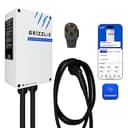
Grizzl-E Classic Connect

Grizzl-E Classic Connect

Grizzl-E retired the old no-app Classic and replaced it with this, and it kept the part that mattered: a metal case rated UL Type 4 for a spot with no shelter, published to keep operating down to -22F. What changed is that the electronics caught up — Wi-Fi, an app, and current you can dial from 40A down to 16A to fit a circuit you already have. It's the rugged pick that no longer asks you to give up scheduling to get it.

Best 14-50 unit to leave on the wall
$349.99 · View on Amazon

Price as of October 10, 2026. #ad How we’re funded

The picks in full

#1Best for a 6-50: adapter supplied by the maker

Grizzl-E Mini 40A Portable Charger (J1772)

The only charger on our dryer-outlet page that can grow past one. It is a UL-certified 40-amp portable on a NEMA 14-50 plug, and United Chargers puts a NEMA 14-30P adapter in the box alongside 6-50P, TT-30P and 5-15P adapters — so it runs at 24 amps on your dryer outlet today and at 40 the day an electrician fits a 14-50. The catch is the one that matters most here: it ships set to 40 amps, United Chargers' current Mini manual says outright that the charger cannot detect a circuit's amperage limit, and turning it down before the first session is your job.

Strengths

  • Three-year warranty and a UL certification from an established North American brand
  • The NEMA 14-30P adapter comes in the box from the manufacturer, not as a third-party add-on
  • A DIP switch inside can cap it at 24 amps in hardware, and no Wi-Fi setting can exceed that cap
  • Runs at a full 40 amps on a NEMA 14-50 if the outlet is upgraded later

Trade-offs

  • Ships set to 40 amps and cannot detect the circuit — on a 14-30 it must be turned down before first use
  • Setting the hardware cap means unplugging it and removing the front cover to reach the switch
  • By a wide margin the most expensive pick, for capacity a dryer outlet will never let you use
  • The adapter adds a plug-and-socket joint that a native 14-30 cord does not have
  • The Amazon J1772 listing describes browser-based Wi-Fi settings, not the Grizzl-E Connect app the newer Mini Connect uses
Max output40 A
Power9.6 kW
ConnectorJ1772
InstallNEMA 14-50 plug, with 14-30P, 6-50P, TT-30P and 5-15P adapters included
Cable length24 ft
Warranty3 years
WiFi + appYes
CertificationsUL certified (United Chargers UL file E510712)

Our charging-speed math. On a NEMA 14-30 dryer outlet it must run at 24 amps: 24A at 240V is 5.76 kW, which at our 3.5 miles-per-kWh reference is roughly 20 miles of range an hour, or about 200 miles across a ten-hour overnight window. On a NEMA 14-50 at its full 40 amps (9.6 kW), it is roughly 34 miles an hour.

Build note. United Chargers publishes a 40A / 9.6 kW maximum on a 50A circuit with the output adjustable down to 7A at 240V (and 7-12A at 120V, which the charger detects automatically), a NEMA 14-50 input plug on an 18-inch lead, four NEMA 14-50R adapters in the box (5-15P, TT-30P, 14-30P and 6-50P), a UL Type 4 indoor/outdoor rating, a -22°F to 122°F operating range, a 6.9 x 3.1 x 2.4 in body weighing 9.8 lb, built-in GFCI, UL file E510712 and a 3-year warranty. Two lines decide how it belongs on a dryer outlet: both Mini manuals give the factory default maximum as 40A, and the current Mini Connect manual adds that the charger "can not detect the circuit amperage limit" (the automatic detection both manuals describe is of 120V versus 240V, not of the circuit's amperage). The limit can be lowered on the Wi-Fi settings page, or capped in hardware with a four-position DIP switch at 40, 32, 24 or 16A; the Wi-Fi setting can never exceed the DIP switch. On cable length, grizzl-e.com lists 25 ft for the current Mini Connect, while this Amazon J1772 listing and United Chargers' original Mini manual both say 24 ft, so we record the lower figure.

Specs read from the manufacturer spec sheet, on September 15, 2026. “Not published” means the brand does not state that figure.

#2Best value on a new 14-50

ELEGRP 40A Portable Level 2 Charger (ECP24-40A0-01)

The cheapest charger in this registry that still publishes everything you would want to check: 9.6 kW, five current levels from 16 to 40 amps, an IP67 body with a stated -21°F floor, ETL certification and a 2-year warranty. There is no Wi-Fi and no app — you get a 1-to-12-hour delay timer on the unit instead — and for a lot of households that is the correct amount of charger.

Strengths

  • Five current levels (16/20/24/32/40A) — it fits whatever circuit you have
  • IP67 with a published -21°F to 121°F range, and a carrying case in the box
  • 2-year warranty and full ETL certification at the bottom of the price band

Trade-offs

  • No Wi-Fi, no app and no energy monitoring — just an on-unit delay timer
  • Not ENERGY STAR listed, so it may not qualify for some utility rebates
  • 40 amps is the plug-in ceiling; a 48-amp unit needs hardwiring
Max output40 A
Power9.6 kW
ConnectorJ1772
InstallNEMA 14-50 plug
Cable length25 ft
Warranty2 years
WiFi + appNo
CertificationsETL certified

Our charging-speed math. Forty amps at 240V is 9.6 kW, and at 3.5 miles per kWh that is roughly 34 miles of range an hour. ELEGRP's own figure is 37 miles an hour, which assumes a slightly more efficient car than our reference.

Build note. ELEGRP publishes 240V, up to 9.6 kW, five selectable current levels of 16, 20, 24, 32 and 40 amps, a NEMA 14-50 plug, a 25 ft cable measured plug-end to connector, a J1772 connector, ETL certification with its PBE overheat protection, an IP67 rating with a -21°F to 121°F range, a 1-12 hour delayed start, a carrying case and a 2-year warranty.

Specs read from the manufacturer spec sheet, on August 19, 2026. “Not published” means the brand does not state that figure.

#3Best 14-50 unit to leave on the wall

Grizzl-E Classic Connect

Grizzl-E retired the old no-app Classic and replaced it with this, and it kept the part that mattered: a metal case rated UL Type 4 for a spot with no shelter, published to keep operating down to -22F. What changed is that the electronics caught up — Wi-Fi, an app, and current you can dial from 40A down to 16A to fit a circuit you already have. It's the rugged pick that no longer asks you to give up scheduling to get it.

Strengths

  • Metal case rated UL Type 4 indoor/outdoor, published from -22F to 122F
  • Current adjusts from 40A down to 16A, so it fits the circuit you already have
  • 25 ft cable — among the longest here — on a simple plug-in NEMA 14-50 install

Trade-offs

  • 40A caps its charging speed below the 48A units
  • Scheduling now runs through Wi-Fi and an account — the old Classic's nothing-to-update simplicity is gone
  • Grizzl-E publishes UL/cUL only for this model, not the ENERGY STAR listing the discontinued Classic carried
Max output40 A
Power9.6 kW
ConnectorJ1772
InstallNEMA 14-50 plug
Cable length25 ft
Warranty3 years
WiFi + appYes
CertificationsUL/cUL listed (file E510712)

Our charging-speed math. At 40A (9.6 kW) and 3.5 mi/kWh it adds roughly 34 miles of range an hour — more than enough to refill a daily commute overnight. Dial it down to 16A and you're at about 13.

Build note. A metal case rated UL Type 4 indoor/outdoor and published for -30C to +50C (-22F to 122F), with 2.4 GHz Wi-Fi and current adjustable from 40A down to 16A.

Specs read from the manufacturer spec sheet, on August 11, 2026. “Not published” means the brand does not state that figure.

Side by side

 NEMA 14-50NEMA 6-50
Rating50 A, 125/250 V50 A, 250 V
Conductors2 hot + neutral + ground2 hot + ground
Max EV charging current40 A (9.6 kW)40 A (9.6 kW)
Neutral used by an EV charger?NoNot present
Usually installed forElectric range, RV shore powerWelder, plasma cutter, kiln
Chargers that ship with this plugEffectively all of themNone we cover — adapter or input-plug swap
Cable for a new runFour conductors (three plus ground)Three conductors (two plus ground)

Charging speed from either receptacle, at our reference 3.5 miles per kWh: roughly 34 miles of range an hour, or about 340 miles across a ten-hour night. Our charge-time guide works that through at every amperage if you want to check it against your own car.

The case for the 14-50

Every charger already has this plug. This is the whole argument and it is close to decisive. The ELEGRP 40A, the Grizzl-E Classic Connect, the Grizzl-E Mini, the Lectron 40A and Leviton’s EV40P all terminate in a NEMA 14-50P. Fit a 14-50 and any plug-in charger you buy — now, or in five years when this one dies — works out of the box with nothing between the wall and the cord.

The circuit stays useful. A 14-50 is the RV shore-power socket and the electric-range socket. If you sell the house, that receptacle reads as a feature to the next owner whether or not they drive an EV. A 6-50 reads as “somebody used to weld in here”.

It is what the rest of the industry assumes. Permit applications, charger manuals and your electrician’s muscle memory all default to it. Our outlet types guide covers what every other receptacle in a typical house is worth, and the 14-50 is the one it keeps pointing at.

The case for the 6-50

It is cheaper to run. One fewer current-carrying conductor. On a short hop from a nearby panel that is pocket change; on a long run to a detached garage, in conduit, it is not — fewer and smaller conductors mean less copper, easier pulls and lower conduit fill. Our detached-garage guide explains why long runs are not priced linearly.

It may already be there. This is the common real-world case. A welder outlet in the garage is a 50-amp, 240-volt circuit sitting unused, and the cheapest Level 2 install is the one where the circuit already exists. Our NEMA 6-50 charger roundup is the page for that situation specifically.

It has nothing in it to be wired wrong. A small point, but a real one: a mis-wired 14-50 — neutral and ground swapped or bonded where they should not be — is a defect that an EV charger may never reveal, because it does not use the neutral. A three-wire 6-50 has fewer ways to be assembled incorrectly.

If a 6-50 is already on the wall

There are three honest options, in the order we would try them.

1. Buy a charger whose maker supplies the adapter. United Chargers’ own Grizzl-E Mini manual lists four NEMA 14-50R adapters in the box — 5-15P, TT-30P, 14-30P and 6-50P — which makes a welder outlet a supported configuration from the company that built and certified the charger. That is a genuinely different thing from a third-party adapter of unknown provenance.

2. Have the receptacle changed to a 14-50. Often cheaper than people expect, and sometimes impossible: it requires a neutral conductor in the existing cable, and a welder circuit frequently does not have one. If the wall has three wires in it, this is a new cable run, not a device swap. Ask before you assume.

3. Ask the manufacturer about an input-plug variant. Some brands sell the same charger with different input plugs. Confirm it for your exact model number rather than assuming, and never cut and re-terminate a charger’s input cord yourself — that voids both the warranty and the safety listing the whole product depends on.

One caution for any existing welder outlet, and we would not skip it: that circuit was installed for intermittentduty — short bursts of current with long gaps. EV charging asks the same wire for hours of continuous current, every night. Have the receptacle, its terminations and its breaker inspected before you trust it overnight. Loose terminations are the failure mode, and heat is how they announce themselves. Our tripping-breaker guide covers what that looks like from the panel.

What about 10-50 and other old 50-amp outlets?

You may find a three-prong NEMA 10-50 in an older house — two hots and a neutral, and no separate equipment ground. Do not charge from it, and do not adapt it. The same reasoning applies to the three-prong NEMA 10-30 dryer outlet, which we cover in full in its own guide: an EV charger continuously monitors the integrity of its ground connection and a receptacle without a dedicated grounding conductor fails that test on purpose. Have it replaced with a modern four-wire receptacle on a properly grounded circuit.

The verdict

New install: fit a NEMA 14-50 and buy the ELEGRP 40A to plug into it. The receptacle is universal, the circuit keeps its resale value, and the ELEGRP gives you five selectable current levels (16/20/24/32/40 A) so it fits whatever breaker your electrician actually puts behind it — which in an older panel may not be 50 amps. A 25 ft cable, IP67, a published −21°F floor and ETL certification at the bottom of the price band.

Existing 6-50: buy the Grizzl-E Mini and use the adapter it came with. Four manufacturer adapters, a cast case under UL file E510712, and a hardware DIP switch that caps the current at 40, 32, 24 or 16 amps — which you will want, because the manual is explicit that the charger cannot detect what circuit it is plugged into.

Either receptacle, and it is never leaving the wall: buy the Grizzl-E Classic Connect. A 14-50 plug, 40 amps adjustable down to 16, a 25 ft cable, a published −22°F to 122°F range, Wi-Fi with the Grizzl-E Connect app, and a warranty you buy as three years or five. For a 6-50 you will need the Mini’s adapter trick or a receptacle change — the Classic is a 14-50 unit.

Frequently asked questions

Is NEMA 14-50 or 6-50 better for EV charging?

Neither charges faster — both are 50-amp, 240-volt circuits, and NEC Article 625's continuous-load rule limits an EV charger to 40 amps (9.6 kW) on either. For a new installation, a 14-50 is the better choice because every plug-in charger ships with that plug and the circuit stays useful for an RV or a range. For an existing 6-50 welder outlet, the 6-50 is better because it is already there, and a charger whose manufacturer supplies a 6-50P adapter closes the gap.

Can I plug a 14-50 EV charger into a 6-50 outlet?

Not directly — the plug geometry is different. You need either an adapter or a charger sold with a 6-50 input. The adapter we would accept is the one United Chargers supplies in the box with the Grizzl-E Mini, because it is the manufacturer's own part under the charger's own UL file. Never cut and re-terminate a charger's input cord to change the plug: that voids the warranty and the safety listing simultaneously.

Does an EV charger use the neutral on a NEMA 14-50?

No. Level 2 AC charging puts 240 volts across the two hot legs and uses the equipment grounding conductor for safety. The neutral slot in a 14-50 sits idle for the entire life of an EV charging installation. It exists because the receptacle was designed for ranges and RV shore power, which run 120-volt loads internally. This is exactly why a 6-50 charges identically despite having one wire fewer.

Is it cheaper to install a 6-50 than a 14-50?

Usually slightly, because a 6-50 needs one fewer current-carrying conductor. On a short run from a nearby panel the saving is small. On a long run — a detached garage, a basement crossing, anything in conduit — it grows, because you are buying less copper and pulling fewer wires through the same pipe. Whether that saving is worth giving up the universal plug is the judgement this page is about.

Can I change a 6-50 outlet to a 14-50?

Only if there is a neutral conductor in the existing cable, and on a welder circuit there frequently is not. If the wall has two hots and a ground, swapping the device is not possible — you need a new cable run with a fourth conductor, which is a different job and a different price. An electrician can tell you in minutes by opening the box. Ask before you buy a charger on the assumption it can be done.

Is a welder outlet safe for overnight EV charging?

It can be, after it has been checked. A welder circuit was installed for intermittent duty — short bursts with long gaps — while EV charging asks it for hours of continuous current every night. The wire gauge is usually fine; the terminations, the receptacle's contacts and an older breaker are what deserve attention. Have an electrician inspect it, and if the receptacle shows any heat discolouration, replace it rather than charging through it.

What about a three-prong 50-amp outlet like a NEMA 10-50?

Do not charge from it and do not adapt it. A 10-50 has two hots and a neutral with no separate equipment grounding conductor, and an EV charger continuously monitors the integrity of its ground connection — a circuit without a dedicated ground fails that check by design. The correct fix is replacement with a modern four-wire receptacle on a properly grounded circuit. Our NEMA 10-30 guide walks through the same problem on the dryer-outlet version.

Sources

  • NFPA — Using the Latest NEC for EV Charger Installations — NFPA on NEC (NFPA 70) Article 625: EV charging is a continuous load, so circuits are sized to 125% of load (the 80% rule) (accessed July 19, 2026)
  • United Chargers — Grizzl-E Mini / Mini Connect User Manual and Installation Guide (Rev. 2.0, April 30, 2026) — Manufacturer manual: ships four NEMA 14-50R adapters (5-15P, TT-30P, 14-30P, 6-50P); the factory default maximum current is 40A; the Wi-Fi current slider runs from 7A up to the DIP switch setting, the DIP switch sets 40, 32, 24 or 16A, and "the charger can not detect the circuit amperage limit"; only 80% of the circuit rating may be used (accessed September 15, 2026)
  • United Chargers — Grizzl-E Mini product page — Manufacturer page (now listing the Mini Connect): up to 40 A / 9.6 kW, adjustable 7-40 A, NEMA 14-50 plug with four adapters included, Type 4 indoor/outdoor rating, -30 C to +50 C (-22 F to 122 F) operating range, 6.9 x 3.1 x 2.4 in enclosure, UL E510712, Wi-Fi (2.4 GHz) with the Grizzl-E Connect mobile app, 3-year default warranty, made in Canada; lists a 25 ft output cable where the Amazon J1772 listing states 24 ft (accessed September 20, 2026)
  • ELEGRP — 40 A Level 2 EV Charger (NEMA 14-50) product page — Manufacturer page, fetched 2026-10-05: a NEMA 14-50 plug delivering up to 9.6 kW with “5 adjustable current levels (16/20/24/32/40A) to match your home capacity”, a 25 ft cable, a 1-12 hour delay timer, an IP67 charging station with an IP54 connector, a published range of -21 °F to 121 °F, ETL certification with ELEGRP's PBE overheat protection, a carrying case, and “up to a 2-year warranty”. The page states Tesla vehicles are compatible “using a NACS adapter (sold separately)”, and its own comparison table lists a separate 16 A sibling model on NEMA 6-20 (240 V) / NEMA 5-15 or 5-20 (120 V) plugs — the 32 A and 40 A models are both NEMA 14-50 only. ELEGRP's marketing figure is “up to 37 miles/h”, which assumes a more efficient car than our 3.5 mi/kWh reference (accessed October 5, 2026)
  • United Chargers — Grizzl-E Classic Connect product page — Manufacturer page, fetched 2026-10-05: a 40 A plug-in Level 2 EVSE, “Max power 40A 10kW”, a NEMA 14-50 plug, adjustable current stated as “40A - 16A”, a 25 ft (7.6 m) output cable, UL Type 4 indoor/outdoor protection, certification “UL/cUL E510712”, Wi-Fi (2.4 GHz) with the Grizzl-E Connect mobile application, an operating temperature of -30 °C to +50 °C (-22 °F to 122 °F) and a 10.25 x 6.25 x 3.75 in enclosure. Available with a J1772 or a NACS output cable, and the warranty is a purchase option on the page — 3 year or 5 year. Listed at $349.99 direct on the date fetched. The page also advertises Demand/Response utility-program participation through the app (accessed October 5, 2026)
  • U.S. DOE Alternative Fuels Data Center — Charging Electric Vehicles at Home — US DOE on home EV charging: most owners charge overnight on Level 1 or Level 2, installs follow NEC Article 625, with example home-charging costs (accessed July 19, 2026)
  • UL Solutions — EV Charging Infrastructure Services — UL on EVSE safety certification: ANSI/UL 2594 is the Standard for Electric Vehicle Supply Equipment (accessed July 19, 2026)
  • FuelEconomy.gov — Electric Vehicles: Learn More About the Label — DOE/EPA on EV efficiency: kWh per 100 miles and MPGe, accounting for AC charging losses (accessed July 19, 2026)

Keep reading