Plug & Range

Leviton EV40P vs ChargePoint Home Flex

A wiring-devices company selling a fixture against a charging-network company selling a configurable charger. Nearly identical money, and one published spec decides it.

By Stephen V.Last updated How we pick

Buy the Leviton EV40P if you already have a 240-volt NEMA 14-50 receptacle on a 50-amp circuit and you want the install to be over in ten minutes. Buy the ChargePoint Home Flex if the circuit does not exist yet, or might change. That is the decision, and it turns on one published line. Leviton specifies the EV40P as a fixed 40-ampcharger and publishes no adjustable amperage range for it. ChargePoint publishes six selectable output steps on the Home Flex — 16, 24, 32, 40, 48 and 50 A, set in the app — which is the widest range of anything in our registry.

The money is close enough to ignore. Both sit in the upper-mid bracket for a home charger, within a few percent of each other on the day we checked, and both prices are live on this page rather than typed into it. So this is not a value comparison. It is a question about what you are buying: a finished electrical fixture, or a charger with a dial on it.

They agree on more than they disagree on. Both are ENERGY STAR certified. Both publish a 25-foot or 23-foot J1772 cable, an outdoor-rated enclosure, Wi-Fi and a manufacturer app. Both will charge any J1772 car, and a Tesla or other NACS vehicle through the adapter that came with it. The third pick below is what we would buy if neither brand name is the thing you are paying for.

How this is funded:we earn a commission if you buy through our links, at no extra cost to you. It never changes which product we recommend, and we’ll tell you when we’d skip one. Full disclosure.

Quick picks

Ranked on published specs, charging speed, electrical fit and value. Select a row to jump to the full write-up. We have not bench-tested these chargers — here is exactly what we do instead.

#ProductBest forPrice
1
ChargePoint Home Flex

ChargePoint Home Flex

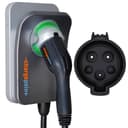
If you'd rather buy a charger once and be done, this is the safe call. You set the current in the app anywhere from 16 to 50 amps, so it fits whatever your panel can spare today and still has room to grow if you upgrade the circuit later. The app is the most polished of the bunch and the warranty is long.

Best overall: six current steps, 16 to 50 amps
$549.00 · View on Amazon

Price as of October 11, 2026. #ad How we’re funded

2
Leviton EV Series Smart Home Charger (EV40P)

Leviton EV Series Smart Home Charger (EV40P)

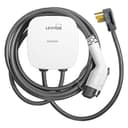
The one charger here from a brand your electrician already stocks. Forty amps, ENERGY STAR, a NEMA 3R shell, a 25-foot cable and a certification list longer than anything else in this registry — plus the My Leviton app, which is the same app that runs Leviton's load centers and switches. You pay a real premium for that, and what it buys is a company that will still be answering the phone in ten years.

Best if the 14-50 receptacle already exists
$499.85 · View on Amazon

Price as of October 11, 2026. #ad How we’re funded

3
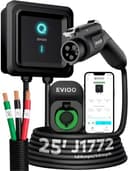
EVIQO 48A Level 2 Charger

EVIQO 48A Level 2 Charger

A lot of charger for the money. You get 48 amps, Wi-Fi scheduling, ENERGY STAR, and the longest usable reach in this group thanks to a 25 ft cable plus a 40-inch input lead. If Emporia is sold out or you want maximum cable, this is the value alternative to have in mind.

Best value if the brand name is not the point
$449.99 · View on Amazon

$510.0012% off

Price as of October 11, 2026. #ad How we’re funded

The picks in full

#1Best overall: six current steps, 16 to 50 amps

ChargePoint Home Flex

If you'd rather buy a charger once and be done, this is the safe call. You set the current in the app anywhere from 16 to 50 amps, so it fits whatever your panel can spare today and still has room to grow if you upgrade the circuit later. The app is the most polished of the bunch and the warranty is long.

Strengths

  • Adjustable 16-50A fits a modest circuit now and a bigger one later
  • The most complete app here: scheduling, reminders and usage history
  • 3-year warranty and a generous 23 ft cable

Trade-offs

  • You pay a brand premium over value 48A units
  • Using the full 50A needs a 70A circuit most older panels can't spare
Max output50 A
Power12 kW
ConnectorJ1772
InstallHardwired (a plug-in NEMA 14-50 SKU is also sold)
Cable length23 ft
Warranty3 years
WiFi + appYes
CertificationsUL/cUL listed, ENERGY STAR

Our charging-speed math. Run it at the full 50 amps (about 12 kW) and, at a middle-of-the-road 3.5 miles per kWh, it puts back roughly 42 miles of range an hour. Turn it down to 40A to live on a 50A circuit and you're at about 34.

Build note. The headline feature is app-adjustable amperage — anywhere from 16A up to 50A, in software.

Specs read from the manufacturer spec sheet, on July 19, 2026. “Not published” means the brand does not state that figure.

#2Best if the 14-50 receptacle already exists

Leviton EV Series Smart Home Charger (EV40P)

The one charger here from a brand your electrician already stocks. Forty amps, ENERGY STAR, a NEMA 3R shell, a 25-foot cable and a certification list longer than anything else in this registry — plus the My Leviton app, which is the same app that runs Leviton's load centers and switches. You pay a real premium for that, and what it buys is a company that will still be answering the phone in ten years.

Strengths

  • ENERGY STAR certified, with an unusually deep listing set (UL 2594, 2231, 2251, 62, 991, 1998, 840)
  • NEMA 3R enclosure and a cable rated to -30°C, so an outdoor install is in spec
  • 25 ft cable and a pre-attached NEMA 14-50 input lead — a genuinely quick install

Trade-offs

  • The most expensive 40-amp charger we cover, by a wide margin
  • Leviton does not publish an adjustable-amperage range for this model
  • 2-year warranty is shorter than ChargePoint's 3
Max output40 A
Power9.6 kW
ConnectorJ1772
InstallNEMA 14-50 plug (pre-attached 3 ft input cable)
Cable length25 ft
Warranty2 years
WiFi + appYes
CertificationsUL 2594, UL 2231-1, UL 2231-2, UL 2251, UL 62, UL 991, UL 1998, UL 840, CSA C22.2 #280, NFPA 70 Article 625, OCPP 1.6, ENERGY STAR

Our charging-speed math. Forty amps at 240V is 9.6 kW, and at a middle-of-the-road 3.5 miles per kWh that is roughly 34 miles of range an hour — about 340 miles across a ten-hour overnight window.

Build note. Leviton publishes 208/240 VAC, 40A, 9.6 kW, a 25 ft (7.6 m) J1772 cable, a NEMA Type 3R water-resistant enclosure, an operating range of -30°C to 50°C, altitude to 6,500 ft, Wi-Fi 802.11 b/g/n with the My Leviton app, optional RFID control, OCPP 1.6 compliance and a 2-year limited warranty.

Specs read from the manufacturer spec sheet, on August 19, 2026. “Not published” means the brand does not state that figure.

#3Best value if the brand name is not the point

EVIQO 48A Level 2 Charger

A lot of charger for the money. You get 48 amps, Wi-Fi scheduling, ENERGY STAR, and the longest usable reach in this group thanks to a 25 ft cable plus a 40-inch input lead. If Emporia is sold out or you want maximum cable, this is the value alternative to have in mind.

Strengths

  • 48A output with Wi-Fi scheduling at a value price
  • 25 ft charging cable plus a 40 in input lead — excellent reach
  • UL, ETL, FCC and ENERGY STAR listings

Trade-offs

  • The hardwired version needs a 60A circuit and an electrician
  • A smaller brand with a shorter track record than ChargePoint or Wallbox
Max output48 A
Power11.5 kW
ConnectorJ1772
InstallHardwired
Cable length25 ft
Warranty3 years
WiFi + appYes
CertificationsUL, ETL, FCC, ENERGY STAR

Our charging-speed math. At 48A (11.5 kW) and 3.5 mi/kWh, about 40 miles of range an hour.

Build note. Re-read from EVIQO's own page on 2026-10-04, which publishes more than the spec table above implies. The 25 ft charging cable plus a 40 in input cable is still among the longest total reach in class, and the current is adjustable two ways: 6-48 A in 1-amp increments from the app, and a hardware DIP switch that caps the maximum at 16, 32, 40 or 48 A. The same DIP block can raise the output to 50 A, which EVIQO says requires a 70 A circuit; the 48 A default needs a 60 A one. The enclosure is IP66 / NEMA-4 rated -22°F to 122°F, the warranty is 3 years and extendable to 4, and the app does remote start/stop, consumption and cost tracking, reminders, up to three schedules and over-the-air updates. No load management or load balancing is described anywhere on the page.

Specs read from the manufacturer spec sheet, on October 4, 2026. “Not published” means the brand does not state that figure.

The published specs, side by side

SpecLeviton EV40PChargePoint Home Flex
Maximum output40 A / 9.6 kW50 A / 12 kW
Adjustable currentNone published — specified as a fixed 40 A unit16, 24, 32, 40, 48, 50 A (set in the app)
InstallPlug-in: pre-attached 3 ft lead with a NEMA 14-50PHardwired on the listing we link (a 14-50 SKU is also sold)
Cable25 ft23 ft
EnclosureNEMA Type 3RNEMA 3R
Operating range−30 °C to 50 °CNot published on the datasheet
Warranty2 years3 years
CertificationUL 2594, 2231-1, 2231-2, 2251, 62, 991, 1998, 840; CSA C22.2 #280; OCPP 1.6; ENERGY STARUL/cUL listed, ENERGY STAR
Load managementNone publishedNone published for the residential Home Flex

The one spec that decides it

A 40-amp charger with no adjustable range can only be installed on a genuine 50-amp circuit. That is not a defect — it is a design decision, and for a great many houses it is the correct one. But it makes the EV40P a charger you buy after you know what is behind the receptacle, not before.

That matters because a NEMA 14-50 outlet is not a promise of a 50-amp breaker. Fourteen-fifties get re-used, re-wired and installed on 40-amp circuits, and in that case the continuous-load limit is 32 amps and a fixed-40 charger is simply the wrong product. The Home Flex drops to 32 A in the app and carries on. Our amp-setting guide covers how to read the real number off your own panel, and our 32-amp roundup is the list for a house where that number comes back as 40.

In the other direction, ChargePoint’s top two steps are the reason to pay the premium at all. If there is any chance you will hardwire onto a 60-amp circuit later, 48 A is there waiting; on a 70-amp circuit, 50 A is. Our 50-amp roundup explains what each of those circuits costs you, and it is a bigger jump than the two amps suggest.

Where Leviton wins

The install is genuinely shorter.Leviton ships the EV40P with a pre-attached 3-foot input lead terminating in a NEMA 14-50P. If the receptacle exists, the job is hanging the bracket and pushing the plug in — no conduit, no terminations, no electrician on the day. The ChargePoint listing our buy link resolves to is the hardwired build, so with that one you are booking a visit. ChargePoint does sell a plug-in 14-50 SKU; buy it deliberately rather than assuming the listing you land on is the right one.

A longer cable, and a published cold floor.Twenty-five feet against twenty-three is a modest edge, but a real one. More useful is that Leviton publishes an operating range of −30 °C to 50 °C where the Home Flex datasheet publishes a NEMA 3R enclosure and no temperature range at all. If the charger is going on a wall in a cold climate, that blank field is the thing to weigh — our outdoor roundup ranks on exactly this.

The certification list is in a different league.Leviton publishes UL 2594, 2231-1, 2231-2, 2251, 62, 991, 1998 and 840, plus CSA C22.2 #280, NFPA 70 Article 625 and OCPP 1.6. That depth is what a 100-year-old wiring-devices company sells, and OCPP 1.6 in particular means the charger can be spoken to by third-party back-end software rather than only by its maker’s app — which is a real hedge against the app being discontinued. Our guide to charger safety listings explains why we weigh a named listing so heavily.

It is the charger your electrician already stocks. Not a spec, but not nothing. Leviton panels, breakers and devices are in the van already.

Where ChargePoint wins

The range, which is the whole product. Six steps from 16 to 50 amps means one charger fits a 20-amp circuit in an apartment garage and a 70-amp circuit in a new build. Nothing else we cover publishes that span.

A year more warranty. Three years against two, on a device bolted to an outside wall for a decade.

The app is the mature one.Scheduling, reminders, usage history and a long record of firmware updates. Leviton’s My Leviton app is competent and has the advantage of also running Leviton’s load centers and switches, so if the house is already Leviton it is one app rather than two — but ChargePoint’s is the more complete charging app, and if time-of-use rates are the reason you are buying a smart charger, our time-of-use guide covers what you actually need it to do.

Two things neither of them does

Neither publishes home load management.This is worth saying plainly because both brands sell load management elsewhere. Leviton’s EV40P page states no load management, load shedding or circuit-sharing capability of any kind. ChargePoint’s own Power Management FAQ names only the CT4000 and CPF50 station families — both commercial — and does not mention the residential Home Flex anywhere. If an electrician has told you the panel has no spare capacity, neither of these chargers is the answer; our load-management roundup is.

Neither gives you clean access control.The EV40P’s description advertises “Optional RFID Control”, but the RFID card accessory on Leviton’s own page is specified for its EV320 and EV480 commercial stations and does not name the EV40P. Both of those statements are Leviton’s, we report both, and the resolution is to confirm against your own model number before buying cards. Leviton also publishes “Cover Locking Mechanism: Phillips Head Screws, No Padlock Option”. Our access-control roundup ranks the chargers that do this properly.

The verdict

If a 50-amp NEMA 14-50 is already on the wall, the Leviton is the better buy. The plug is attached, the cable is longer, the cold floor is published, the certification list is the deepest in our registry, and 40 amps is about 34 miles of range an hour — roughly 340 miles across a ten-hour night, which is more than almost any household puts back in a day. You are not giving up charging speed you will notice; you are giving up headroom you will probably never reach.

If the circuit is still a question, buy the ChargePoint Home Flex. Six current steps means the charger cannot be made wrong by whatever the electrician finds, or by a service upgrade three years from now. Add a year of warranty and the better app, and the premium is defensible. Just buy the SKU you mean — hardwired or 14-50 — because both exist and they are not interchangeable.

And if neither brand name is what you are paying for, buy the EVIQO 48A. It is less money than either, it is 48 amps rather than 40, it publishes 6 to 48 A from the app plus hardware DIP switches that cap the maximum, and it carries UL, ETL, FCC and ENERGY STAR listings with a 25 ft cable and a 40-inch input lead. What you give up is brand permanence — a shorter track record than either company here — and a hardwired-only install on a 60-amp circuit.
Frequently asked questions

Is the Leviton EV40P as fast as the ChargePoint Home Flex?

At the amperage most houses actually run, yes. The EV40P is 40 A / 9.6 kW, roughly 34 miles of range an hour at 3.5 mi/kWh. The Home Flex can go to 48 A (about 40 miles an hour) on a 60-amp circuit or 50 A (about 42) on a 70-amp one — but on the 50-amp circuit a 14-50 receptacle implies, both chargers run at exactly 40 amps and charge at exactly the same speed.

Can the Leviton EV40P be set to a lower amperage?

Leviton publishes no adjustable amperage range for this model and specifies it as a fixed 40-amp unit, so we treat it as one. That means it needs a genuine 50-amp circuit and cannot be fitted to anything smaller. If your circuit is a 40-amp one — which happens more often than people expect behind an existing 14-50 — this is the wrong charger and the Home Flex, which drops to 32 A, is the right one.

Which one is easier to install?

The Leviton, clearly, provided the receptacle exists. It ships with a pre-attached 3 ft input lead ending in a NEMA 14-50P, so the install is a bracket and a plug. The ChargePoint listing we link is the hardwired build, which needs an electrician. ChargePoint does sell a plug-in NEMA 14-50 version of the same charger; if that is what you want, buy that SKU deliberately.

Do both work with a Tesla?

Yes, through the J1772 adapter that comes with the car. Both chargers have a J1772 connector, which is the standard AC plug for every non-Tesla EV sold in North America, and every Tesla ships with a J1772 adapter. If you would rather have a native NACS connector with no adapter in the chain, our NACS roundup covers the wall units built that way.

Which has the longer warranty?

ChargePoint, at three years against Leviton's two. That is one of the clearer differences between them, and it matters on a device that lives on an exterior wall. Leviton's counterweight is the certification depth — UL 2594, 2231-1, 2231-2, 2251, 62, 991, 1998 and 840, plus CSA C22.2 #280 and OCPP 1.6 — which is the deepest listing set in our registry.

Does either charger have load management?

No, and both manufacturers' own pages say so by omission. Leviton's EV40P page states no load management, load shedding or circuit-sharing capability. ChargePoint's Power Management FAQ names only its CT4000 and CPF50 commercial station families and never mentions the residential Home Flex. If you need a charger that watches the house and backs off, neither of these is it.

Can I use a card or a PIN to stop other people charging?

Not reliably on either. Leviton's EV40P description advertises 'Optional RFID Control', but the RFID card accessory on Leviton's own page is specified for its EV320 and EV480 commercial stations and does not name the EV40P — so confirm against your model number before buying cards. Both chargers can be started and stopped from their app on your own account, which is a weaker control than a credential at the unit.

Is either one rated for an outdoor wall?

Both publish an outdoor-rated enclosure — NEMA Type 3R for the Leviton and NEMA 3R for the Home Flex — but only Leviton publishes an operating temperature range, at −30 °C to 50 °C. The ChargePoint datasheet does not state one. In a cold climate we would read that blank field as a reason to prefer the Leviton, or to look at a charger with a published range like the Autel MaxiCharger.

Sources

  • Leviton — EV40P Level 2 smart charger product page — Manufacturer page, fetched 2026-10-04: 40 A, 9.6 kW, a 25 ft (7.6 m) cable, a NEMA Type 3R enclosure, an operating range of -30 °C to 50 °C, UL 2594 / 2231-1 / 2231-2 / 2251 / 62 / 991 / 1998 and OCPP 1.6 compliance, and a 2-year limited warranty. Recorded for a negative finding as much as a positive one: the page states NO load management, load shedding, load balancing or circuit-sharing capability, and publishes no adjustable amperage range — it is specified as a fixed 40-amp unit (accessed October 4, 2026)
  • Leviton — EV40P product page (access-control and enclosure lines) — Manufacturer page, fetched 2026-10-11. The product description lists "Optional RFID Control" alongside "Wi-Fi Compatible (Wi-Fi Function 802.11 b/g/n)" and the My Leviton app, and the standards block lists OCPP 1.6 compliance. Under Product Features the page publishes "Cover Locking Mechanism : Phillips Head Screws, No Padlock Option" — the enclosure cannot be padlocked shut. The same page's related-products strip describes the ERFID accessory as an "Additional Access Control (RFID) Card for use with Leviton EV320 and EV480 Level 2 Electric Vehicle Charging Stations", naming the commercial stations and not the EV40P, which conflicts with the EV40P's own "Optional RFID Control" claim. Also re-confirmed on this date: 208/240 VAC, 40 A, 9.6 kW, a 25 ft J1772 cable, a pre-attached 3 ft input lead with a NEMA 14-50P plug, a NEMA Type 3R enclosure, status indicators for Power Present / Charging / Fault, UL 2594 / 2231-1 / 2231-2 / 2251 / 62 / 991 / 1998 / 840 plus CSA C22.2 #280 and NFPA 70 Article 625, and a 2-year limited warranty (accessed October 11, 2026)
  • ChargePoint — Home Flex datasheet — Manufacturer datasheet: output adjustable in the app to 16, 24, 32, 40, 48 or 50 A (up to 12 kW); the dedicated dual-pole breaker must be rated for 125% of the maximum load (its example: a 50 A breaker for 40 A output) (accessed September 18, 2026)
  • ChargePoint — Power Management FAQ — ChargePoint's own FAQ for its Power Management feature, which allocates a circuit's capacity across stations. Fetched 2026-10-04: it states that “currently, the CT4000 and CPF50 station families support Power Management with the appropriate cloud plan” — both commercial station families. The residential Home Flex is not named anywhere on the page, and no home hardware requirement, home power-sharing behavior or whole-house panel monitoring is described (accessed October 4, 2026)
  • EVIQO — Level 2 48 A hardwired charging station product page — Manufacturer page, fetched 2026-10-04: 48 A / 11.5 kW as standard with a 50 A output available by changing internal DIP switches (which it says requires a 70 A circuit), current adjustable 6-48 A in 1-amp increments from the app, and hardware DIP switches that set the maximum at 16, 32, 40 or 48 A. A 25 ft charging cable plus a 40 in input cable, an IP66 / NEMA-4 enclosure rated -22 °F to 122 °F, UL / ETL / FCC / ENERGY STAR certification, and a 3-year warranty extendable to 4. The app does remote start/stop, current setting, consumption and cost tracking, charging reminders, up to three custom schedules and over-the-air firmware updates. Hardwired only, and a 60 A dedicated circuit is stated for 48 A output. No load management or load balancing is described anywhere on the page (accessed October 4, 2026)
  • NFPA — Using the Latest NEC for EV Charger Installations — NFPA on NEC (NFPA 70) Article 625: EV charging is a continuous load, so circuits are sized to 125% of load (the 80% rule) (accessed July 19, 2026)
  • UL Solutions — EV Charging Infrastructure Services — UL on EVSE safety certification: ANSI/UL 2594 is the Standard for Electric Vehicle Supply Equipment (accessed July 19, 2026)
  • SAE International — J1772 Conductive Charge Coupler — The SAE J1772 connector standard for AC Level 1 and Level 2 charging in North America (accessed July 19, 2026)
  • FuelEconomy.gov — Electric Vehicles: Learn More About the Label — DOE/EPA on EV efficiency: kWh per 100 miles and MPGe, accounting for AC charging losses (accessed July 19, 2026)

Keep reading