The rule that decides it above 40 amps
Start here, because for a lot of buyers this ends the discussion. If your question is about the shape of the charger rather than the connection — a portable cord set against a wall box — see our portable versus wall-mounted comparison.
Under the National Electrical Code’s Article 625, EV charging is treated as a continuous load, so the branch circuit is sized to 125% of the charger’s continuous draw. A 40-amp charger therefore wants a 50-amp circuit. A 48-amp charger wants a 60-amp circuit.
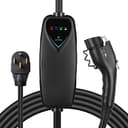
The NEMA 14-50 receptacle — the outlet every plug-in EV charger uses — is a 50-amp device. There is no common household receptacle for a 60-amp circuit. So a plug-in charger tops out at 40 amps of continuous draw, and every 48-amp and 50-amp charger on the market is hardwired.
Which means: if you want more than 40 amps, you are hardwiring. Not because hardwiring is better, but because there is nothing to plug into. Our 40A vs 48A comparisoncovers whether those extra eight amps are worth reorganizing your decision around — the honest answer is about six miles of range an hour.
The case for plug-in
It comes with you
This is the big one. A plug-in charger is your property in a way a hardwired unit is not. If you rent, it is close to the only sensible choice: you install an outlet with the landlord’s permission, and when you move you unplug the charger and take it. If you own but expect to move within a few years, the same logic applies with less urgency.
You can replace it yourself
Chargers fail. When a plug-in unit fails outside warranty, the replacement takes thirty seconds. When a hardwired one fails, it is an electrician visit and a wait. Over a ten-year ownership window that is a real difference in both cost and hassle.
The electrical work is more familiar
Installing a NEMA 14-50 receptacle on a dedicated 50-amp circuit is a job every residential electrician has done many times, often for a range or a workshop. It is not cheaper by any large margin, but it is well-trodden, and the outlet has value beyond EV charging — a welder, a kiln, an RV, a future charger of a different brand.
It travels
A plug-in charger works at any properly wired 14-50 outlet anywhere: a relative’s garage, a rental, a campground pedestal. That is the entire premise of our portable charger roundup, and it is a genuine capability rather than a consolation prize.
The case for hardwired
More amps
Covered above — 48 and 50-amp chargers exist only in hardwired form. If you need the speed, this is the route.
One fewer connection under continuous load
A plug and receptacle is a mechanical joint carrying its rated current for hours at a time, night after night, for years. A good receptacle handles that. The failure mode people actually encounter is a cheap receptacle, a loose termination or a worn contact heating up under sustained load — which is why electricians recommend a quality industrial-grade 14-50 receptacle for EV duty rather than the cheapest one on the shelf. Hardwiring removes the joint entirely.
Better weather sealing
A hardwired unit has a sealed conduit entry. A plug-in unit has a cord passing through a weatherproof-while-in-use cover, which is a code-compliant arrangement but is inherently more openings. On a genuinely exposed exterior wall, the sealed entry is an advantage — and it is why the outdoor specialists in our outdoor roundup tend to be hardwired.
It looks finished
A clean box on a wall rather than a box, a cord, an outlet and a cover plate. Minor, and people care.
Cost: closer than you would think
The instinct is that plug-in must be cheaper because it sounds simpler. In practice the two installs are not far apart, because most of the cost is the circuit rather than the termination.
An electrician runs a dedicated 240V circuit from your panel to the charger location either way. That is the wire, the breaker, the labor, the permit, and possibly the panel work — and it is the bulk of the bill. Whether the run ends in a receptacle or in a charger’s terminal block is a modest difference at the end of a much larger job.
Where the costs genuinely diverge is amperage. A 60-amp circuit for a hardwired 48-amp charger needs heavier conductors and takes more out of your service load calculation than a 50-amp circuit for a 40-amp plug-in charger. So the real cost question is not “plug or terminal” — it is “how many amps,” which our how many amps guide covers. Our installation guide covers published utility cost ranges for the job as a whole, and note that the federal 30C credit that used to offset part of it has expired.
Some chargers do both
A useful thing to know while shopping: several chargers are sold in both configurations, or ship configurable. The Emporia Level 2 and the ChargePoint Home Flex both come in hardwired and NEMA 14-50 versions, which lets you decide on install method without changing which charger you like.
The catch is the one from the top of the page: on the plug-in configuration, a 48-amp charger runs at 40 amps, because that is what a 50-amp receptacle allows. You are not getting 48 amps through a plug regardless of what the charger is capable of.
Others are one or the other by design. The Wallbox Pulsar Plus is hardwired only; the Grizzl-E Classic Connect and the Lectron 40Aare plug-in. Do not assume you can convert one to the other — check the specific model, because it is a design decision rather than an accessory.
If you have already decided the plug is what you want, our best plug-in chargers roundupranks that field on the specs that actually separate them once 40 amps is a given — whether the current adjusts and in how many steps, cable length, and whether a temperature range is published at all. It also covers which receptacle to have fitted, since a NEMA 14-50 or a 6-50 charges at exactly the same rate.
The safety points worth stating
Never use an extension cord with either.A Level 2 charger draws its rated current continuously for hours; a household extension cord is not built for that duty and each extra joint is a place to overheat. If the cable does not reach, move the charger or extend the circuit — our cable reach guide covers measuring the run properly.
Buy a good receptacle if you go plug-in. This is where the plug-in route earns its reputation for trouble, and it is entirely avoidable. Ask for an industrial-grade 14-50 receptacle rated for continuous duty rather than the cheapest available one.
Both need permits and inspection in most jurisdictions. A dedicated 240V circuit is permitted work almost everywhere, whichever way it terminates. Getting it inspected also matters for your insurance.
Check the plug by hand occasionally. On a plug-in install, a receptacle that feels warm after an hour of charging is telling you something. Our troubleshooting guide covers what to check and in what order.
The tiebreaker nobody plans for: moving
One consequence of this choice only shows up years later. A plug-in charger is an appliance — it comes off the wall in twenty minutes with no electrician, and it works at the next house the moment a matching receptacle exists there. A hardwired charger is generally treated as a fixture, which means it stays with the house unless the sale contract says otherwise, and taking it means paying an electrician at both ends plus properly terminating the circuit you leave behind. Our guide to moving house with an EV charger covers what to do in each case. If a move is anywhere on your horizon, it is a real argument for the plug.
The verdict, by buyer
Go plug-inif you rent, if you expect to move, if 40 amps is enough for your driving — which for most single-car households it is — or if you value being able to replace the charger yourself. The outlet also has independent value and outlives any particular charger.
Go hardwired if you want more than 40 amps, if the charger will live somewhere genuinely weather-exposed, or if you own the house and simply want the permanent, tidier, one-fewer-connection install. Our hardwired roundup covers the units worth doing that job for.
Hedge by buying a charger sold in both configurations. Then the install method follows what your electrician finds in the panel, rather than forcing you to change chargers when the load calculation comes back.