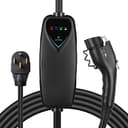
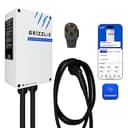
The one that decides it: does the charger get wet?
Grizzl-E publishes a UL Type 4 indoor/outdoor rating on a metal case, plus an operating range of −30°C to +50°C — −22°F to 122°F. Lectron does not publish an outdoor or IP enclosure rating for the 40A at all.
We want to be precise about what that means, because it is easy to overstate in either direction. It does not mean the Lectron fails outdoors. It means the brand has not committed to a figure, so we cannot tell you it is rated for permanent outdoor mounting — and we will not guess. We treat an unpublished spec as a finding rather than an assumption: what a brand withholds is information too.
The practical reading:
- Closed garage, or a wall with a real roof over it? The missing rating costs you nothing. Buy on price.
- Open driveway, carport with no walls, or a climate with real winters? Buy the rating. The Grizzl-E’s published temperature floor is the specification that speaks to January, and it is rarer on a spec sheet than an enclosure rating.
Our cold-weather guide explains why an enclosure rating and a temperature rating are different qualifications, and our outdoor roundup ranks the whole field on both.
Cable: 16 feet against 25
This is the difference people underestimate and then regret. Nine feet is a lot of cable in a garage.
Sixteen feet works if the charger mounts close to where the car parks and the charge port is on the near side. It stops working the moment the port is on the far side of the car, the run has to go around an obstacle, or you sometimes park nose-in and sometimes back in. Twenty-five feet covers essentially any single-bay geometry and most two-bay ones.
The thing not to do is close the gap with an extension cord. An EV charger draws its rated current continuously for hours; household extension cords are not rated for that duty and every extra plug-and-socket joint is somewhere heat can build. If reach is genuinely your constraint, buy the reach — our long-cable roundup covers the field.
Software: none against Wi-Fi
The Lectron 40A has no Wi-Fi, no account and no scheduling of its own — you schedule from the car. The Grizzl-E Classic Connect joins a 2.4 GHz network and pairs with the Grizzl-E Connect app for statistics, schedules, remote control and utility demand/response programs. It can also be dialed from 40 amps down to 16 in software, which matters if your panel cannot support a full 50-amp circuit.
Our honest position on charger apps: the genuinely valuable function is scheduling around a cheaper overnight rate, and every modern EV already does that from the car, for free, with a schedule that travels with the vehicle rather than the parking spot. So for most single-car households the app is not the reason to spend more. The two cases where it is: enrolling in a utility demand-response program, and needing to run the charger below 40 amps because of a panel constraint. Our smart charger roundup covers which features earn their keep, and our Wi-Fi setup guide covers the fact that a garage is one of the worst places in a house for 2.4 GHz.
One historical note worth knowing if you are reading older reviews elsewhere: the Grizzl-E Classicfamously had no app at all, and was recommended for that. Amazon no longer sells it — Grizzl-E replaced it with the Connect model covered here, which added Wi-Fi. If a no-software charger is specifically what you want, the Lectron is now the pick on this page that provides it.
Warranty and certification
Warranty. Lectron publishes two years; Grizzl-E publishes three as standard and sells a five-year extension separately. A year of coverage on a device with a ten-year service life is a real if modest part of the price gap.
Certification. Both clear the bar that matters. Lectron is ETL listed to UL 2594 and UL 2231; Grizzl-E is UL/cUL listed under file E510712. Those are equivalent third-party safety qualifications against the EV supply equipment standard. This is the point we make repeatedly and it is worth repeating here, because this matchup demonstrates it: price is not the safety signal — the mark is. A budget charger with a real ETL listing has been tested by an independent lab exactly as the expensive one has. Our guide on whether cheap EV chargers are safe covers how to read the marks and which claimed listings mean nothing.
ENERGY STAR.Neither publishes one. Lectron does not publish an ENERGY STAR listing for the 40A, and Grizzl-E publishes UL/cUL but no ENERGY STAR figure for the Classic Connect — the discontinued Classic carried one under a different model number, and certifications do not carry over. If a utility rebate is part of your budget, that is a genuine constraint on both of these; see our ENERGY STAR roundup for the picks that do qualify.
Portability, which cuts the other way
The Lectron wins one thing outright: it is built and sized to be carried. Compact body, shorter cable, nothing bolted to a bracket — it lives in a trunk between trips. The Grizzl-E is a plug-in unit too, so it can move, but it is a heavier wall-oriented box that you would relocate when you move house rather than throw in the car for a weekend.
If you want one charger that travels to relatives, holiday rentals or an RV pad, that is a real point for the Lectron. Our portable roundup ranks on portability specifically, and our RV park guide covers the travel case.
The verdict, by buyer
Buy the Lectron 40A if the charger lives under a roof, the outlet is reasonably close to the charge port, and you are happy to schedule charging from the car. That is a large fraction of households, and in that situation you are paying more for the Grizzl-E to get specifications you will never exercise. It is also the pick if you want a charger that travels, or if you specifically want no software in the loop.
Buy the Grizzl-E Classic Connect if the charger is going somewhere exposed, if you need more than 16 feet of cable, if you want to enroll in a utility demand-response program, or if you need to run below 40 amps because of a panel constraint. Any one of those justifies the gap on its own; two or more make it obvious.
Buy neitherif you have decided to hardwire. Both of these are plug-in chargers capped at 40 amps by the 14-50 receptacle, and if you are running a new circuit anyway, 48 amps is available for a modest step up — see our 48-amp roundup and 40A vs 48A comparison for whether the extra six miles an hour is worth the 60-amp circuit it requires.