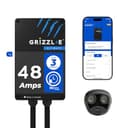
Why 48 amps, and why not more
A home charger cannot push power into a car faster than the car’s own onboard charger will take it. On the IONIQ 5 that limit is 10.9 kW, per Hyundai’s own figure above. Divide by 240 volts and you get about 45 amps.
Chargers are not sold in 45-amp sizes, so the practical question is which standard size sits closest to the car’s appetite:
- A 48-amp charger (11.5 kW)is the first standard size above the car’s ceiling. The car takes what it wants and ignores the rest. This is the right answer.
- A 40-amp charger (9.6 kW)is about 12% below the ceiling. Not a disaster — see the arithmetic below — but you are leaving something on the table.
- A 50-amp charger (12 kW) delivers exactly the same charge rate to this car as a 48-amp one, because the car is the bottleneck in both cases. It also asks for a 70-amp circuit instead of a 60-amp one. For an IONIQ 5 that is pure cost.
How much does the 40-amp compromise actually cost you? Using EPA’s own efficiency figure for the 2026 RWD — 30 kWh per 100 miles, which is 3.33 miles per kWh measured at the wall — the car at its full 10.9 kW puts back roughly 36 miles of range an hour. A 40-amp charger held to 9.6 kW gives roughly 32 miles an hour. That is a difference of about four miles per hour, or around 40 miles across a ten-hour overnight charge. That arithmetic is ours, from EPA’s published figures, and we are showing it so you can re-run it rather than take our word for it.
If 40 miles overnight is irrelevant to you — and for most commutes it is — a 40-amp charger on the 50-amp circuit you may already have is a perfectly rational buy, and it is the cheaper install by a wide margin. Our 40-amp roundup covers that side, and 40A vs 48A is the full version of this trade-off.
What EPA publishes, by model year
Hyundai gives one figure for the current car. The federal government gives a figure for every trim of every model year, which is useful if yours is not new: FuelEconomy.gov publishes a 240-volt charge time and a kWh-per-100-mile consumption figure for each one. Those two numbers together are the only government-published measure of how fast an IONIQ 5 drinks AC power at home.
The right-hand column is ourarithmetic, not EPA’s and not Hyundai’s: EPA’s consumption figure times its range, divided by its charge time, which gives the average power drawn at the wall across a full charge. It is a derived average rather than a peak, and because EPA’s consumption figure is measured at the wall it includes charging losses.
| Model year & trim | EPA 240V charge time | EPA kWh/100 mi | EPA range | Derived average power at the wall |
|---|
| 2026 Standard range | 6.3 hr | 29.0 | 245 mi | ~11.3 kW |
| 2026 RWD | 9.1 hr | 30.0 | 318 mi | ~10.5 kW |
| 2026 AWD (19 in) | 8.2 hr | 31.7 | 290 mi | ~11.2 kW |
| 2026 AWD (20 in) | 8.2 hr | 34.5 | 269 mi | ~11.3 kW |
| 2026 AWD XRT | 8.2 hr | 35.8 | 259 mi | ~11.3 kW |
| 2026 N | 8.7 hr | 43.0 | 221 mi | ~10.9 kW |
| 2024 Standard range RWD | 6.3 hr | 31.0 | 220 mi | ~10.8 kW |
| 2024 Long range RWD | 8.5 hr | 30.0 | 303 mi | ~10.7 kW |
| 2024 Long range AWD | 8.5 hr | 34.0 | 260 mi | ~10.4 kW |
The 2025 records carry the same charge times and consumption figures as the 2026 ones for every trim they share, and the 2022 records match the 2024 ones, so we have not repeated those rows. What matters is the pattern in the last column: across four model years and nine trims, every IONIQ 5 lands between about 10.4 and 11.3 kWat the wall. That brackets Hyundai’s published 10.9 kW from both sides, which is the useful result — two independent sources agreeing that a 48-amp charger is the ceiling worth buying and a bigger one is not.
One more thing the table shows: the 10-to-100% figure Hyundai quotes (7 hours 20 minutes) is shorter than EPA’s full-charge time for the same car, because Hyundai is charging 90% of the pack and EPA is measuring a complete charge including the losses in the charger and the cable. Neither is wrong. If you want the general version of this, our guide to onboard charger limits explains how to find the figure for any car, and how long charging takes at home works through the math from the other direction.
The connector: look at your own car before you buy anything
This is where IONIQ 5 owners lose money, so it is worth slowing down. On Hyundai’s own US page, the current IONIQ 5 “comes with a Tesla Supercharger-compatible NACS port…Plus, it comes with a CCS adapter for other networks like Electrify America and ChargePoint”, and the spec line reads “NACS charging port with included NACS-to-CCS adapter”.
Earlier IONIQ 5s were built with the CCS1 inlet instead — the tall two-part port whose upper round half isthe J1772 AC connector. Because Hyundai’s own page speaks only for the current car, the honest instruction is the simple one: go look at your charge port. If it is a single small oval socket, it is NACS. If it is a round socket with a second two-pin section below it, it is CCS1, and its AC half is J1772.
That one observation picks your charger:
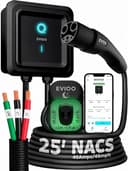
- NACS port→ buy a charger with a NACS cable (picks 1, 2 and 5 here), or keep a J1772-to-NACS adapter on a J1772 charger (pick 4).
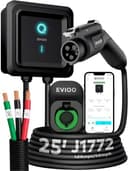
- CCS1 / J1772 port→ buy a J1772 charger (pick 3), which is also the larger and cheaper half of the market.
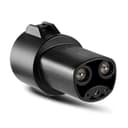
Note that the adapter included with a new IONIQ 5 runs the wrong wayfor home charging — it is a NACS-to-CCS adapter for DC fast charging on other networks, not something that lets a J1772 wall charger reach a NACS port. For that you need the small AC adapter in pick 4. Our J1772 vs NACS explainer covers the whole transition, and the J1772-to-NACS adapter review covers that specific part.
Hardwired or plug-in, and the circuit behind it
Every 48-amp charger is hardwired, because 48 amps continuous needs a 60-amp circuit and there is no household receptacle rated to carry it. A plug-in charger on a NEMA 14-50 outlet is capped at 40 amps, since code limits a continuous load to 80% of the receptacle’s rating. That is the real fork in the road:
- New electrical work anyway? Hardwire a 48-amp unit on a 60-amp circuit and match the car exactly.
- Already have a 14-50 outlet? A 40-amp plug-in charger costs you about four miles of range an hour on this car and saves you an electrician.
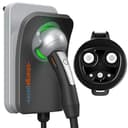
- Panel already full? Buy the adjustable charger (pick 2) and set it to what the panel can give, or read our load-management roundup before anyone quotes you a service upgrade.
For the numbers behind the circuit, our breaker-size table gives the minimum breaker for every output from 12 to 50 amps, and Level 2 electrical requirements runs through the whole list an electrician will work from. If you are deciding between the two install types in the abstract, hardwired vs plug-in is the dedicated page.
What we did not rank, and why
Hyundai’s own branded charger. Hyundai promotes home charging through dealer and installer programs rather than selling a wall unit we can price on Amazon, and every buy link on this site resolves to a retailer we can show a live price for. If that changes we will add it.
Any charger above 48 amps, on the merits.The Autel MaxiCharger and the ChargePoint Home Flex both go to 50 amps and both are chargers we recommend elsewhere — see our 50-amp roundup — but on a car with a 10.9-kW ceiling the extra two amps deliver nothing while the 70-amp circuit they need to reach them costs real money. The ChargePoint appears here in its NACS version for its adjustability, not its top end.
Portable chargers. A 32-amp or 40-amp portable is a travel and backup tool, not a nightly solution for a car this size. If you want one for the trunk as well, our portable charger roundup is the page, and the road-trip portable roundup ranks on the adjustable current that matters at an outlet you did not install.
Any claim about how this car behaves in the cold. We own no IONIQ 5 and have run no winter test, so we have published no cold-weather charge figures for it. EPA publishes the general effect, and our cold-weather charging guide covers what is actually known.
The verdict
For most IONIQ 5 owners doing new electrical work: the EVIQO NACS 48A. It matches the car’s 10.9-kW appetite with 48 amps, plugs in natively so no adapter lives on the car, carries a 25 ft cable and an IP66 / NEMA 4 enclosure, and is ENERGY STAR certified, which several utility rebate programs require. It is hardwired on a 60-amp circuit, which is the price of 48 amps from anyone.
If the panel is the problem: the ChargePoint Home Flex NACS. Six published current settings from 16 to 50 amps mean it fits the circuit you can actually get today and can be turned up later if you upgrade. You pay a brand premium for that, and for the best app in the category.
If your IONIQ 5 has the CCS1 inlet: the EVIQO 48A in its J1772 version. Identical argument, standard connector, and generally the cheaper half of the market.
And if you already own a perfectly good J1772 charger and just bought a NACS car: buy the adapter. An 80-amp UL 2252 certified, IP67 AC adapter costs a fraction of a new charger and solves the entire problem. Leaving it permanently fitted is slightly more to catch on and one more connection in the chain — that is the honest trade — but replacing a working charger over a connector shape is not a good use of money.