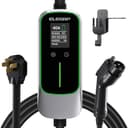
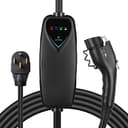
The decisive spec: what a fixed 40 amps costs you
A charger fixed at 40 amps can only be used on a circuit that supports 40 amps continuous — which, because NEC Article 625 treats EV charging as a continuous load, means a 50-amp circuit and nothing smaller. That sounds like a technicality until it decides your whole project.
At home, it decides whether you can install at all.If your panel cannot spare a 50-amp circuit today, a fixed-40 charger leaves you two options: a service upgrade, or a different charger. An adjustable charger gives you a third and much cheaper one — install on a smaller circuit, set the charger to match, and turn it up later if the electrical situation changes. Our panel capacity guide covers the calculation and our load management guide covers the alternatives to an upgrade.
On a 30-amp outlet, it rules the charger out entirely. A 14-30 or 10-30 receptacle supports 24 amps continuous. With an adjustable charger you fit a plug adapter, set 24 amps, and charge safely. With a fixed-40 charger there is no safe configuration, and an adapter does not create one. Our outlet types guide has the full receptacle table.
Away from home, it removes your safety margin.A 14-50 outlet at a holiday rental or a friend’s garage may be on wiring installed for an occasional welder cycle rather than for 40 amps for six hours straight. Being able to drop to 24 or 16 amps is how you charge conservatively when you cannot verify what is behind the wall. Our road-trip guide makes this the central spec for travel, and our RV park guide covers the pedestal case.
In short: the two chargers charge identically in the one situation where both work, and the ELEGRP works in several situations where the Lectron cannot be used at all.
Nine feet of cable
Twenty-five feet against sixteen. This is the difference people underestimate at purchase and regret afterwards.
The reach you need is from the unit to where the charge port sits when the car is parked — not to the bumper — plus slack so the cable hangs rather than stretches. Cars put the port in different places, garages put the outlet in the wrong corner, and reversing in is not always an option. Nine feet frequently decides whether the cable reaches at all.
It matters more than usual here because there is no acceptable workaround. An extension cord is the fix people reach for and it is the one that genuinely does not work, for reasons our guide sets out in detail. Measure the real route before you choose; our long-cable roundup covers the wider field if reach is your binding constraint.
Sealing, and reading an unpublished rating
ELEGRP publishes IP67 — dust-tight and rated for temporary immersion — along with a temperature range of −21°F to 121°F, and ships a carrying case. Lectron publishes no enclosure rating for the 40A, which our spec table records as “Not published”.
We want to be careful about what that means. Unpublished is not the same as unsealed; it means the manufacturer has not committed to a testable claim, so neither can we. The practical reading is that the Lectron is a fine charger for a sheltered garage and the weaker choice for an exposed wall, a carport or a boot — and that the ELEGRP has told you something specific you could hold it to. Our spec sheet guide covers why a blank field is itself information.
The warranty terms are the same — both publish two years — so this is not a case of one brand standing behind its product and the other not.
Where the Lectron holds its own
It is a genuinely decent charger and we are not going to pretend otherwise.
It is ETL listed to UL 2594 and UL 2231, which is the same third-party safety bar the ELEGRP meets and the only certification question that really matters at this price point — our guide on whether cheap chargers are safe explains why. It publishes a two-year warranty. It delivers the full 40 amps with no asterisk. And Lectron is a brand with a wide, well-supported range across adapters and Level 1 chargers, which counts for something if you are buying several things at once.
The one scenario where we would actively choose it: you already have a correctly-installed 50-amp circuit, the outlet is in the right place so 16 feet reaches comfortably, the charger will live in a dry garage, and on the day you are buying the Lectron is meaningfully cheaper. In that specific case you are paying less for capability you would not use. Prices move, so check both.
The verdict
Buy the ELEGRP unless the Lectron is clearly cheaper and every one of the conditions above holds. Five current levels, nine more feet of cable, a published IP67 rating with a temperature range, and a carrying case, at the same tier of the market and the same warranty term. The adjustable range alone makes it usable on circuits and at outlets the Lectron cannot serve, and that is capability rather than specification. Our full ELEGRP review has the detail.
Buy neitherif you want the charger to report what your charging actually cost at the wall — neither has an app, and the Emporia Level 2 is the sensible step up. Our smart versus basic comparison is the page to read if you are unsure whether you want that, and our 40-amp roundup puts both of these against the rest of the tier.