Tiebreaker one: plug-in or hardwired
If the EVIQO is on your shortlist against a premium brand rather than against Emporia, our EVIQO 48A versus ChargePoint Home Flex comparison is the other matchup worth reading — same charger, a different opponent, and a tiebreaker about where the current limit is enforced rather than about cable reach.
This is the biggest practical difference, and it is not on most spec sheets in a way that jumps out.
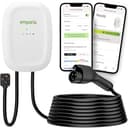
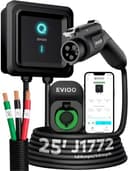
The Emporia Level 2 is sold both hardwired and as a plug-in unit on a NEMA 14-50. The EVIQO 48A is hardwired.
Three things follow from that. If you rent, or might move, the Emporia is the only one of the two that unplugs and comes with you — a hardwired charger is terminated into the building’s circuit and effectively becomes the property’s. If you already have a 14-50 outlet near the car, the Emporia works today with no electrician at all, while the EVIQO needs a circuit run and terminated. And if the unit ever fails outside warranty, swapping a plug-in charger takes thirty seconds; swapping a hardwired one is an electrician’s visit.
The catch, and it is important: on a 14-50 plug the Emporia is capped at 40 amps, not 48. A NEMA 14-50 receptacle is a 50-amp device and the NEC’s continuous-load rule limits it to 40 amps of continuous draw. You only get the full 48 by hardwiring — at which point you are choosing between these two on other grounds anyway. Our hardwired vs plug-in comparison covers the trade properly, and our 40A vs 48A comparison covers whether that eight-amp difference is worth anything to you (short answer: about six miles of range an hour).
Tiebreaker two: total reach
Both publish 25-foot charging cables, which is the top of this class. But EVIQO also publishes a 40-inch input lead on the supply side, and that is a genuinely different specification that people overlook.
The charging cable determines how far the connector reaches from the charger. The input lead determines how far the chargercan sit from where the circuit terminates. Together they decide whether you can mount the unit where it is convenient rather than where the conduit happens to arrive. In a garage where the panel is on one wall and the parking spot is at the far end, that extra three-and-a-bit feet of positioning freedom is worth more than it sounds — and it means the installer does not have to move the circuit to make the geometry work.
If neither cable is long enough, neither of these is your charger and you should read our long-cable roundup. And the thing not to do is bridge the gap with an extension cord: an EV charger draws its rated current continuously for hours, which generic cords are not built for.
Enclosure: close, with an edge to EVIQO on paper
EVIQO publishes IP66 alongside NEMA 4. Emporia publishes NEMA 4. Both are genuine outdoor-capable ratings — Type 4 covers windblown dust and hose-directed water, and IP66 specifically means dust-tight and protected against powerful water jets.
In practical terms that difference is small, and neither is the charger we would pick for a genuinely brutal install. Neither brand publishes an operating temperature range, which is the specification that actually speaks to a hard freeze — an enclosure rating tells you about water, not about January. If your charger is going on an exposed wall in a real winter, that gap is the reason we point at the Autel MaxiCharger(NEMA 4X, published to around −40°F) or the Grizzl-E Classic Connect(UL Type 4, published to −22°F) instead. Our outdoor roundup ranks on exactly this and our cold-weather guide explains why the two ratings are not interchangeable.
The app, and the one real feature difference
Both are Wi-Fi connected with scheduling. Emporia’s differentiator is energy tracking that is actually a measurementrather than an on/off toggle — it reports what the charger drew, at the wall, over time. That is the one smart feature we think is worth paying for, because it is the only thing the car genuinely cannot tell you: your vehicle estimates energy added to the battery, which excludes charging losses, so the two numbers never match and only one of them is what your utility bills you for.
The counterweight is honest: the other genuinely valuable app function is scheduling around a cheap overnight rate, and every modern EV can already do that from the car, for free, with a schedule that travels with the vehicle rather than the parking spot. So if you do not care about measured consumption, the app difference here is close to noise. Our smart charger roundup covers which features earn their keep.
Emporia is also the larger operation of the two, with a broader product line — including the Emporia Pro, whose PowerSmart load management is the answer if an electrician tells you the panel has no spare capacity. That matters if you think you might want an ecosystem later rather than a single box.
Where they are genuinely tied
Speed.Both 48 amps, about 11.5 kW, roughly 40 miles of range per hour. Identical. Both need a 60-amp circuit to deliver it, under the NEC’s continuous-load rule — which is the cost that dominates either purchase, and which our panel capacity guide and installation cost guide cover.
Certification and rebates.Both are UL-family listed against the ANSI/UL 2594 EV supply equipment standard, and both publish ENERGY STAR listings — which matters because many utility rebate programs require ENERGY STAR by model number. Either one keeps that door open; see our ENERGY STAR roundup.
Warranty. Three years each.
The verdict, by buyer
Buy the Emporia Level 2if you want the option to plug in — because you rent, because you might move, because a 14-50 already exists near the car, or because you would rather be able to swap the unit yourself if it dies. Buy it also if measured energy consumption at the wall is something you will genuinely use. It is our overall value pick across the site for these reasons.
Buy the EVIQO 48A if you are hardwiring anyway and the geometry of your garage is awkward. The 25-foot cable plus 40-inch input lead is the longest total run we cover, and it buys the installer freedom to put the unit where it makes sense. The IP66 rating is a small bonus if the wall sees some weather.
Buy neitherif your panel cannot spare 60 amps. At that point 48 amps is not available to you at all, and the honest move is a 40-amp charger on a 50-amp circuit — you lose about six miles of range an hour and quite possibly avoid a service upgrade. Our main roundup covers the options, and our 48-amp roundup covers the rest of this tier.