Tiebreaker one: where the current limit lives
Both chargers let you set a maximum. Only one of them lets you set it in a way that cannot be undone from a phone.
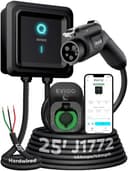
ChargePoint’s datasheet describes the output as adjustable in the app— 16, 24, 32, 40, 48 or 50 amps — and that is the whole mechanism. EVIQO does it twice over: the app sets the current anywhere from 6 to 48 amps in single-amp steps, and a block of DIP switches inside the unit independently caps the maximum at 16, 32, 40 or 48 amps. A software setting can never exceed the hardware cap.
For a lot of buyers that is a distinction without a difference: you set the number once and never touch it again either way. For some it is the deciding factor. If the install was permitted on a 32-amp circuit, a hardware cap is how you guarantee it stays a 32-amp install after a firmware update, a factory reset, a new phone or a new occupant. If you are a landlord, an Airbnb host or anyone handing a charger to someone else, that is the version you want — our host roundup ranks on related thinking. And if a teenager with your app password shares the garage, the same logic applies.
One honest caveat about EVIQO’s range: the low end of 6 amps is not as useful as it looks. Six amps at 240 volts is about 1.4 kW, which is Level 1 territory with extra steps. The genuinely useful part of the range is the band between 16 and 40, which is exactly where ChargePoint lives too. EVIQO’s advantage is granularity and the hardware switch, not the floor.
Tiebreaker two: can you unplug it?
This is the practical difference most people should weigh hardest, and it is not about performance at all.
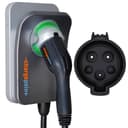
The EVIQO 48A unit we link here is hardwired only, with a 40-inch input cable, and EVIQO states a 60-amp dedicated circuit for 48-amp output. The ChargePoint Home Flex is sold both hardwired and as a plug-in NEMA 14-50 SKU. A plug-in charger comes off the wall when you move, swaps out in ten minutes if it fails, and does not need an electrician to replace — which is why it is the answer for renters and for anyone who expects to leave the house inside the next few years. Our hardwired versus plug-in comparison argues that trade properly, and our renter picks take it as the starting point.
Hardwiring is not a penalty, though. It is the more permanent, tidier install, and above 40 amps it is the only option on most units — a NEMA 14-50 receptacle caps you at 40 amps continuous whatever the charger is rated for. If you are running 48 amps, you are hardwiring either way, and at that point the ChargePoint’s plug-in SKU stops being an advantage. Our outlet types guide covers why the receptacle sets that ceiling.
Tiebreaker three: the money, and what the app is worth
The EVIQO is the cheaper charger, and by enough that it is not a rounding error — check the live prices in the table above rather than taking a number from prose, because both move. What the gap buys you, in ChargePoint’s favor, is software and institutional permanence.
ChargePoint’s app is the most mature in the category and it is attached to a public charging network, so one account covers the charger in your garage and the station at the mall. The company has been doing this since before most of its rivals existed, which matters for a device whose scheduling depends on a cloud service continuing to run. EVIQO’s app does the things that matter — remote start and stop, current setting, consumption and cost tracking, charging reminders, up to three custom schedules, over-the-air firmware updates — and EVIQO is a far smaller company with a shorter record. That is a real risk with a smart charger and a negligible one with a dumb one.
Which is the moment to say the obvious thing: if the app is the reason you are paying the premium, check whether you will use it. Every current EV schedules its own charging from the car, that setting follows the car to any charger, and it does not depend on anyone’s cloud. Our smart versus basic comparisonargues this at length, and the honest conclusion there is that wall-side energy measurement is the one app feature worth real money — and both of these chargers have it.
Where the EVIQO quietly wins on paper
Two specs, and neither is the headline either brand leads with.
Reach. EVIQO publishes a 25-foot charging cable plus a 40-inch input lead, against ChargePoint’s 23 feet. Two feet sounds trivial until the charger is on the wrong wall of the garage; cable length is the spec buyers regret most, and our long-cable roundup exists because of how often it comes up. The 40-inch input lead also buys you some freedom in where the hardwire junction goes.
Enclosure, and a published temperature range. EVIQO publishes IP66 / NEMA 4 with an operating range of -22°F to 122°F. ChargePoint publishes NEMA 3R. NEMA 4 is the tougher rating — sealed against water jets rather than falling rain — and more importantly EVIQO publishes the temperature range while ChargePoint’s datasheet does not give one we can cite. For a charger that will live on an exposed wall through a real winter, that is the spec that decides it, not the headline amperage. Our outdoor and cold-weather roundup ranks the whole field on exactly that, and our cold weather guide explains why an enclosure class and a temperature rating are different claims.
Warranty is close to a tie: three years each, with EVIQO stating its term is extendable to four.
The 50-amp question, and why it is mostly noise
ChargePoint’s nominal advantage is 50 amps against 48, and EVIQO answers it with a DIP-switch mode that also reaches 50. Both answers run into the same wall, which is the NEC rather than either charger.
EV charging is a continuous load, so the circuit is sized at 125% of the draw. Fifty amps continuous therefore wants a circuit rated above 60 amps — EVIQO states 70 amps for its 50-amp mode, and ChargePoint’s own datasheet makes the same point in general terms when it says the breaker must be rated for 125% of the maximum load. Forty-eight amps, by contrast, fits a standard 60-amp circuit exactly. That is why 48 amps is the real ceiling for home charging and 50 is a spec-sheet number for most houses. Our fastest home charger guide works through that arithmetic, and our 40A versus 48A comparison covers the step below it.
In range terms the difference is academic anyway. Forty-eight amps at 240 volts is about 11.5 kW, roughly 40 miles of range an hour at our 3.5 mi/kWh reference. Fifty amps is about 12 kW, roughly 42. Across a ten-hour night that is twenty miles you will not notice, and on plenty of cars it is zero, because the car’s own onboard charger is the limit rather than the wall — see our onboard charger limits guide before paying for either ceiling.
One thing neither of them does
Neither charger has dynamic load management, and it is worth being clear about that because ChargePoint’s brand suggests otherwise. ChargePoint does sell a Power Management feature that allocates a circuit’s capacity across stations, but its own FAQ names the CT4000 and CPF50 station familiesas the ones that support it — both commercial — and the Home Flex is not listed on that page. EVIQO describes no load management at all. What both offer instead is the fixed-limit approach discussed above, which is enough for most tight panels and costs nothing extra. If you need a charger that watches the rest of the house and backs off, our load management roundup covers the three that genuinely do it and what each one costs in extra hardware.
The verdict
Buy the EVIQO for a hardwired install you intend to keep. It is the cheaper charger, it has the longer reach, it publishes the tougher enclosure rating and an actual temperature range, and its hardware DIP switch is the better answer if the current limit needs to be permanent rather than a setting. For a garage you own, on a wall that sees weather, at 48 amps, it is the more charger for the money. Our full EVIQO 48A review goes through it spec by spec.
Buy the ChargePoint if you want the plug-in option, the best app in the category, or a company you are confident will still be running a cloud service in a decade. Those are not small things, and the plug-in SKU in particular is the right answer for anyone renting, moving soon, or unwilling to call an electrician to replace a failed unit. Our Home Flex review has the detail, and Emporia vs ChargePoint and Wallbox vs ChargePoint set it against the other two obvious alternatives.
And if your panel is the problem rather than the charger, neither of these is where to start. Get the load calculation first — our panel capacity guidewalks it — then come back knowing which number you need to dial these chargers down to. Both of them can hit it. That is the whole reason they are in this matchup.