Plug & Range

Portable vs Wall-Mounted EV Charger

Plug both into the same NEMA 14-50 outlet and they charge at the same 40 amps. The differences are in the box around the electronics, the warranty behind it, and whether it ever needs to leave the garage.

By Stephen V.Last updated How we pick

A “portable” Level 2 charger is a cord set: a plug, a control box that hangs in the middle of the cable, and a connector for the car. A “wall-mounted” charger puts the same electronics in a box that bolts to the wall, usually with a holster for the connector and a hook for the cable. Both are EV supply equipment, both carry the same safety standards, and on the same outlet both are limited to the same current. A NEMA 14-50 receptacle allows 40 amps of continuous charging whichever shape of charger is plugged into it.

So speed is not the decision. What separates them is where it lives (a wall box is built to stay put, often outdoors; a portable is built to be coiled into a trunk), what it can connect to (only a wall unit can be hardwired, which is the only route to 48 amps), and what you get for the money— warranty length, an app, cable management. We ranked the picks on those three, and chose one of each type plus a portable that is designed to do both jobs.

As on every page here, the specs come from each manufacturer’s own sheet and the charging-speed arithmetic is ours; we have not bench-tested these chargers.

How this is funded:we earn a commission if you buy through our links, at no extra cost to you. It never changes which product we recommend, and we’ll tell you when we’d skip one. Full disclosure.

Quick picks

Ranked on published specs, charging speed, electrical fit and value. Select a row to jump to the full write-up. We have not bench-tested these chargers — here is exactly what we do instead.

#ProductBest forPrice
1
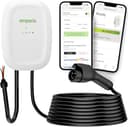
Emporia Level 2 EV Charger

Emporia Level 2 EV Charger

The value pick that never feels like one. You get the full 48 amps, an ENERGY STAR listing, real Wi-Fi energy tracking and a 25 ft cable for well under what the marquee brands charge. When someone asks us where to start, this is usually the first name out of our mouths.

Best wall-mounted
$449.00 · View on Amazon

Price as of September 18, 2026. #ad How we’re funded

2
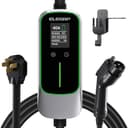
ELEGRP 40A Portable Level 2 Charger (ECP24-40A0-01)

ELEGRP 40A Portable Level 2 Charger (ECP24-40A0-01)

The cheapest charger in this registry that still publishes everything you would want to check: 9.6 kW, five current levels from 16 to 40 amps, an IP67 body with a stated -21°F floor, ETL certification and a 2-year warranty. There is no Wi-Fi and no app — you get a 1-to-12-hour delay timer on the unit instead — and for a lot of households that is the correct amount of charger.

Best portable
$209.99 · View on Amazon

Price as of September 18, 2026. #ad How we’re funded

3
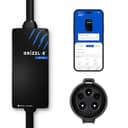
Grizzl-E Mini 40A Portable Charger (J1772)

Grizzl-E Mini 40A Portable Charger (J1772)

The only charger on our dryer-outlet page that can grow past one. It is a UL-certified 40-amp portable on a NEMA 14-50 plug, and United Chargers puts a NEMA 14-30P adapter in the box alongside 6-50P, TT-30P and 5-15P adapters — so it runs at 24 amps on your dryer outlet today and at 40 the day an electrician fits a 14-50. The catch is the one that matters most here: it ships set to 40 amps, United Chargers' current Mini manual says outright that the charger cannot detect a circuit's amperage limit, and turning it down before the first session is your job.

Best portable that also wall-mounts
$479.99 · View on Amazon

Price as of September 18, 2026. #ad How we’re funded

4
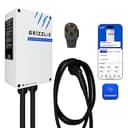
Grizzl-E Classic Connect

Grizzl-E Classic Connect

Grizzl-E retired the old no-app Classic and replaced it with this, and it kept the part that mattered: a metal case rated UL Type 4 for a spot with no shelter, published to keep operating down to -22F. What changed is that the electronics caught up — Wi-Fi, an app, and current you can dial from 40A down to 16A to fit a circuit you already have. It's the rugged pick that no longer asks you to give up scheduling to get it.

Best wall unit for an exposed spot
$349.99 · View on Amazon

Price as of September 18, 2026. #ad How we’re funded

The picks in full

#1Best wall-mounted

Emporia Level 2 EV Charger

The value pick that never feels like one. You get the full 48 amps, an ENERGY STAR listing, real Wi-Fi energy tracking and a 25 ft cable for well under what the marquee brands charge. When someone asks us where to start, this is usually the first name out of our mouths.

Strengths

  • 48A and ENERGY STAR at a genuinely value price
  • The app tracks energy use, not just an on/off toggle
  • Long 25 ft cable and a remote holster in the box

Trade-offs

  • 48A hardwired needs a 60A circuit; on a NEMA 14-50 plug it's capped at 40A
  • The app is less polished than ChargePoint's, and support is a smaller operation
Max output48 A
Power11.5 kW
ConnectorJ1772
InstallHardwired or NEMA 14-50 plug
Cable length25 ft
Warranty3 years
WiFi + appYes
CertificationsUL listed, ENERGY STAR

Our charging-speed math. Hardwired at 48A (11.5 kW), figure about 40 miles of range an hour at 3.5 mi/kWh. Drop to a 40A plug-in circuit and it's closer to 34.

Build note. Runs 48A hardwired, or 40A on a NEMA 14-50 outlet, with a 25 ft cable and a wall holster included.

Specs read from the manufacturer spec sheet, on July 19, 2026. “Not published” means the brand does not state that figure.

#2Best portable

ELEGRP 40A Portable Level 2 Charger (ECP24-40A0-01)

The cheapest charger in this registry that still publishes everything you would want to check: 9.6 kW, five current levels from 16 to 40 amps, an IP67 body with a stated -21°F floor, ETL certification and a 2-year warranty. There is no Wi-Fi and no app — you get a 1-to-12-hour delay timer on the unit instead — and for a lot of households that is the correct amount of charger.

Strengths

  • Five current levels (16/20/24/32/40A) — it fits whatever circuit you have
  • IP67 with a published -21°F to 121°F range, and a carrying case in the box
  • 2-year warranty and full ETL certification at the bottom of the price band

Trade-offs

  • No Wi-Fi, no app and no energy monitoring — just an on-unit delay timer
  • Not ENERGY STAR listed, so it may not qualify for some utility rebates
  • 40 amps is the plug-in ceiling; a 48-amp unit needs hardwiring
Max output40 A
Power9.6 kW
ConnectorJ1772
InstallNEMA 14-50 plug
Cable length25 ft
Warranty2 years
WiFi + appNo
CertificationsETL certified

Our charging-speed math. Forty amps at 240V is 9.6 kW, and at 3.5 miles per kWh that is roughly 34 miles of range an hour. ELEGRP's own figure is 37 miles an hour, which assumes a slightly more efficient car than our reference.

Build note. ELEGRP publishes 240V, up to 9.6 kW, five selectable current levels of 16, 20, 24, 32 and 40 amps, a NEMA 14-50 plug, a 25 ft cable measured plug-end to connector, a J1772 connector, ETL certification with its PBE overheat protection, an IP67 rating with a -21°F to 121°F range, a 1-12 hour delayed start, a carrying case and a 2-year warranty.

Specs read from the manufacturer spec sheet, on August 19, 2026. “Not published” means the brand does not state that figure.

#3Best portable that also wall-mounts

Grizzl-E Mini 40A Portable Charger (J1772)

The only charger on our dryer-outlet page that can grow past one. It is a UL-certified 40-amp portable on a NEMA 14-50 plug, and United Chargers puts a NEMA 14-30P adapter in the box alongside 6-50P, TT-30P and 5-15P adapters — so it runs at 24 amps on your dryer outlet today and at 40 the day an electrician fits a 14-50. The catch is the one that matters most here: it ships set to 40 amps, United Chargers' current Mini manual says outright that the charger cannot detect a circuit's amperage limit, and turning it down before the first session is your job.

Strengths

  • Three-year warranty and a UL certification from an established North American brand
  • The NEMA 14-30P adapter comes in the box from the manufacturer, not as a third-party add-on
  • A DIP switch inside can cap it at 24 amps in hardware, and no Wi-Fi setting can exceed that cap
  • Runs at a full 40 amps on a NEMA 14-50 if the outlet is upgraded later

Trade-offs

  • Ships set to 40 amps and cannot detect the circuit — on a 14-30 it must be turned down before first use
  • Setting the hardware cap means unplugging it and removing the front cover to reach the switch
  • By a wide margin the most expensive pick, for capacity a dryer outlet will never let you use
  • The adapter adds a plug-and-socket joint that a native 14-30 cord does not have
  • The Amazon J1772 listing describes browser-based Wi-Fi settings, not the Grizzl-E Connect app the newer Mini Connect uses
Max output40 A
Power9.6 kW
ConnectorJ1772
InstallNEMA 14-50 plug, with 14-30P, 6-50P, TT-30P and 5-15P adapters included
Cable length24 ft
Warranty3 years
WiFi + appYes
CertificationsUL certified (United Chargers UL file E510712)

Our charging-speed math. On a NEMA 14-30 dryer outlet it must run at 24 amps: 24A at 240V is 5.76 kW, which at our 3.5 miles-per-kWh reference is roughly 20 miles of range an hour, or about 200 miles across a ten-hour overnight window. On a NEMA 14-50 at its full 40 amps (9.6 kW), it is roughly 34 miles an hour.

Build note. United Chargers publishes a 40A / 9.6 kW maximum on a 50A circuit with the output adjustable down to 7A at 240V (and 7-12A at 120V, which the charger detects automatically), a NEMA 14-50 input plug on an 18-inch lead, four NEMA 14-50R adapters in the box (5-15P, TT-30P, 14-30P and 6-50P), a UL Type 4 indoor/outdoor rating, a -22°F to 122°F operating range, a 6.9 x 3.1 x 2.4 in body weighing 9.8 lb, built-in GFCI, UL file E510712 and a 3-year warranty. Two lines decide how it belongs on a dryer outlet: both Mini manuals give the factory default maximum as 40A, and the current Mini Connect manual adds that the charger "can not detect the circuit amperage limit" (the automatic detection both manuals describe is of 120V versus 240V, not of the circuit's amperage). The limit can be lowered on the Wi-Fi settings page, or capped in hardware with a four-position DIP switch at 40, 32, 24 or 16A; the Wi-Fi setting can never exceed the DIP switch. On cable length, grizzl-e.com lists 25 ft for the current Mini Connect, while this Amazon J1772 listing and United Chargers' original Mini manual both say 24 ft, so we record the lower figure.

Specs read from the manufacturer spec sheet, on September 15, 2026. “Not published” means the brand does not state that figure.

#4Best wall unit for an exposed spot

Grizzl-E Classic Connect

Grizzl-E retired the old no-app Classic and replaced it with this, and it kept the part that mattered: a metal case rated UL Type 4 for a spot with no shelter, published to keep operating down to -22F. What changed is that the electronics caught up — Wi-Fi, an app, and current you can dial from 40A down to 16A to fit a circuit you already have. It's the rugged pick that no longer asks you to give up scheduling to get it.

Strengths

  • Metal case rated UL Type 4 indoor/outdoor, published from -22F to 122F
  • Current adjusts from 40A down to 16A, so it fits the circuit you already have
  • 25 ft cable — among the longest here — on a simple plug-in NEMA 14-50 install

Trade-offs

  • 40A caps its charging speed below the 48A units
  • Scheduling now runs through Wi-Fi and an account — the old Classic's nothing-to-update simplicity is gone
  • Grizzl-E publishes UL/cUL only for this model, not the ENERGY STAR listing the discontinued Classic carried
Max output40 A
Power9.6 kW
ConnectorJ1772
InstallNEMA 14-50 plug
Cable length25 ft
Warranty3 years
WiFi + appYes
CertificationsUL/cUL listed (file E510712)

Our charging-speed math. At 40A (9.6 kW) and 3.5 mi/kWh it adds roughly 34 miles of range an hour — more than enough to refill a daily commute overnight. Dial it down to 16A and you're at about 13.

Build note. A metal case rated UL Type 4 indoor/outdoor and published for -30C to +50C (-22F to 122F), with 2.4 GHz Wi-Fi and current adjustable from 40A down to 16A.

Specs read from the manufacturer spec sheet, on August 11, 2026. “Not published” means the brand does not state that figure.

Portable vs wall-mounted at a glance

Portable (ELEGRP 40A)Wall-mounted (Emporia)
Max on a NEMA 14-5040 A40 A
Hardwired optionNoYes — 48 A on a 60 A circuit
EnclosureIP67 control boxNEMA 4
Cable25 ft25 ft
AppNone (delay timer on the unit)Wi-Fi app with energy tracking
Warranty2 years3 years
ENERGY STARNot listedCertified

Those two columns are the two chargers the manufacturers publish; they are not a rule for every portable or every wall unit, but they show the pattern: at the same current, the wall unit usually buys a longer warranty, an app and a hardwired option, and the portable buys a lower price and the ability to travel.

Choose a portable if…

You rent, or expect to move. A portable charger leaves with you and leaves nothing on the wall but the receptacle. Our apartment and renter picks build on exactly that.

You charge away from home.A cabin, a relative’s house, a campground pedestal — a portable goes where a 240-volt outlet is. If that is the main use, choose one with adjustable current so it can be turned down to fit an outlet you did not install; our road-trip charger roundup ranks on exactly that.

Budget matters more than an app.The ELEGRP is ETL certified, IP67 rated and publishes five current steps, at the bottom of our price range, with no Wi-Fi to set up. For many households the car’s own scheduling is all the smart charging they need.

Choose a wall-mounted charger if…

You want 48 amps. A plug-in charger is capped at 40 by the receptacle; only a hardwired install on a 60-amp circuit gets you 48. Our hardwired versus plug-in comparison covers what that costs.

It will live outside, permanently.A wall unit with a sealed enclosure, a holster and a hook keeps the connector out of puddles and the cable off the driveway. The Grizzl-E Classic Connect’s metal case is rated UL Type 4 and published down to -22°F. A portable’s control box left hanging from an outdoor outlet is a different arrangement, and an outdoor receptacle may need a weatherproof in-use cover — a question for your electrician.

You want the numbers.Energy tracking in an app is what turns “charging is cheap” into an actual monthly figure. Our energy monitoring guide explains why that figure differs from what the car reports.

The one that does both

The Grizzl-E Mini is a portable 40-amp charger that ships with a mounting bracket and a holster, so it can live on the garage wall and still come off for a trip. United Chargers also puts four plug adapters in the box, including one for a four-prong NEMA 14-30 dryer outlet. That flexibility has a catch that matters: it ships set to 40 amps, and United Chargers’ current Mini manual states that the charger cannot detect a circuit’s amperage limit, so on any outlet smaller than a 14-50 it must be turned down before use. Our dryer outlet roundup explains how.

One rule applies to every shape of charger: never bridge the gap to the car with a household extension cord. EV charging is hours of continuous current, and our extension cord guide explains why the joints fail before the wire does.
Frequently asked questions

Is a portable EV charger as fast as a wall charger?

On the same outlet, yes. A NEMA 14-50 receptacle allows 40 amps of continuous charging — about 9.6 kW, or roughly 34 miles of range an hour at our 3.5 miles-per-kWh reference — whether the charger plugged into it is portable or wall-mounted. Only a hardwired wall unit on a 60-amp circuit can reach 48 amps.

Can I leave a portable EV charger plugged in all the time?

Yes, many owners do, and a portable charger used as the everyday home charger is a normal arrangement. Mount or support the control box so it is not hanging by its cable, keep the connector off the ground, and if the outlet is outdoors ask your electrician whether it needs a weatherproof in-use cover.

Do wall-mounted EV chargers need to be hardwired?

No. Many wall-mounted chargers, including the Emporia and Grizzl-E Classic Connect here, are sold with a NEMA 14-50 plug, and the Emporia also comes in a hardwired version. Hardwiring is only required if you want more than 40 amps.

Which is better for renters, a portable or wall-mounted charger?

A plug-in charger of either shape — the key is that it plugs in rather than being hardwired, so it leaves with you. A portable has the edge if you also want to use it away from home.

Are portable EV chargers safe?

A portable charger with a listing from a recognized lab — UL, ETL or CSA against UL 2594 — is tested to the same standard as a wall unit. The ELEGRP here is ETL certified and the Grizzl-E Mini is UL certified. What makes any charger unsafe is an undersized or worn outlet, an adapter used without turning the current down, or an extension cord.

Sources

Keep reading