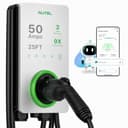
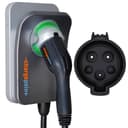
Enclosure and cold: the Autel’s case
Autel publishes a NEMA 4X enclosure. ChargePoint publishes NEMA 3R. Those are two meaningfully different commitments.
NEMA 3R covers falling rain, sleet and external ice formation — the assumption is a wall that gets weather but not a beating. Type 4 adds windblown dust and hose-directed water. The X in 4X adds corrosion resistance, which is the specification you want near salted winter roads or coastal air. That is a real distinction rather than a marketing letter: road salt spray is what actually kills hardware mounted low on a driveway wall.
The figure we would shop on, though, is temperature, because an enclosure rating tells you about water and dust and says nothing about January. Autel publishes an operating floor of around −40°F. Very few home chargers publish a low-temperature figure at all, and it is a separate qualification from the enclosure rating. Cold is its own engineering problem — plastics get brittle, seals shrink, and electronics that behave at 40°F can behave differently at −20°F. A brand that publishes a number has committed to it. Our cold-weather guide covers this distinction in depth, and our outdoor roundup ranks the whole field on it.
If your charger lives inside a closed garage, ignore this entire section. Neither rating will ever be tested, and paying for 4X is paying for a specification that will spend a decade doing nothing.
Adjustable amperage: the ChargePoint’s case
The Home Flex’s headline feature is that its output is set in software, anywhere from 16 to 50 amps. That sounds like a convenience and is actually a financial hedge, because of how EV circuits are sized.
NEC Article 625 treats EV charging as a continuous load, so the circuit is rated to 125% of the draw. Fifty amps needs a 60-amp circuit. Forty amps needs 50. Thirty-two amps needs 40. If an electrician tells you the panel can spare 40 amps and not 60, a fixed 50-amp charger is simply the wrong purchase — whereas the Home Flex gets installed at 32 amps today and turned up in software if you ever upgrade the service.
That matters most when you are buying before anyone has run a load calculation, which is the order most people actually do it in. Our panel capacity guide walks the calculation, and our how many amps guideturns the answer into a shortlist. The Autel is not inflexible in the same way — but the Home Flex’s range is the widest and best-documented on the market, and that is the specific thing you are buying.
Where they are effectively tied
Speed.Both reach 50 amps, about 12 kW, roughly 42 miles of range per hour at our reference efficiency. Over a ten-hour overnight window, about 420 miles. Neither will ever be your constraint. Note the standard caveat: if your car’s onboard AC charger is rated below 12 kW, both units will deliver the same lower figure, because the charger is the ceiling and never the floor.
The 60-amp circuit. Getting the full 50 amps out of either one requires a 60-amp circuit, which is the install many older panels cannot take. This is the cost that dominates both purchases, and our installation cost guide covers what drives the quote. Our 40A vs 48A comparison makes the case that most households should be shopping a tier below both of these.
Certification.Both carry third-party safety certification against the EV supply equipment standard — ChargePoint UL/cUL listed, Autel CSA certified, which sits on the same footing in North America — and both publish ENERGY STAR listings. That last point matters for rebates, since a number of utility programs require ENERGY STAR by model number; see our ENERGY STAR roundup and rebates guide.
Install type.Both are hardwired in their headline configuration. ChargePoint also sells a plug-in NEMA 14-50 SKU, which caps at 40 amps like anything on a 14-50 — useful if you rent or might move. Our hardwired vs plug-in comparison covers what that changes.
Cable. Autel publishes 25 feet, ChargePoint 23. Two feet decides nothing; if reach is genuinely your problem, our long-cable roundup has better answers than either.
If neither of these is quite the charger you want, the Autel’s other obvious rival is worth a look: our Autel vs Emporia Pro comparison sets the same weatherproof enclosure and card reader against panel-aware load management and whole-house energy data, which is a genuinely different question from the one this page answers.
The app, honestly
Both connect over Wi-Fi and both have competent apps. ChargePoint’s is the more mature product with the longer track record, and it is integrated with ChargePoint’s public charging network, which is genuinely convenient if you use public charging regularly — one account, one app, home and away. Autel adds Bluetooth alongside Wi-Fi, which makes initial pairing and local control more reliable in a detached garage where Wi-Fi is weak. If that describes your garage, it is not a trivial advantage; our Wi-Fi setup guide covers why.
The honest framing on apps generally: the one genuinely valuable function is scheduling around a cheaper overnight rate, and every modern EV can already do that from the car, for free, with a schedule that travels with the vehicle. Energy measured at the wall rather than estimated by the car is real but narrower. Our smart charger roundup covers which features actually earn their keep.
If ChargePoint is not really in the running and you are weighing Autel against the other premium brand in this category, our Autel vs Wallbox Pulsar Plus comparison settles that one — and it turns on a finding rather than a feature: what Wallbox has stopped publishing about its own enclosure and warranty.
The verdict, by buyer
Buy the Autel MaxiCharger if the charger is going on an exterior wall with no shelter, in a climate with real winters or near salted roads or the coast. The NEMA 4X body plus a published low-temperature figure is a combination almost nothing else at this amperage offers, and Bluetooth is a practical bonus in a detached garage.
Buy the ChargePoint Home Flexif your electrical situation is not settled, or you suspect the panel is tight. Adjustable 16-to-50-amp output means you install for the circuit you have and turn it up later, which is the single best hedge available. Also buy it if you use ChargePoint’s public network and want one app, or if you need the plug-in SKU because you might move.
Buy neitherif you are inside a closed garage on a normal panel and simply want a good charger for less money. Both of these are premium units justified by specific constraints — absent those constraints, the Emporia Level 2 or EVIQO 48A give you 48 amps and an ENERGY STAR listing for less, and the difference in charging speed is about two miles an hour. Our main roundup covers the full field.