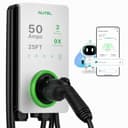
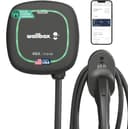
Side by side, from the makers’ own pages
| Spec | Autel MaxiCharger AC Elite Home | Wallbox Pulsar Plus |
|---|
| Output | 50 A / 12 kW, adjustable 16–50 A | 48 A / 11.5 kW (40 A and 48 A variants sold) |
| Circuit required | 70 A for full output (60 A at 48 A) | 60 A dedicated at 48 A |
| Install | Hardwired | Hardwired |
| Connector | J1772 | J1772 |
| Cable | 25 ft | 25 ft |
| Enclosure | IP65 / NEMA 4X | Not published on the maker’s page as of Oct 4, 2026 |
| Temperature range | −40°F to 131°F | Not published |
| Load management | Charger-to-charger DLB with no extra hardware; whole-home ALM requires unnamed additional hardware | Dynamic load management requires a Wallbox Power Meter |
| Solar charging | Not published as a feature | Yes, requires the Power Meter; not compatible with multi-charger installs or OCPP |
| Access control | App, AutoStart and RFID cards (cards sold separately) | App |
| Connectivity | Bluetooth, Wi-Fi, Ethernet, CAN, RS485 | Wi-Fi and Bluetooth |
| Warranty | 3 years | Not published as of Oct 4, 2026 (3 years on our earlier read) |
| Range added per hour (3.5 mi/kWh) | about 42 miles at 50 A | about 40 miles at 48 A |
The amperage difference is smaller than it looks
Autel’s 50 amps against Wallbox’s 48 is two amps, which is 480 watts, which at our 3.5 miles-per-kWh reference is about 1.7 miles of range an hour. That is not a reason to choose anything.
What is a reason is the circuit behind each number. EV charging is a continuous load, so the breaker is sized at 125% of output. Forty-eight amps lands on a 60-amp circuit. Fifty amps lands on 62.5, which rounds up to a 70-ampbreaker — and Autel states that 70-amp requirement plainly on its own product page, which we count in its favor rather than against it. If your panel can only give 60 amps, the Autel simply runs at 48 like the Wallbox does and nothing is lost; it is adjustable from 16 amps up. Our 50-amp roundup works through why 50 amps is worth having as a setting and rarely worth building a house around, and our breaker-size guide has the full amperage-to-breaker table.
The accessory tax, on both sides
This is the most useful thing on the page, because both brands have a version of it and almost nobody notices until after the install.
Wallbox.Two of the Pulsar Plus’s headline energy features — solar charging and dynamic load management — require a separately sold Wallbox Power Meter. Wallbox describes the load management itself clearly (“maximize charging speed while staying within your home’s power limit. When overall energy consumption is high, charging speed drops”), and that is genuinely the feature that can turn a “you need a service upgrade” quote into a charger purchase. It is just not in the box. Wallbox also states that solar charging is not compatible with multiple-charger installations or with OCPP, which is worth knowing before you plan a two-car garage around it.
Autel.Autel splits load management in two and is specific about which half is free. Charger-to-charger Dynamic Load Balancing — two Autel chargers sharing one circuit — “works between chargers without additional hardware.” Whole-home Adaptive Load Management “requires compatible additional hardware,” and Autel does not name the hardware on that page. So: do not buy the Autel expecting whole-house load management to work out of the box, and do buy it if the plan is two Autels on one circuit for two cars. Our load-management roundup compares every approach in our registry, and best chargers for two EVs covers the two-car case directly.
Weather, which is where this stops being close
Autel publishes IP65 / NEMA 4X and −40°F to 131°F. That is a specific, testable commitment at both ends, and 4X adds corrosion resistance — which matters within reach of road salt or coastal air.
Wallbox, on the page we read on October 4, 2026, published no enclosure rating and no temperature range. Our registry records NEMA 4 from an earlier read and we continue to show it with its date, because deleting a sourced figure would be worse than carrying a dated one. But if the charger is going on an exposed wall, there is only one of these two whose manufacturer has told you where its limits are. Our outdoor and cold-weather roundup ranks that constraint properly, and the Autel is near the top of it for exactly this reason.
Where Wallbox still wins
Three honest points in its favor. It is the brand with the clearest solar story in our registry — Wallbox will let the charger run on 100% solar or a blend of solar and grid, and it documents that, while Autel’s page does not list solar charging as a feature at all. It is sold in both a 40-amp and a 48-amp variant, so there is a cheaper entry point on a 50-amp circuit. And it is a genuinely small unit for a 48-amp charger, which is why it sits in our “compact smart” slot on the homepage — relevant if the wall space is in a tight garage corner rather than an open bay. Our solar charging roundup is the page to read if that first point is the deciding one.
The verdict
Buy the Autel MaxiCharger. It is cheaper on the date on this page, it goes to 50 amps and down to 16, and it is the only one of the two whose maker currently publishes an enclosure rating, a temperature range and a warranty term. Add the RFID-card option if other people can reach the charger, skip it otherwise, and do not buy it for whole-home load management unless Autel can name the hardware that enables it.
Buy the Wallbox Pulsar Plus if the plan involves solar.That is the one thing it documents and the Autel does not. Budget for the Power Meter at the same time — without it, solar charging and load management are both features you have paid for and cannot use.
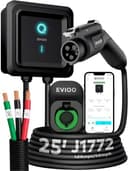
And if neither argument is yours, the EVIQO 48A does the core job for less. Forty-eight amps, IP66 / NEMA 4, −22°F to 122°F, a 1-amp app slider with a hardware cap behind it, ENERGY STAR for the rebate paperwork, three years extendable to four, and no accessory required to make any of it work. Our EVIQO vs Grizzl-E comparison is the next page if that is where you have landed.