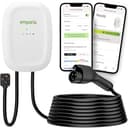
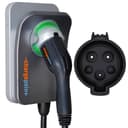
Charging speed: effectively a tie
ChargePoint publishes 50 amps at the top of its adjustable range; Emporia publishes 48. In power terms that is about 12 kW against about 11.5 kW, and at our standard reference of roughly 3.5 miles of range per kWh it works out to about 42 miles of range per hour against about 40.
Two miles an hour is inside the noise of how efficiently your particular car drives on a particular day. Across a ten-hour overnight window it is twenty miles of range, on a charge that has already delivered four hundred. Treat this as a tie and decide on something else.
There is a catch worth naming on the ChargePoint side: reaching 50 amps requires a 60-amp circuit under the National Electrical Code’s 125% continuous-load rule, and so does Emporia’s 48. If your panel cannot spare 60 amps, both chargers land at 40 amps in practice — and then the comparison is entirely about the other differences.
The one feature that actually separates them: adjustable amperage
This is the real difference, and it is worth more than the spec sheet makes it look. The Home Flex sets its output in software anywhere from 16 amps up to 50. The Emporia is a 48-amp charger that runs at 48 amps hardwired, or 40 amps on a NEMA 14-50 plug.
Why adjustability matters: you are buying a charger against a circuit you may not have yet. If the electrician comes back and says your panel can spare 40 amps but not 60, the ChargePoint is set to 32 or 40 and everything is fine; you can raise it later if you upgrade the service or move. The Emporia in the same situation is a 48-amp charger permanently running below its rating — not broken, but you paid for headroom you cannot use, and you have no way to see or control what it is doing.
The reverse case matters too. If your panel is comfortably large and you already know your circuit, adjustability is a feature you will set once and never touch, and paying for it is paying for optionality you have no use for. Our how many amps guide is the fastest way to find out which of those two people you are, and it is genuinely the thing to settle before you compare anything else.
The apps
Both are real apps rather than remote on/off switches, which already puts them ahead of the no-app chargers in this category.
ChargePointhas the most mature software in home charging: scheduling, reminders, session history, and — the part that is hard to replicate — a company large enough and old enough that the app is very likely to still be maintained in five years. It also connects to ChargePoint’s public network, which is convenient if you use it.
Emporiatracks energy use rather than just charging status, and integrates with Emporia’s wider home energy monitoring platform. If you already run Emporia energy monitoring, or you want a genuine view of what charging is adding to your electricity bill, that integration is worth real money to you. The app is less polished than ChargePoint’s and Emporia is a smaller operation with smaller support behind it.
The honest framing: if you want the app you are least likely to have to think about, take ChargePoint. If you want the app that tells you the most about your electricity, take Emporia. If you plan to schedule from the car and ignore both apps — which is what many owners actually do — this section does not decide anything and you should buy on price.
Hardware: cable, enclosure and install
Cable.Emporia publishes 25 feet, ChargePoint 23. Two feet sounds trivial and occasionally is not — it can be the difference between parking nose-in and having to reverse every night if your charge port is on the far side. Our guide to measuring cable reach covers how to work out whether it matters for your garage.
Enclosure.Emporia publishes NEMA 4; ChargePoint publishes NEMA 3R. NEMA 4 is the tougher rating — it adds windblown dust and hose-directed water to the rain, sleet and ice that 3R covers. If the charger lives inside a garage, neither rating will ever be tested and this does not matter. If it lives on an exposed exterior wall, Emporia has the edge, and if the wall is genuinely hostile, neither is the right answer — our outdoor roundup covers the NEMA 4X options.
Install.Both are sold in hardwired and plug-in forms, which is unusual and useful — most 48A-class chargers are hardwired only. Note that on a NEMA 14-50 plug, Emporia caps at 40 amps, because the receptacle is a 50-amp device and the continuous-load rule takes 20% off. Our hardwired vs plug-in comparison covers that decision.
Certification and warranty. Both are UL listed against the ANSI/UL 2594 EV supply equipment standard and both are ENERGY STAR certified for standby efficiency. Both carry three-year warranties. There is no meaningful safety or support-term gap between them.
What the price gap actually buys
Strip it down and the ChargePoint premium buys three things: adjustable amperage, a more mature app, and the confidence of a larger company. It does not buy charging speed, a better enclosure, or a longer cable — Emporia wins or ties on all three.
That is a genuinely reasonable set of things to pay for, and it is also a set of things a lot of buyers do not need. Which is why our answer here is not “the expensive one is better” or “the cheap one is a bargain,” but a question about your panel.
The verdict, by buyer
Buy the Emporia if you know what circuit you are getting, your panel can take it, and you would rather spend the difference on the installation or a longer cable run. It is the better value, it has the tougher enclosure and the longer cable, and its app does the one thing an app should do. It is our value pick on the Level 2 roundup for those reasons.
Buy the ChargePoint Home Flexif your circuit is uncertain, your panel is tight, or you expect to move or upgrade — adjustable amperage is the hedge, and it is the single best reason to pay the premium. Also buy it if app longevity genuinely matters to you, which is a fair thing to care about on a device you are bolting to a wall for a decade.
Buy neither if your panel is full: a charger with dynamic load management, like the Emporia Pro, may save you a service upgrade that costs more than both of these chargers put together. And if you drive a Tesla, settle the connector question first — our Tesla charger guide covers whether to go native NACS or use a J1772 charger with an adapter.