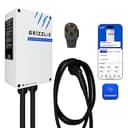
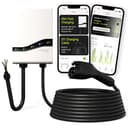
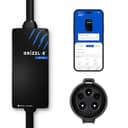
The published specs, side by side
| | Grizzl-E Classic Connect | Emporia Pro |
|---|
| Max output | 40 A / 10 kW (Grizzl-E’s figure) | 48 A / 11.5 kW |
|---|
| Published adjustable range | 40 A – 16 A | Not published |
|---|
| Install | NEMA 14-50 plug | Hardwired (a NEMA 14-50 SKU is also sold) |
|---|
| Circuit needed | 50 A | 60 A at 48 A |
|---|
| Cable | 25 ft | 25 ft |
|---|
| Enclosure | UL Type 4, cast case | NEMA 4 |
|---|
| Operating range | −22 to 122 °F | Not published |
|---|
| App | Grizzl-E Connect, 2.4 GHz Wi-Fi | Emporia app, with Invite2Charge multi-user |
|---|
| Load management | Not published | PowerSmart (needs the Emporia Vue monitor) |
|---|
| Solar surplus charging | Not published | Yes, with the Vue monitor |
|---|
| Certification | UL/cUL E510712 | UL listed, ENERGY STAR |
|---|
| Warranty | 3 or 5 years — a purchase option | 3 years |
|---|
| Connector options | J1772 or NACS output cable | J1772 |
|---|
Forty amps at 240 volts is 9.6 kW; Grizzl-E rounds its own figure to 10 kW. At our 3.5 miles-per-kWh reference that is roughly 34 miles of range an houragainst the Emporia Pro’s 40at 48 amps. Across a ten-hour night that is about 340 miles versus 400 — a difference that matters to a small number of households and to nobody else.
What Grizzl-E is actually selling
Metal, and a published temperature range. United Chargers builds in a cast enclosure to UL Type 4 and publishes −30 °C to +50 °C (−22°F to 122°F) for both the Classic Connect and the Mini. Emporia publishes a NEMA 4 enclosure and no temperature range — which is a documentation gap rather than a known weakness, but on a comparison page we go with what is published. If the charger lives outside in a cold state, that asymmetry is the finding.
No electrician. The Classic Connect is a plug-in charger on a NEMA 14-50. If the receptacle exists, the install is a bracket and a plug. The Emporia Pro is primarily hardwired, which is an electrician, a permit in most jurisdictions and a charger that is now a fixture. Our hardwired vs plug-in comparison covers what that means at resale and at a house move, and our plug-in roundup is the wider list.
A warranty you can buy. Grizzl-E publishes the warranty as a purchase option— three years or five — on its own product page. Emporia publishes three. A manufacturer willing to sell you five years on a cast-aluminium box is making a statement about the box, and our lifespan guide treats warranty terms as the closest thing to a published lifespan anyone in this category offers.
A NACS option. The Classic Connect is sold with either a J1772 or a NACS output cable. If the household is Tesla-only, that removes the adapter from the equation permanently. Our NACS roundup covers why a native Tesla plug is not automatically the right answer in a mixed-car household.
What Emporia is actually selling
A view of the whole house. Emporia makes energy monitors; the charger is an extension of that business. The Vue monitor plus the charger gives circuit-level consumption for the house with the charging session inside it, which is a genuinely different product from a charger that reports its own kWh. Our energy-monitoring guide explains why the wall-side number and the car’s number never match, and which one to trust.
PowerSmart, which can cancel a service-upgrade quote. This is the single most valuable thing either brand publishes. Emporia states PowerSmart dynamically adjusts charging speed to prevent overloading the panel, and that it requires the Vue monitor. If an electrician has told you a charger means a panel or service upgrade, this feature is the cheapest route around that quote. Grizzl-E publishes no load management of any kind. Our load-management roundup compares all three mechanisms on the market, and our panel-capacity guide covers the calculation that tells you whether you need it.
Solar surplus charging. Emporia publishes solar charging integration on the Pro, again with the Vue, so the car charges on production rather than on the grid. Grizzl-E’s page advertises Demand/Response utility-program participation through the app, which is a related but different idea — the utility asking the charger to back off, rather than the charger following your panels. Our solar roundup covers which chargers can genuinely do this and what hardware each one needs.
Named multi-user access. Emporia publishes Invite2Charge, described on its own page as multi-user access control. Grizzl-E publishes an app but no named multi-user or card mechanism, so a Grizzl-E on an open driveway will charge whatever plugs into it. Our access-control roundup ranks the field on exactly that.
The cost that is not on the box
The Pro’s headline features need the Emporia Vue energy monitor, and Emporia lists a PowerSmart upgrade alongside it. A Pro without a Vue is an expensive standard Emporia. The Grizzl-E’s equivalent hidden cost is the receptacle: if there is no NEMA 14-50 on the wall, fitting one is the same electrical work as hardwiring would have been. Price the installed system, not the carton — our installation-cost guide has the electrical line items.
The verdict
For most households: the Grizzl-E Classic Connect. Forty amps is enough for essentially any overnight charge, the cast Type 4 case with a published −22°F floor is the most weather-honest thing in this comparison, it goes in without an electrician if the receptacle exists, the current adjusts from 40 down to 16 amps, and you can buy five years of warranty. It has Wi-Fi and an app if you want them, and it does not need them to work. Read the full Grizzl-E Classic review.
If your panel is the constraint, or you have solar: the Emporia Pro. PowerSmart is the best-documented panel-aware load management we cover, solar surplus charging is a real published feature, Invite2Charge handles a two-driver household, and 48 amps on a 60-amp circuit is the faster charge if you genuinely need it. Buy the Vue at the same time or you have not bought the feature. Read the full Emporia Pro review.
And if the outlet in your garage is not a NEMA 14-50: the Grizzl-E Mini. Same brand, same UL file, same metal philosophy, and the only charger we cover whose manufacturer supplies the outlet adapters — 5-15P, TT-30P, 14-30P and 6-50P — with a hardware DIP switch (40/32/24/16 A) to cap the current where a smaller circuit requires it. Our Mini vs Classic comparison settles which Grizzl-E to buy.