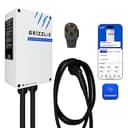
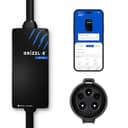
What is actually the same
It is worth being explicit about this, because it removes most of the usual reasons to agonise. From United Chargers’ own product pages for the two units, both published:
- 40 amps maximum on a NEMA 14-50 plug. Both are plug-in rather than hardwired, both want a 50-amp circuit for full output under the 125% continuous-load rule in NEC Article 625, and both therefore top out at the plug-in ceiling of 9.6 kW.
- A metal case rated UL Type 4 indoor/outdoor. Not a plastic shell with an IP claim — the same cast-metal design philosophy that put the Grizzl-E name on our outdoor roundup in the first place.
- A published operating range of -30°C to +50°C (-22°F to 122°F). Identical, and published, which is rarer than it should be. Most brands state an enclosure rating and no temperature range at all, and an enclosure rating is about water and dust, not cold.
- UL file E510712, and Wi-Fi with the Grizzl-E Connect app. Same certification, same software, same three-year baseline warranty. The Classic Connect page additionally offers the warranty as a purchase choice between three and five years, and advertises participation in utility demand-response programs through the app.
Two chargers this closely related is unusual, and it means you are not trading away ruggedness, certification or charging speed in either direction. You are choosing a form factor.
Difference one: what is in the box
This is the real reason to pay the Mini premium, and the only one we would call decisive.
The Mini ships on a NEMA 14-50 plug with four manufacturer-supplied adapters: 5-15P, TT-30P, 14-30P and 6-50P. In plain terms, that is a standard household 120-volt socket, a 30-amp RV pedestal, a four-prong dryer outlet and a welder outlet — four of the five places a 240-volt or 120-volt circuit already exists in an ordinary American garage or campsite. The adapters are named in United Chargers’ own manual, under the same UL file as the charger, which is a meaningfully different thing from an unbranded adapter that names no safety lab. Our cheap chargers guide explains why we draw that line hard: the adapter becomes the hottest joint in a circuit carrying hours of continuous current.
The Classic Connect ships with a mounting kit and the EasyEvPlug, and no outlet adapters. It is a 14-50 charger for a 14-50 outlet.
So: if the outlet you are charging from is a 14-50, the adapters are worth nothing to you and you are paying for them anyway. If it is a dryer outlet, a welder outlet or an RV pedestal — or if you want the charger to come on road trips and work at whatever a relative’s garage happens to have — the adapters are the product, and the Mini is the only Grizzl-E that has them. That is exactly why the Mini leads our NEMA 6-50 roundup and is a pick on our dryer-outlet roundup.
Difference two: cable, and a number worth sourcing
The Classic Connect’s cable is published at 25 ft (7.6 m). The Mini’s is where it gets interesting, and we record the conservative figure deliberately: grizzl-e.com lists 25 ft for the current Mini Connect, while the Amazon J1772 listing we link and United Chargers’ original Mini manual both state 24 ft. We publish 24 ftbecause when a manufacturer’s own sources disagree, the lower number is the one that cannot leave you short at the car.
Either way the practical conclusion is the same: the Classic Connect gives you at least as much reach as the Mini, and possibly a foot more. If you were expecting the wall-mounted unit to be the compromise on cable, it is not. The Mini is also physically tiny — 6.9 x 3.1 x 2.4 inches and 9.8 lb against the Classic Connect’s 10.25 x 6.25 x 3.75 inch enclosure — which is the point of a unit designed to travel, and irrelevant on a garage wall. Our long-cable roundup covers the cases where reach is the deciding spec.
Difference three: how the limit is enforced
Both can be turned down. They publish it differently, and if your circuit is smaller than 50 amps, this is the paragraph that matters.
The Minipublishes two mechanisms: a four-position internal DIP switch at 40, 32, 24 or 16 amps, and a Wi-Fi current slider that runs from 7 amps up to whatever the DIP switch allows and can never exceed it. That is a hardware cap — once set, no app, account or firmware update gets past it. It comes with a warning we repeat everywhere we mention this charger, because it is from United Chargers’ own manual: the Mini ships with a factory default of 40 amps and the manual states the charger “can not detect the circuit amperage limit”. On anything smaller than a 50-amp circuit, turning it down before the first session is your job, and nothing will do it for you. Our Mini review opens on that line.
The Classic Connectpublishes an adjustable current of “40A - 16A” on its product page, set through Wi-Fi and the Grizzl-E Connect app. United Chargers does not name a DIP switch or a hardware cap for this model on that page, and it does not publish the individual steps within the range — so we record a published range and no published hardware enforcement, which is not the same as saying there is none. If a hardware-enforced limit is a requirement for your install, that uncertainty is itself a reason to choose the Mini, or to choose a charger that publishes the switch explicitly — our 32-amp roundup ranks on exactly this.
One extra capability only the Mini has: United Chargers publishes 7-12 amps at 120 volts with automatic voltage detection, so the Mini doubles as a Level 1 charger on an ordinary household socket using the included 5-15P adapter. The Classic Connect is a 240-volt charger. For a household that wants one cord to cover both, that is a genuine point for the Mini — see our Level 1 vs Level 2 comparison for what 12 amps at 120 volts is actually worth.
One difference that is not about either charger
The Classic Connect is available with a J1772 or a NACS output cable, as a choice on United Chargers’ page. The Mini listing we link is J1772. If you drive a Tesla or another NACS car and you want a native plug with no adapter hanging off the end, that is a reason to look at the Classic Connect specifically — though check availability of the exact variant, because connector options on these pages change and our live price and stock come from the J1772 Amazon listings. Our J1772 vs NACS explainer covers which connector your car actually has, and our NACS roundup is the page for wall-mounted native-NACS units.
The verdict
Buy the Grizzl-E Classic Connect if the charger is going on a wall next to a NEMA 14-50 and staying there. It is the cheaper unit, it has at least as much cable, it has the larger enclosure, it offers a five-year warranty as a purchase option, and it gives up nothing on certification, build or cold-weather rating. The Mini’s premium is for adapters you will never open and a portability you will never use.
Buy the Grizzl-E Mini if the outlet is not a 14-50, or if the charger needs to travel. Four manufacturer-supplied adapters covering a dryer outlet, a welder outlet, an RV pedestal and a household socket is a real product, not a bundled accessory — it is the difference between charging tonight and booking an electrician. Add a hardware DIP cap and 120-volt capability, and for anyone whose charging situation is not a clean 14-50 in their own garage, the Mini is worth every dollar of the difference. Set the DIP switch before you plug it in.