Where they are identical
Get this out of the way, because it is now most of the spec sheet.
Both deliver 48 amps, which at 240 volts is about 11.5 kW— roughly 40 miles of range per hour at our 3.5 miles-per-kWh reference, or around 400 miles across a ten-hour overnight window. Both carry a 25-foot cable and a J1772 connector. Both publish a NEMA 4 enclosure. Both publish a three-year warranty. Both have a phone app that schedules charging. Both require a 60-amp circuit, because NEC Article 625 treats EV charging as a continuous load and sizes the circuit to 125% of the draw.
There is no meaningful charging-speed difference between them and there is no scenario in which one fills a battery faster than the other. Anyone telling you otherwise is describing marketing, not physics. And before you commit to either, check that your car can actually accept 11.5 kW — our onboard charger limits guidecovers how to find your vehicle’s own ceiling, and our 40A versus 48A comparison covers whether you need this tier at all.
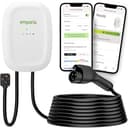
One genuine difference in shape: the Emporia is sold in both hardwired and NEMA 14-50 plug-in configurations, while the WOLFBOX E48 is hardwired only. If you rent, or expect to move, that alone may settle it — a hardwired charger stays with the house. Our hardwired versus plug-in comparison covers the trade. Note that WOLFBOX does sell the same chassis as a 40-amp plug-in unit, but that is a different purchase at a different speed.
The enclosure is a tie now, and that matters
If you have read our older WOLFBOX coverage, the headline was NEMA 4X against NEMA 4 — the X denoting additional corrosion resistance on top of the water and dust protection both classes provide. That was the WE48. It does not carry over.
WOLFBOX’s own E-series spec table gives NEMA 4X only for the 40-amp Tesla-connector version; the 48-amp model is listed as NEMA 4, IP66, which is what Amazon’s product title says too. The bullet copy on the same Amazon listing says “NEMA 4X”, and we do not think that inconsistency should be resolved in the seller’s favour. We record the spec table’s figure. Emporia publishes NEMA 4. Same class, no advantage either way.
Both are silent on operating temperature range, which is the enclosure spec that actually decides a cold-climate install — a sealed box and a cable that stays flexible at −20°F are different claims. If you are somewhere genuinely cold, neither of these is the right answer and our outdoor roundup covers the units that do publish a range. Our cold-weather guide explains why the cable matters more than the box.
Certification: Emporia wins, and it is the reason to read this page
Both brands print a certification list. Only one of them survives being checked against the certifier.
ENERGY STAR.Emporia carries the certification. WOLFBOX prints “CSA / FCC / Energy Star” in the safety-certifications row of its E-series spec table — but the ENERGY STAR certified-EVSE list contains exactly two WOLFBOX entries, the E40 at a 40-amp nameplate rating and the E50at 50 amps. There is no 48-amp WOLFBOX entry, and Amazon’s own item model number for this charger is “E50(48)”. A certification is granted to a model at a tested rating, and a rebate administrator checks the list for a model number rather than reasoning about which chassis a variant came from.
The direct energy saving is small — ENERGY STAR reports certified chargers use about 40% less energy in standby — but a number of utility rebate programs name the certification as an eligibility condition, and that can be worth more than the entire price difference between these two. Our ENERGY STAR roundup and rebates guide cover it. If a rebate is in your budget, this is not a close call.
The safety listing. Emporia is UL listed. WOLFBOX is CSA certified and states that it meetsUL 2594 standards. CSA is a recognized third-party certification body, so this is not a case of one being certified and the other not — but “meets UL standards” is a conformance statement rather than a UL listing, and precision matters here. Our guide on whether cheap chargers are safe covers reading certification language carefully.
The warranty, with a footnote. Both publish three years. WOLFBOX publishes 36 months for EV chargers in its warranty policy, but the table is headed as the default for purchases on wolfbox.com and the same policy says coverage on other official or authorized platforms may vary. Our buy links go to Amazon. Emporia publishes three years without a channel qualifier. In practice that is a small edge rather than a decisive one, but it is an edge.
Where WOLFBOX genuinely pulls ahead
Two things, and neither is nothing.
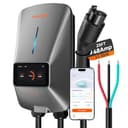
The screen on the unit. The E48 has a 4.3-inch LCD reporting charge rate, elapsed time, voltage, internal temperature and energy delivered, with an LED strip that colour-codes the charging stage. Almost every smart charger at this price puts its status behind an app, an account and a network connection, and all three of those are things that fail: a router change, a firmware update, a brand that loses interest in its software. A display wired to the same board as the contactor is still telling you what the charger is doing in year eight. Our smart versus basic comparison covers our general skepticism about charger apps, and this is the shape of answer we like.
Published current steps.WOLFBOX lists 16, 24, 32, 40 and 48 amps. That looks like a footnote and it is the line that decides whether the charger fits a house that cannot spare a 60-amp circuit — set it to 32 on a 40-amp breaker and it is still a usable charger, with the top setting available later if the service is upgraded. Emporia does not publish an equivalent step list for this unit, so we cannot record one. Our panel capacity guide walks the load calculation that makes this matter.
Where Emporia genuinely pulls ahead
Wall-side energy monitoring.Emporia’s app reports measured energy at the charger. WOLFBOX describes real-time charging data and cost estimates, which is a figure derived from a tariff rather than a measurement. The distinction sounds pedantic and is not: the car’s own figure is battery-side and the charger’s is wall-side, and the gap between them is the charging loss you are paying for but not driving on. Our energy monitoring guide explains it, and it is the single app feature we think is worth paying for.
The plug-in option.Emporia sells the same charger in a NEMA 14-50 configuration. It is capped at 40 amps continuous in that form, because a 14-50 receptacle is a 50-amp device — but it means one product line covers both the “wire it in properly” buyer and the renter who needs the charger to come with them.
The verdict
Buy the Emporiaunless you have a specific reason not to. Same speed, same cable, same enclosure class, same warranty term — plus a UL listing, an ENERGY STAR listing you can find on the certified list, measured energy reporting, and the option of a plug-in version that moves house with you. That is a longer list of things you can hold someone to, at comparable money. Our Emporia review covers it in full, and our 48-amp roundup shows where it sits against the premium field.
Buy the WOLFBOX E48 if you want the readout on the wall rather than in an app, or if the published step-down range is what makes the charger fit your panel. Both are real reasons and neither is exotic. Go in knowing that the ENERGY STAR line on its spec table is not one you should plan a rebate around, and that the three-year warranty comes with a channel caveat worth confirming with the seller. Our WOLFBOX E48 review has the full spec picture.
Buy neither if your car cannot accept 11.5 kW or your panel cannot spare a 60-amp circuit. Both are common, and both mean you are paying for a hardwired install you cannot use. Read our panel capacity guide and our 40-amp roundup before committing.