Plug & Range

Lectron Vortex Plug vs Vortex Plus

Same amps, same volts, same kilowatts. Then Lectron's two product pages part company on certification, on how the connection is held, and on whether there is a warranty at all.

By Stephen V.Last updated How we pick

Buy the Vortex Plus. It is the one Lectron calls UL 2252 certified, it is the one with the automatic dual interlock, and it is the only one of the two with a published warranty term. On the day we read both product pages the Plug was the cheaper of the two by a margin small enough to be erased by a single coupon — and the thing you are buying is a hand-held connector that carries up to 500 amps of direct current into your car’s battery. This is not the place to save the price of a tank of gas.

Here is why the two look identical and are not. Both adapters are published at the same ceiling: 500 amps, 1,000 volts, 500 kilowatts. Both let a CCS1 car with automaker-granted access plug into a Tesla Supercharger. Both are DC-only, both are useless at a home charger, and neither works on a Tesla. Everything that actually differs between them is a sentence on Lectron’s own pages rather than a number in a spec box, which is exactly why the listings look like the same product at two prices.

Three sentences decide it. The Plug’s page says “UL2252 Compliant” and its FAQ says the Plug “adheres to UL 2252 design standards”; the Plus’s page says “UL2252 Certified” and adds that it is “tested by SGS”. The Plug has a “manual locking latch”; the Plus has an “automatic internal dual-locking mechanism (interlock) on both the NACS and CCS1 connections”. And the Plus publishes a “standard 2-Year Manufacturer Warranty”where the Plug page publishes no term at all. Those are Lectron’s words, read on the date at the top of this page.

How this is funded:we earn a commission if you buy through our links, at no extra cost to you. It never changes which product we recommend, and we’ll tell you when we’d skip one. Full disclosure.

Quick picks

Ranked on published specs, charging speed, electrical fit and value. Select a row to jump to the full write-up. We have not bench-tested these chargers — here is exactly what we do instead.

#ProductBest forPrice
1
Lectron Vortex Plus NACS to CCS Adapter

Lectron Vortex Plus NACS to CCS Adapter

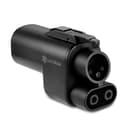
The one adapter on this site that has nothing to do with home charging — it is for the road. It lets a CCS1 car whose maker has bought into the Tesla network plug into a Supercharger, at up to 500 amps and 1,000 volts. Lectron publishes it as the first NACS-to-CCS adapter certified to UL 2252, and it carries a mechanical interlock, which is the part that matters on a connector handling that much DC.

The one to buy: certified, interlocked, warranted
$199.99 · View on Amazon

Price as of October 18, 2026. #ad How we’re funded

2
Lectron Vortex Plug NACS to CCS Adapter

Lectron Vortex Plug NACS to CCS Adapter

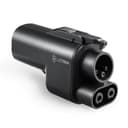
Lectron's older and cheaper road adapter, and the honest way to describe it is by what it does not have. Same headline numbers as the Vortex Plus — 500 amps, 1,000 volts, 500 kW — but Lectron's own page calls this one "UL2252 Compliant" rather than certified, holds the connection with a manual locking latch instead of an automatic dual interlock, and publishes neither an ingress-protection rating nor a warranty term for it. If the two are close in price on the day you look, there is no argument for this one.

Only if it is much cheaper on the day
$183.85 · View on Amazon

Price as of October 18, 2026. #ad How we’re funded

3
Lectron Tesla (NACS) to J1772 Adapter, 48A

Lectron Tesla (NACS) to J1772 Adapter, 48A

The mirror image of the J1772-to-Tesla adapter, for the other kind of driver: it lets a non-Tesla (J1772) car pull power from a Tesla Wall Connector, Destination Charger or Mobile Connector. Handy if your home charger is a NACS unit, or a relative's Tesla charger is the one in the garage. It's capped at 48A and SGS-certified to UL 2251 — and it is not for Superchargers.

What most people actually need instead
$127.78 · View on Amazon

Price as of October 18, 2026. #ad How we’re funded

The picks in full

#1The one to buy: certified, interlocked, warranted

Lectron Vortex Plus NACS to CCS Adapter

The one adapter on this site that has nothing to do with home charging — it is for the road. It lets a CCS1 car whose maker has bought into the Tesla network plug into a Supercharger, at up to 500 amps and 1,000 volts. Lectron publishes it as the first NACS-to-CCS adapter certified to UL 2252, and it carries a mechanical interlock, which is the part that matters on a connector handling that much DC.

Strengths

  • 500A / 1,000V rating — it is not the bottleneck at a V3 or V4 Supercharger
  • Lectron publishes it as the first publicly available NACS-to-CCS adapter certified to UL 2252
  • Built-in interlock holds the connection during a high-voltage DC session

Trade-offs

  • Only works if your automaker has enabled Supercharger access for your car
  • Not compatible with Tesla vehicles, and not for AC charging at all
  • Costs multiples of an AC home-charging adapter
Max output500 A
Power500 kW
ConnectorNACS
InstallNot published
Cable lengthNot published
Warranty2 years
WiFi + appNot published
CertificationsUL 2252 certified (Lectron states it is tested by SGS)

Our charging-speed math. This is DC fast charging, so our 240V home math does not apply. Lectron publishes up to 150 miles in about 15 minutes, and states that the actual rate depends on the Supercharger generation and your car.

Build note. A NACS (SAE J3400) to CCS1 adapter published at 500A / 1,000V / 500 kW with a built-in interlock, certified to UL 2252. Lectron's FAQ describes it as an "automatic internal dual-locking mechanism (interlock) on both the NACS and CCS1 connections" and calls it automaker-approved, publishes an IP67 ingress-protection rating and a standard 2-year manufacturer warranty, and states the adapter is tested by SGS. Lectron states it is for CCS1 EVs with automaker-granted Supercharger access, that it works at V3 and V4 Superchargers but not older V2 units, and that it is not compatible with Tesla vehicles or with any AC charging station. Re-read 2026-10-18: the kW figure, the IP rating and the warranty term are published today and were null in this registry from the 2026-08-12 read.

Specs read from the manufacturer spec sheet, on October 18, 2026. “Not published” means the brand does not state that figure.

#2Only if it is much cheaper on the day

Lectron Vortex Plug NACS to CCS Adapter

Lectron's older and cheaper road adapter, and the honest way to describe it is by what it does not have. Same headline numbers as the Vortex Plus — 500 amps, 1,000 volts, 500 kW — but Lectron's own page calls this one "UL2252 Compliant" rather than certified, holds the connection with a manual locking latch instead of an automatic dual interlock, and publishes neither an ingress-protection rating nor a warranty term for it. If the two are close in price on the day you look, there is no argument for this one.

Strengths

  • Same published electrical ceiling as the Plus: 500A / 1,000V / 500 kW
  • Usually the cheaper of Lectron's two NACS-to-CCS adapters
  • Light enough to live in a door pocket — Lectron gives it as about 2 lb

Trade-offs

  • "UL2252 Compliant" on Lectron's own page, not UL 2252 certified — the Plus is the certified one
  • A manual locking latch rather than the Plus's automatic dual interlock
  • No ingress-protection rating and no warranty term published for this model
  • DC only, Superchargers only, and only if your automaker has granted your car access
Max output500 A
Power500 kW
ConnectorNACS
InstallNot published
Cable lengthNot published
WarrantyNot published
WiFi + appNot published
CertificationsUL 2252 compliant (Lectron's wording; it does not claim certification)

Our charging-speed math. DC fast charging, so our 240V home arithmetic does not apply. Lectron publishes roughly 150 miles in about 15 minutes and states the real rate depends on the Supercharger generation and the car.

Build note. A NACS (SAE J3400) to CCS1 adapter published at 500A / 1,000V / 500 kW, weighing approximately 2 lb. Lectron's page states "UL2252 Compliant" and its FAQ says the Plug "adheres to UL 2252 design standards" — not that it is certified — and describes its retention as a "manual locking latch", explicitly contrasting it with the Vortex Plus's automatic dual interlock. The page publishes no ingress-protection rating, no warranty term and no dimensions. It states the adapter is designed exclusively for CCS1-equipped EVs with automaker-granted Supercharger access, and is not for Tesla vehicles, Tesla Destination Chargers, other CCS networks, or Level 1 / Level 2 AC charging of any kind.

Specs read from the manufacturer spec sheet, on October 18, 2026. “Not published” means the brand does not state that figure.

#3What most people actually need instead

Lectron Tesla (NACS) to J1772 Adapter, 48A

The mirror image of the J1772-to-Tesla adapter, for the other kind of driver: it lets a non-Tesla (J1772) car pull power from a Tesla Wall Connector, Destination Charger or Mobile Connector. Handy if your home charger is a NACS unit, or a relative's Tesla charger is the one in the garage. It's capped at 48A and SGS-certified to UL 2251 — and it is not for Superchargers.

Strengths

  • Lets a J1772 car use a Tesla Wall Connector or NACS home charger
  • 48A / 240V rating covers full-speed home AC charging
  • SGS certified to the UL 2251 standard

Trade-offs

  • Works with Tesla AC connectors only — not Superchargers (DC)
  • 48A ceiling, so it won't exceed a typical home circuit anyway
Max output48 A
Power11.5 kW
ConnectorJ1772
InstallNot published
Cable lengthNot published
WarrantyNot published
WiFi + appNot published
CertificationsSGS certified (UL 2251)

Our charging-speed math. At its 48A / 11.5 kW ceiling and 3.5 mi/kWh, about 40 miles of range an hour — assuming the Tesla source can supply that.

Build note. Converts a Tesla/NACS AC connector to J1772; works with Tesla Wall Connectors, Destination Chargers and Mobile Connectors, not Superchargers.

Specs read from the manufacturer spec sheet, on July 19, 2026. “Not published” means the brand does not state that figure.

The two adapters, line by line

Every cell below is what the manufacturer publishes for that model, read from Lectron’s own product pages on the date in our sources. Where a page does not publish a figure, the cell says so — and on this comparison the blanks are the whole story.

 Vortex PlugVortex Plus
Published ceiling500 A / 1,000 V / 500 kW500 A / 1,000 V / 500 kW
Certification, as worded“UL2252 Compliant”; FAQ: “adheres to UL 2252 design standards”“UL2252 Certified”; FAQ: “UL 2252 certified and tested by SGS”
How the connection is heldManual locking latchAutomatic internal dual interlock, NACS side and CCS1 side
Ingress protectionNot publishedIP67
WarrantyNot published2 years
WeightApproximately 2 lbNot published
Supercharger generationsNot statedV3 and V4; Lectron says it will not work on older V2 units
Works on a home chargerNo — DC onlyNo — DC only
Works on a TeslaNoNo

Certified versus compliant is not a quibble

It is the single most important line in that table, so it is worth being precise about what the two words mean. A manufacturer saying a product complies with or adheres to the design standards of a safety standard is making a claim about its own engineering. A manufacturer saying a product is certifiedto that standard is saying an independent body tested a sample and issued a mark — and Lectron names the body for the Plus, SGS, which is a real and checkable third-party testing house.

We hold every charger on this site to the same line. It is why our guide to cheap chargers treats a named listing as the floor rather than the ceiling, and why our reliability roundup ranks how specifically a certification is stated as one of its four criteria. Neither of these adapters is a no-name part, and we are not suggesting the Plug is dangerous. We are saying that when the same company sells you two versions of the same part and uses the stronger word on only one of them, the stronger word is the one worth paying for.

The interlock belongs in the same paragraph. UL 2252 is the adapter standard, and an interlock is the mechanism that keeps the two halves mated while hundreds of amps of DC are flowing. A manual latch depends on a person seating it properly; an automatic dual interlock engages on both faces by itself. Lectron also describes the Plus’s interlock as automaker-approved, which matters for a practical reason covered below: the automakers, not Tesla and not Lectron, decide whether your car is allowed on the network at all.

The mistake that brings most people to this page

Search traffic for these two adapters is full of people who want to charge at home. Neither of these will do it. Both are DC fast-charge adapters for the Tesla Supercharger network, and Lectron states plainly that they do not work with Level 1 or Level 2 AC charging, with Tesla Destination Chargers, or with your wall unit in the garage.

If what you actually have is a Tesla-style connector on a wall and a J1772 car — a Destination Charger at a hotel, or a friend’s Tesla Wall Connector — the part you want is the third pick above, a NACS-to-J1772 AC adapter, and it costs a small fraction of either Vortex. If it is the other way around and you have a NACS car in front of a J1772 charger, you want a J1772-to-NACS adapter instead. Our guide to EV charging adapters lays out which direction each one runs, and J1772 vs NACS explains why the connector on your car is about to stop being the connector on your next one.

What to look for in any DC fast-charge adapter

These two are not the only NACS-to-CCS adapters on the shelf, and the cheapest listings in that search are generic brands at well under half the price of either Lectron. We have not ranked those here, because the criteria below are the ones that decide whether an adapter is a tool or a liability, and the budget end of this category tends to fail the first one. If you are comparing any adapter against these two, these are the four questions worth asking in this order.

1. Is it certified, and to what, by whom? UL 2252 is the standard written for EV charging adapters, and the word that matters is certified rather than compliant, designed to or meets the requirements of. A named test house is better than an unnamed one. This is the same bar we apply to wall chargers in our guide to cheap EV chargers, and it is the one place in this category where we would spend the extra money without thinking about it.

2. How is the connection held, mechanically? A DC fast charge runs hundreds of amps through two mated interfaces instead of one, and a partial disconnect under that load is the failure nobody wants to describe in detail. An automatic interlock on both faces removes the human from that job; a manual latch does not. If a listing does not say how the adapter is retained, treat the silence as the answer.

3. Does it publish an ingress rating? This part lives in a trunk and gets used in rain, road salt and slush, then goes back in the trunk wet. An IP67 rating is a specific, testable claim about dust and water. No rating is not a claim at all. The same logic runs through our outdoor charger picks, where the enclosure rating is the ranking criterion rather than a footnote.

4. Is there a warranty term, in writing? A warranty is the only durability signal in this category that costs the manufacturer money, which is exactly why we use it as one of the four criteria in our reliability roundup. Two years on a $200 adapter is a modest promise. No published term is worse than a modest promise.

Notice what is noton that list: the amp and voltage numbers. Both of these adapters are published at 500 amps and 1,000 volts, and so is almost every competitor, because the adapter is never the bottleneck — the Supercharger and your car’s own pack decide the rate. A listing competing on a bigger headline number than 500 A is selling you a specification that cannot be used. We make the same point about AC adapters on the adapters page.

Three things to check before you buy either one

Your automaker has to have granted Supercharger access.The adapter is the easy part. Lectron’s FAQ for the Plus names the cars it expects to work — the Mustang Mach-E and F-150 Lightning, Chevrolet, Cadillac and GMC EVs, the Rivian R1T and R1S, the Hyundai IONIQ 5 and IONIQ 6, the Kia EV6 and EV9, the Genesis GV60 — and both pages tell you to check with your automaker. If your car is not enrolled, no adapter in the world opens that stall.

A new car may not need an adapter in this direction at all. The whole reason these adapters exist is that cars built with CCS1 inlets came before the industry agreed on NACS. Newer cars are shipping with the NACS port built in and the adapter in the other direction in the trunk — Hyundai, for instance, publishes that the current IONIQ 5 has a native NACS port and comes with a CCS adapter in the box. If you are shopping for a car as well as an adapter, check our IONIQ 5 charging guide for what that change does to the home-charging side of the question.

Supercharger generation.Lectron states the Plus works at V3 and V4 Superchargers and not at older V2 stalls, and publishes nothing on the question for the Plug. That is not a reason to prefer the Plug — an unstated limit is not an absent one.

The verdict

The Vortex Plus is the one to buy, and the gap is not close. Certified rather than compliant, tested by a named third party, an automatic dual interlock on both connector faces, IP67, and two years of warranty. On our read the price difference between the two was roughly the cost of one fast-charging stop.

The Vortex Plug only makes sense if the gap on the day is large. It is the same published electrical ceiling in a lighter package, and if the Plus is out of stock or the Plug is deeply discounted, it is a real product from the same company. Go in knowing the three things it does not publish, and seat the latch deliberately every time.

And most readers want neither. If your charging problem is at home rather than on a road trip, the money belongs in a Level 2 charger or, if the connector is your problem, in a ten-dollar-class AC adapter. A DC adapter is a road-trip purchase for a specific network, nothing more.
Frequently asked questions

What is the difference between the Lectron Vortex Plug and the Vortex Plus?

Three published differences, all from Lectron's own product pages. The Plus is described as "UL2252 Certified" and tested by SGS, while the Plug is described as "UL2252 Compliant" and as adhering to UL 2252 design standards. The Plus has an automatic internal dual interlock on both the NACS and CCS1 connections, while the Plug has a manual locking latch. And the Plus publishes an IP67 rating and a 2-year warranty, where the Plug page publishes neither. The electrical ceiling is identical: 500 amps, 1,000 volts, 500 kW.

Is the Vortex Plus worth the extra money over the Vortex Plug?

On our read the price gap was roughly the cost of a single fast-charging session, and for that you get third-party certification instead of a self-declared design claim, an automatic interlock instead of a manual latch, a published water and dust rating, and a warranty that exists. For a hand-held part that carries up to 500 amps of DC, yes.

Can I use a Lectron Vortex adapter to charge at home?

No. Both Vortex adapters are DC fast-charge adapters for the Tesla Supercharger network, and Lectron states they do not work with Level 1 or Level 2 AC charging or with Tesla Destination Chargers. If you need to connect a J1772 car to a Tesla-style AC connector, that is a different and much cheaper adapter — see our adapters guide.

Does the Lectron Vortex work on a Tesla?

No. Both pages state the adapter is not compatible with Tesla vehicles. It converts a Supercharger's NACS connector to a CCS1 inlet, which is the inlet a Tesla does not have. The adapter that goes the other way — a CCS car's charger to a Tesla's port — is a separate product.

Will the Vortex Plus work at any Tesla Supercharger?

Lectron states it works at V3 and V4 Superchargers and that it will not work at older V2 units. Separately, your car has to be enrolled: Supercharger access is granted by your automaker, not by the adapter, and Lectron's own page notes that Tesla does not officially guarantee third-party adapter compatibility.

What does UL 2252 mean on an EV charging adapter?

It is the safety standard that covers EV charging adapters specifically, as distinct from UL 2594 for the charging station itself. The important nuance on this page is the difference between a manufacturer saying its product complies with a standard — a claim about its own engineering — and saying the product is certified to it, which means an independent body tested a sample and issued a mark. Lectron uses the first wording for the Plug and the second for the Plus.

Which cars can use a NACS to CCS adapter?

CCS1 cars whose manufacturer has enabled Supercharger access. Lectron's FAQ names the Ford Mustang Mach-E and F-150 Lightning, GM's Chevrolet, Cadillac and GMC EVs, the Rivian R1T and R1S, the Hyundai IONIQ 5 and IONIQ 6, the Kia EV6 and EV9, and the Genesis GV60, and both pages tell you to confirm with your automaker. Enrollment usually happens through the car maker's own app.

Do I still need an adapter if my car has a NACS port?

Not for Superchargers. A car built with a native NACS port plugs straight in, which is why Hyundai's own page for the current IONIQ 5 says Supercharger access needs no adapter and ships a CCS adapter in the box for the other networks instead. The adapter you may still want in that case is for AC charging at a J1772 station.

Sources

  • Lectron — Vortex Plug NACS to CCS adapter product page — Manufacturer page, fetched 2026-10-18: published as "500A / 1,000V / 500 kW", weighing approximately 2 lb, for CCS1-equipped EVs with automaker-granted Supercharger access (the FAQ names Ford, GM, Rivian, Hyundai, Kia, Genesis, Volvo, Polestar, Mercedes-Benz and Nissan). Two wordings decide the comparison on our page and both are Lectron's own: the features list says "UL2252 Compliant" and the FAQ says the Plug "adheres to UL 2252 design standards" — neither claims certification — and the FAQ describes its retention as a "manual locking latch", explicitly contrasting that with the Vortex Plus's automatic dual interlock. The page publishes NO ingress-protection rating, NO warranty term and NO dimensions. It states the adapter is not for Tesla vehicles, Tesla Destination Chargers, other CCS networks, or Level 1 / Level 2 AC charging (accessed October 18, 2026)
  • Lectron — Vortex Plus NACS to CCS adapter with interlock product page — Manufacturer page, fetched 2026-10-18: published as "500A / 1,000V / 500 kW", "UL2252 Certified" with the FAQ adding "it is UL 2252 certified and tested by SGS" (no file number is given), an "IP67 Ingress Protection rating", an "automatic internal dual-locking mechanism (interlock) on both the NACS and CCS1 connections" described as automaker-approved, and a "standard 2-Year Manufacturer Warranty covering defects in materials and workmanship". Compatibility is stated as CCS1 vehicles with automaker-approved Supercharger access, with the FAQ naming the Mustang Mach-E, F-150 Lightning, Chevrolet / Cadillac / GMC, R1T and R1S, IONIQ 5 and IONIQ 6, EV6 and EV9 and the GV60. Limits, in Lectron's words: it "will not work with older V2 Superchargers, nor will it work with Level 1 or Level 2 AC chargers", it is "not compatible with Tesla vehicles or AC charging stations", and "Tesla does not officially guarantee third-party adapter compatibility" (accessed October 18, 2026)
  • Hyundai USA — IONIQ 5 vehicle page, charging section and charging FAQ — The manufacturer's own US page, fetched 2026-10-18. On the port: the current IONIQ 5 "comes with a Tesla Supercharger-compatible NACS port, giving you instant access to over 30,000 Tesla Superchargers—no adapter required. Plus, it comes with a CCS adapter for other networks like Electrify America and ChargePoint", and the spec line reads "NACS charging port with included NACS-to-CCS adapter". On home charging, the number this site needed and could not previously source: "Approximately 7 hours and 20 minutes to charge from 10% to 100% on a 10.9-kW, 240V AC charger." On DC: 10-80% in as little as 20 minutes at 800V/350kW using the included CCS adapter, or approximately 24 minutes (63 kWh battery models) and 30 minutes (84 kWh battery models) at a NACS V3/V4 Supercharger through the native port (accessed October 18, 2026)
  • SAE International — J3400 North American Charging System (NACS) — The SAE J3400 / NACS standard (the Tesla-derived connector) now being adopted industry-wide (accessed July 19, 2026)
  • SAE International — J1772 Conductive Charge Coupler — The SAE J1772 connector standard for AC Level 1 and Level 2 charging in North America (accessed July 19, 2026)
  • U.S. DOE Alternative Fuels Data Center — Electric Vehicles for Consumers — US DOE on connector types: J1772 for Level 1/2, and CCS, CHAdeMO or NACS (J3400) for DC fast charging (accessed July 19, 2026)
  • U.S. DOE Alternative Fuels Data Center — Electric Vehicle Charging Infrastructure Development — DOE on the install process: obtain required permits, determine inspection requirements and their impact on the project timeline, and note that permitting may require a site installation plan plus approval from fire, environmental or electrical inspection entities; work must comply with local and state codes and be completed by a licensed electrical contractor, and utilities should be engaged early (accessed August 19, 2026)

Keep reading