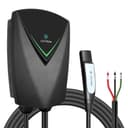
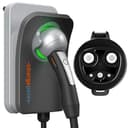
The app question, answered honestly
The Lectron Nexus NACS has no app. The ChargePoint Home Flex NACS has what is, in our reading of the published feature sets, the most complete app of any NACS home charger: scheduling, reminders, usage history, and a mature platform behind it.
On a spec comparison sheet that looks like a knockout. In a Tesla driveway it mostly is not, for one reason: your car already does this.Every Tesla schedules charging from the vehicle — departure time, scheduled start, charge limit — and that schedule travels with the car. Plug in at a friend’s house or a rental and your settings come along. A charger-side schedule stays with the wall.
So for the single feature most people buy a smart charger for, the Tesla owner is the one buyer who genuinely does not need it. That is not a knock on ChargePoint; it is a statement about who is shopping. Our smart vs basic comparison makes the general version of this argument, and our smart charger roundup covers the features that do earn their keep.
What you lose with the Lectron is measurement. The car reports energy added to the battery; it cannot tell you what came through the wall, which is what your utility bills you for. If tracking real charging cost matters to you, that is the honest argument for the ChargePoint — or for a J1772 charger with energy monitoring plus the adapter, which our energy monitoring guide covers.
Fifty amps against forty-eight
ChargePoint is rated at 50 amps (about 12 kW), Lectron at 48 (about 11.5 kW). At our 3.5 mi/kWh reference that is roughly 42 miles of range per hour against 40.
Two miles an hour is inside the noise of how efficiently you happen to be driving that week. It should not influence this decision at all. Both units need the same 60-amp circuitunder the NEC’s 125% continuous-load rule, so there is not even an installation saving on the Lectron side — the panel requirement is identical.
The ChargePoint’s more useful flexibility is that its amperage is adjustable in software, which matters if your panel cannot carry 60 amps and you need to dial the charger down to fit the circuit you can actually get. Our panel capacity guide covers finding that ceiling, and our load management guide covers the options when it is tight.
Enclosure: IP66 against NEMA 3R
This is the one spec where the cheaper unit is ahead on paper. Lectron publishes IP66— dust-tight and protected against powerful water jets. ChargePoint publishes NEMA 3R, which covers falling rain, sleet and ice formation but is a less demanding rating than Type 4 or IP66 against wind-driven water.
For a garage or a sheltered wall, both are more than adequate and this is worth nothing. For a fully exposed outdoor wall it is a real edge to the Lectron. And for a genuinely severe climate, neither is our pick — neither brand publishes an operating temperature range for these models, which is the figure that actually speaks to a hard freeze. Our outdoor roundup and our Autel vs Grizzl-E comparison cover what to buy when the wall really is exposed.
Certification: both properly listed
Lectron publishes ETL listing against UL 2594/2231/2251 plus ENERGY STAR and FCC. ChargePoint publishes UL/cUL listing plus ENERGY STAR. Both are certified by an accredited laboratory against the right EV supply equipment standards, and both will satisfy an inspector.
The ENERGY STAR listing on both is the practically useful part, because a number of utility rebate programs require it by model number. Our rebates guide covers what those programs typically ask for. If you are wondering whether a certification mark is worth caring about at all, our are cheap chargers safe guide explains why it is the single spec we would never compromise on.
The option neither of these is
Worth saying plainly: you may not need a NACS charger.Every Tesla ships with a J1772 adapter, and a J1772 charger plus that adapter works perfectly well. That route opens the entire market to you rather than the two units on this page, which usually means more charger for the money — our main roundup is the field.
What you trade is the small daily friction the adapter introduces, and the risk of misplacing it. Some people find that genuinely irritating and some never think about it. Our best chargers for Tesla roundup lays out both routes properly, and our J1772 to Tesla adapter review covers the adapter route if you go that way.
The verdict, by buyer
Buy the Lectron Nexus NACS if you drive a Tesla, schedule charging in the car like almost every Tesla owner already does, and would rather put the money into the charger than into an app you will not open. The IP66 enclosure is a bonus if the wall sees weather, and the ENERGY STAR listing keeps rebate eligibility open.
Buy the ChargePoint Home Flex NACSif you want measured energy data rather than the car’s estimate, if you want amperage you can dial down in software to fit a constrained circuit, or if you value a large vendor with a long track record behind the firmware. It is the premium option and it is priced like one.
Buy neitherif you are not sure the adapter genuinely bothers you. Try living with it for a month first — it costs nothing, it came with the car, and if it turns out not to annoy you, the whole J1772 market opens up.