The spec that decides it
Forty-eight amps of charging requires a 60-amp circuit. NEC Article 625 treats EV charging as a continuous load, so the breaker is sized to 125% of the draw: 48 x 1.25 = 60. That is a substantial circuit. On a full 100- or 125-amp service it often does not exist without a load calculation that says otherwise, a subpanel, or a service upgrade — which is the subject of our panel capacity guide and the reason our 100-amp panel roundup exists.
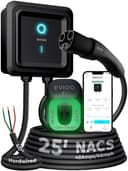
The EVIQO survives that conversation. Its DIP switch positions are 16, 32, 40 and 48 amps, which map onto 20-, 40-, 50- and 60-amp circuits respectively. Set the switch to 32 and you have a charger that fits a 40-amp circuit permanently, in hardware, where no app update or new household member can raise it. The app slider then moves anywhere from 6 amps up to that cap in single-amp steps, which is genuinely useful during peak-rate hours. One honest note on EVIQO’s own copy: a banner on the page reads “Easily set power (6-50A)” while the FAQ on the same page gives the DIP positions as 16/32/40/48. We cite the FAQ, because it is the specific statement, and we record the discrepancy rather than quietly picking the larger number.
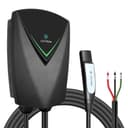
The Lectron does not survive it. Lectron’s page for the NEXUS NACS states that it requires “professional hardwired installation by a licensed electrician on a dedicated 240V circuit”, and publishes 48 amps / 11.52 kW as the output. It does not publish an adjustable range, a DIP switch, selectable levels, or an app in which to change anything. That is not a criticism of the charger — it is a deliberately simple product, and we say so below — but it means the charger has exactly one electrical requirement and no way to negotiate it. If your panel cannot carry a 60-amp circuit, this charger is not a candidate, and nothing on the listing tells you that.
This is the same finding our Lectron NEXUS J1772 review leads with for the J1772 sibling, and it is why neither NEXUS appears on our 32-amp roundup. A charger’s maximum tells you nothing about its minimum.
Tiebreaker one: cable reach
The EVIQO publishes a 25 ft charging cable plus a 40-inch input lead, describing the cable as fourth-generation and including a fluorescent holster. The Lectron publishes 23 ft, with a wall-mount J-hook and plug holder, and — unusually — a cable thickness of 16.0 mm (±0.5 mm), which is a spec almost nobody publishes.
Two feet of cable sounds trivial and is not. The input lead matters more than the headline figure: 40 inches of flexible input cable means the charger body does not have to sit directly over the junction box, which gives an electrician real freedom about where the unit lands on the wall. If the car parks nose-in on the far side of a two-car garage, measure the actual path — around the car, not through it — before you decide either is enough. Our long-cable roundup is the page for when reach is the deciding spec, and it is a more common problem than buyers expect.
Tiebreaker two: the app, and whether a Tesla owner needs one
The EVIQO has a full app: pairing over 2.4 GHz Wi-Fi, up to three charging schedules, live energy and cost tracking, remote amperage adjustment, and automatic over-the-air firmware updates. The Lectron NEXUS NACS has no app, no Wi-Fi and no account anywhere on its page.
For a Tesla, that gap is smaller than it looks, and this is the single most useful thing on this page if you drive one. The car already does the scheduling. A Tesla sets departure times, off-peak windows and a charge limit in the vehicle, with no reference to the charger at all — so the charger’s scheduler is a second place to configure the same behaviour, and two schedulers fighting each other is a genuine source of “why didn’t my car charge” confusion. Our smart versus basic comparison makes this argument in full: on a car that schedules itself, the feature that still earns a premium is wall-side measurement, not scheduling.
And wall-side measurement is the one thing the EVIQO app genuinely adds. The car reports energy that reached the battery; the charger reports energy that left the wall, and the gap between them is charging losses you are paying for. If you want to know your real cost per mile, or you are claiming a utility rebate that asks for kWh, that is worth something — see our energy monitoring guide. If you do not care, the Lectron’s absence of an app is a feature: nothing to pair, no account, no firmware, and no cloud service that can be discontinued in five years.
Tiebreaker three: certification and what each brand publishes
Both are ENERGY STAR certified, which is the listing most utility rebate programmes actually ask for — our rebates guide covers what administrators look at, and our ENERGY STAR roundup ranks the certified field.
Beyond that they publish differently. Lectron names its standards precisely: ETL listed to UL 2594, UL 2231 and UL 2251, plus FCC, with protection against overcurrent, overvoltage and ground faults. EVIQO states UL, ETL, FCC and ENERGY STAR without naming individual standards on the page, and adds an enclosure figure Lectron does not publish at all: a stated operating range of -22°F to 122°Fon the IP66 / NEMA-4 body. Both describe an IP66 enclosure; only EVIQO tells you how cold it is rated to work in, and an enclosure rating is about water and dust, not temperature. If the charger is going on an outside wall in a cold climate, that is a real difference — our outdoor roundup ranks on published temperature ranges for exactly this reason, and our cold-weather guide explains what the cold does to charging itself.
On warranty, both publish three years. EVIQO offers a four-year extension as a purchase option. Neither is a long warranty by the standards of the category — the Grizzl-E range offers five as an option — but three years is the norm.
What neither of them solves
Both of these chargers have a Tesla plug permanently attached, and that is a commitment. A J1772 car — which is every non-Tesla EV sold in North America until very recently — cannot use either one without a NACS-to-J1772 adapter hanging off the end of the cable. If your household has, or might have, one Tesla and one other EV, the honest recommendation is a J1772 charger plus a J1772-to-Tesla adapter for the Tesla, which is the argument our NACS roundup opens with and the reason our adapters page exists. A native NACS wall unit does not remove the adapter problem; it moves it onto whichever car in the household is not a Tesla.
The verdict
If your panel cannot comfortably carry a 60-amp circuit, buy the EVIQO NACS 48A. It is the only one of the two that can be installed at all under that constraint: cap it at 32 amps with the DIP switch for a 40-amp circuit, and you still get roughly 27 miles of range an hour, an app that measures what you are actually using, two extra feet of cable plus a 40-inch input lead, and a published cold-weather figure. The DIP switch also means the limit on the permit is the limit in the hardware.
If you already have, or are installing, a 60-amp circuit and you drive a Tesla, buy the Lectron NEXUS NACS. It is the cheaper of the two, it names its safety standards individually rather than in a bundle, and its lack of an app is the right trade on a car that schedules its own charging. There is nothing to pair, nothing to update and no account to lose — and on a charger that will be screwed to a wall for a decade, that is worth more than most buyers credit. Just confirm the circuit before you order, because this charger gives you no way to adapt to a smaller one.