How a charger actually holds 24 amps
There are four mechanisms, and they are not equally trustworthy. In order from best to worst:
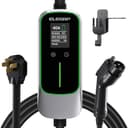
1. Native hardware. The charger cannot exceed 24 amps because it was never built to. The EVDANCE pick is this case: 24 amps is its maximum at 240 volts, and its plug is a NEMA 14-30, so the plug and the ceiling match the circuit. Nothing can be mis-set.
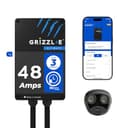
2. A physical cap.A DIP switch or dial inside the unit that an app cannot override. The Grizzl-E Mini publishes a four-position switch at 40, 32, 24 and 16 amps, and United Chargers states the Wi-Fi setting can never exceed it — which is exactly the right way round.
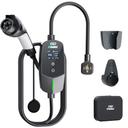
3. An on-unit button or code. You step through the levels on the charger itself. The ELEGRP publishes five levels (16, 20, 24, 32 and 40 amps) and the EVDANCE five (10, 12, 16, 20 and 24 amps), both selected before the connector goes into the car. No phone, no account, nothing to lose when the app is retired.
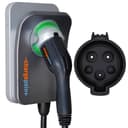
4. A setting in an app. Convenient, and fine when the install is right, but it is the weakest of the four because it depends on a radio, a login and a company. ChargePoint publishes six steps from 16 to 50 amps and EVIQO publishes 6 to 48 in one-amp increments; both are genuinely useful, and both should be set by whoever commissions the circuit rather than left to the homeowner to remember.
The 30-amp circuit you probably already have
If your 30-amp circuit is a dryer outlet, read our NEMA 14-30 charger picks next — that page is about the receptacle rather than the current, and it covers the dryer-conflict problem and the named-laboratory question in more detail than there is room for here. If it is an older three-prong 10-30 receptacle, stop and read why a 10-30 is a different problem before you buy anything: that outlet has no separate ground.
The awkward case is a 40-amp-plug charger on a 30-amp circuit. Three of the picks above end in a NEMA 14-50 plug, which will not fit a 14-30 receptacle, so you are either changing the receptacle to match the breaker or using an adapter. Our 14-50 to 14-30 adapter guide explains the one condition that makes that safe — the charger must be turned down to 24 amps first, and must stay there — and why the adapter itself is the least important part of the decision. The clean answer, if the circuit is permanent, is to hardwire.
What you give up at 24 amps
Time, and only time. A 24-amp charger is not less safe, less durable or less smart than a 48-amp one — three of the picks above are 40- and 48-amp chargers, running turned down. What changes is the clock: about 20 miles of range an hour instead of about 40. On a mid-size EV with a 75 kWh pack, a full charge from nearly empty is roughly 13 hours at 24 amps against roughly 6.5 at 48. Overnight, both finish. From a genuinely empty battery on a weekday evening, only one does.
That is the real decision, and it is about your driving rather than the hardware. Our guide to how many amps you actually need works it through with real daily mileage, and what amps to set your charger to covers the setting itself. If it turns out your panel has more room than you thought, our 32-amp picks are the next step up, on a 40-amp circuit.
Why there is no “24-amp charger” aisle
Only two products in our registry are built as 24-amp chargers, and both are the same EVDANCE unit with a different connector on the end. Everything else at this current is a bigger charger turned down. That is not a gap in the market so much as a consequence of how the hardware works: the expensive parts — the contactor, the ground-fault protection, the enclosure, the certification — cost the same at 24 amps as at 48, so makers build one unit and make the current adjustable. It is why a charger that can run at 24 amps today and 48 amps after a panel upgrade is usually the better buy than a unit that can only ever do one of them.