Why hardwired, and why under $500 is now normal
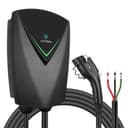
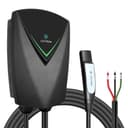
A hardwired charger is wired straight into a dedicated breaker with no receptacle in between. Three consequences follow:
You can use 48 amps. A NEMA 14-50 receptacle is a 50-amp device, and the continuous-load rule caps a charger on it at 40 amps. To draw 48 you need a 60-amp circuit and a hardwired connection. That is the single biggest functional difference between the two install types.
You remove the part that wears out.A 240-volt receptacle carrying 32 to 40 amps for six to ten hours a night, every night, is doing a job no dryer outlet was designed for. It is the most common failure point in a home charging circuit — see why an EV charger plug gets hot. Hardwiring deletes it.
You give up portability. A hardwired charger does not come with you when you move, and it cannot be taken on a trip. Our guide to taking a charger with you when you move is worth five minutes before you commit, and hardwired versus plug-in is the full comparison.
As for the price: hardwired chargers used to carry a premium because the hardwired units were the flagship models. That has reversed. Several of the cheapest 48-amp chargers in this registry are hardwire-only, because leaving off the plug and the input cord assembly removes cost rather than adding it.
The install is the real expense
Be honest with yourself about the total. PG&E, a large California utility, publishes an average installation cost of $400 to $1,200 on top of the charger itself, and a long conduit run, a full panel or a service upgrade sits above that range. A 60-amp circuit for a 48-amp charger is heavier wire than a 50-amp one, and the 125% continuous-load rule is what sets that. Our installation cost guide covers the five things that move a quote, and breaker and wire size gives the table your electrician will work from.
Which means: a $70 difference between two chargers on this page is noise. Pick on specification, not on the last few dollars. And if your panel cannot comfortably feed a 60-amp circuit, read the 100-amp panel page before you buy a 48-amp charger at all — four of the five units here can be turned down, but a charger you have to run at 24 amps forever is a charger you over-bought.
How to choose between them
Most houses:the EVIQO 48A. The adjustable range is the widest and finest here — 6 to 48 amps in one-amp increments — which means it fits a tight panel today and the full 60-amp circuit later. ENERGY STAR matters if a utility rebate is part of your budget, because plenty of programs require it.
If you do not want an app:the Lectron NEXUS J1772. It is the charger with the fewest dependencies in this registry, and the ENERGY STAR certified-product list records the point neatly — the NEXUS is certified twice, once without a radio at 1.86 watts standby and once with one at 3.02 watts. The catch, stated plainly: Lectron publishes no adjustable current range for this model, so it needs a 60-amp circuit to be used at all.
For a Tesla or NACS car: the EVIQO NACS 48A first, because it is the one hardwired NACS charger here that can be dialed down. The Lectron NEXUS NACS is the simpler, quieter alternative with the same no-radio trade.
For a wall with no roof over it:the Grizzl-E Ultimate 48A, in a cast-aluminum UL Type 4 case published from −22°F to 122°F, with OCPP as well as Grizzl-E’s own app. One honest catch we repeat everywhere: the only child listing Amazon carries for the Ultimate 48A is the NACS output-cable version, so a J1772 car needs an adapter permanently in the chain.
Just over the line
Three hardwired chargers we rate highly sit above $500 and do not appear here, and it is worth knowing what the extra money buys. The Autel MaxiChargerhas the widest published environmental envelope in this registry (IP65 / NEMA 4X, −40 to 131°F) and 50 amps, which needs a 70-amp circuit. The Emporia Proadds PowerSmart load management, though that needs the Vue monitor plus a PowerSmart upgrade — two separate line items. The Wallbox Pulsar Plus is the compact premium option, with the caveat that on our last read its own US page published neither an enclosure rating nor a warranty term. All three are ranked in full on our hardwired roundup.
And if the daily check moves a price while you are reading, the list above changes with it. That is deliberate: we would rather drop a charger than publish a price that has stopped being true.