Plug & Range

Best EV Chargers Under $200

The verdict before the list: two hundred dollars does not buy a Level 2 charger on this site. It buys a good 120-volt cord, or an adapter that unlocks chargers you do not own — and for a lot of drivers that is genuinely the right call.

By Stephen V.Last updated How we pick

The verdict first, and it is a blunt one. No Level 2 charger in this registry comes in under $200. What does is a good Lectron Level 1 cord at 15 amps— our top pick, and the fastest 120-volt charging on this page — and the J1772-to-NACS adapter, which is the best value of anything here and our budget pick: for the price of a tank of gas it opens every J1772 charger in the country to a Tesla or any native-NACS car. If your car takes a Tesla plug and you do not own that adapter, buy it before you buy anything else on this site.

Now the honest arithmetic, because the real question is not which cord to buy. It is whether a 120-volt cord is enough for you. Level 1 charging at 12 amps is about 1.44 kW, which at the 3.5 miles-per-kWh reference figure this site uses everywhere works out to roughly 5 miles of range an hour— our arithmetic, printed so you can re-run it. The 15-amp pick is about 1.8 kW, roughly 6 miles an hour. Over a twelve-hour overnight plug-in, that is 60 to 75 miles of range put back.

Compare that to how far people actually drive. For a commute under about 40 miles a day, a Level 1 cord on a normal household socket genuinely keeps up, every night, with no electrician, no permit and no $400-to-$1,200 install bill. For a plug-in hybrid it is not a compromise at all: most PHEV packs are small enough to fill overnight on 120 volts, and many cannot accept more than a few kilowatts anyway. Our plug-in hybrid charging guide works that through.

Where Level 1 fails: a long daily drive, a big battery you regularly run down, a cold climate where some of the energy goes to heating the pack rather than into it, or two cars sharing one cord. In those cases the right answer is not a cheaper charger but a bigger one — and the cheapest real Level 2 on this site is on our under-$500 portable page, where a full 40 amps starts near $200.

Everything below appears only if the daily retailer check put it under $200 on the last render. If a price crosses the line, the product drops off the page by itself rather than sitting here with a number that has stopped being true.

How this is funded:we earn a commission if you buy through our links, at no extra cost to you. It never changes which product we recommend, and we’ll tell you when we’d skip one. Full disclosure.

Quick picks

Ranked on published specs, charging speed, electrical fit and value. Select a row to jump to the full write-up. We have not bench-tested these chargers — here is exactly what we do instead.

#ProductBest forPrice
1
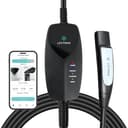
Lectron Level 1 Charger, 15A

Lectron Level 1 Charger, 15A

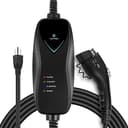
The charger you buy when you can't install anything. It plugs into an ordinary 120V household outlet and pulls 15 amps — the top of what a standard circuit will give you — which makes it the fastest thing you can do with zero electrical work. It is genuinely slow next to a 240V unit, and we won't pretend otherwise. But for a plug-in hybrid, a short commute or a rented parking spot, slow-and-installed beats fast-and-impossible.

Best overall under $200
$159.99 · View on Amazon

$179.9911% off

Price as of November 12, 2026. #ad How we’re funded

2
Lectron Level 1 Charger, 12A (Wi-Fi)

Lectron Level 1 Charger, 12A (Wi-Fi)

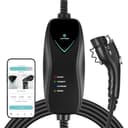
Level 1 charging with a brain. It gives up three amps against the plain 15A version and gets back the Lectron app — live charging status, scheduled sessions, and a kWh cap so you can stop a charge at a set amount. On Level 1 that scheduling matters more than it sounds: a trickle charge runs for most of the night anyway, so being able to start it when your off-peak rate does is worth more than the amps you traded away.

Best with scheduling
$169.99 · View on Amazon

$179.996% off

Price as of November 12, 2026. #ad How we’re funded

3
Lectron Level 1 Tesla (NACS) Charger, 12A (Wi-Fi)

Lectron Level 1 Tesla (NACS) Charger, 12A (Wi-Fi)

The Level 1 charger for a Tesla that does not make you carry an adapter. It is the same honest proposition as any Level 1 unit — an ordinary household socket, no electrician, no permit, and a slow overnight trickle — with the difference that the plug on the car end is the one your car actually has. The 15-amp version of this charger is gone from Amazon; what Lectron sells now is this 12-amp unit with the app, which trades three amps for scheduling and a kWh cap. On a charge that runs all night anyway, that is a fair swap.

Best for a Tesla or NACS car
$179.99 · View on Amazon

Price as of November 12, 2026. #ad How we’re funded

4
Lectron J1772 to Tesla (NACS) Adapter, 80A

Lectron J1772 to Tesla (NACS) Adapter, 80A

The single most useful accessory a Tesla or NACS owner can keep in the trunk. Snap it onto any J1772 home charger and it plugs straight into a Tesla — so you can buy the charger that's actually the best value and let this bridge the connector. It's rated to 80A/240V and UL 2252 certified, so it isn't the weak link.

Best value on this page, and the budget pick
$39.99 · View on Amazon

Price as of November 12, 2026. #ad How we’re funded

5
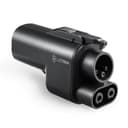
Lectron Vortex Plug NACS to CCS Adapter

Lectron Vortex Plug NACS to CCS Adapter

Lectron's older and cheaper road adapter, and the honest way to describe it is by what it does not have. Same headline numbers as the Vortex Plus — 500 amps, 1,000 volts, 500 kW — but Lectron's own page calls this one "UL2252 Compliant" rather than certified, holds the connection with a manual locking latch instead of an automatic dual interlock, and publishes neither an ingress-protection rating nor a warranty term for it. If the two are close in price on the day you look, there is no argument for this one.

Cheapest DC road adapter
$183.85 · View on Amazon

Price as of November 12, 2026. #ad How we’re funded

6
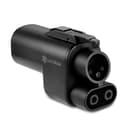
Lectron Vortex Plus NACS to CCS Adapter

Lectron Vortex Plus NACS to CCS Adapter

The one adapter on this site that has nothing to do with home charging — it is for the road. It lets a CCS1 car whose maker has bought into the Tesla network plug into a Supercharger, at up to 500 amps and 1,000 volts. Lectron publishes it as the first NACS-to-CCS adapter certified to UL 2252, and it carries a mechanical interlock, which is the part that matters on a connector handling that much DC.

Best DC road adapter, if it fits the band
$199.99 · View on Amazon

Price as of November 12, 2026. #ad How we’re funded

The picks in full

#1Best overall under $200

Lectron Level 1 Charger, 15A

The charger you buy when you can't install anything. It plugs into an ordinary 120V household outlet and pulls 15 amps — the top of what a standard circuit will give you — which makes it the fastest thing you can do with zero electrical work. It is genuinely slow next to a 240V unit, and we won't pretend otherwise. But for a plug-in hybrid, a short commute or a rented parking spot, slow-and-installed beats fast-and-impossible.

Strengths

  • Works from any standard 120V outlet — no electrician, no install
  • 15A is the practical ceiling for Level 1, so it's the fastest version of the slow option
  • IP65 weather resistance and a 16 ft cable at a budget price

Trade-offs

  • Level 1 is genuinely slow — plan in overnights, not hours
  • No app or scheduling on this version
  • Lectron doesn't publish a warranty term for it
Max output15 A
Power1.8 kW
ConnectorJ1772
InstallNEMA 5-15 plug (standard 120V outlet)
Cable length16 ft
WarrantyNot published
WiFi + appNo
CertificationsETL listed (UL 2594 / UL 2231)

Our charging-speed math. 15A at 120V is about 1.8 kW, so at 3.5 mi/kWh it adds roughly 6 miles of range an hour — call it 60-plus miles across a 10-hour overnight, before charging losses.

Build note. Lectron publishes 120V / 15A / 1.8 kW through a NEMA 5-15 plug, a 16 ft cable and an IP65-rated body with over-voltage, over-current and short-circuit protection.

Specs read from the manufacturer spec sheet, on August 11, 2026. “Not published” means the brand does not state that figure.

#2Best with scheduling

Lectron Level 1 Charger, 12A (Wi-Fi)

Level 1 charging with a brain. It gives up three amps against the plain 15A version and gets back the Lectron app — live charging status, scheduled sessions, and a kWh cap so you can stop a charge at a set amount. On Level 1 that scheduling matters more than it sounds: a trickle charge runs for most of the night anyway, so being able to start it when your off-peak rate does is worth more than the amps you traded away.

Strengths

  • App gives real-time status, scheduling and a kWh charge limit
  • Same no-install 120V convenience as the plain model
  • ETL listing to the same UL 2594 / UL 2231 standards

Trade-offs

  • 12A instead of 15A — slower again than an already slow charging level
  • You're paying for an app on a charger that mostly runs unattended overnight
  • No published warranty term
Max output12 A
Power1.44 kW
ConnectorJ1772
InstallNEMA 5-15 plug (standard 120V outlet)
Cable length16 ft
WarrantyNot published
WiFi + appYes
CertificationsETL listed (UL 2594 / UL 2231)

Our charging-speed math. 12A at 120V is about 1.44 kW, so at 3.5 mi/kWh that's roughly 5 miles of range an hour — about 50 miles across a 10-hour overnight, before losses.

Build note. Lectron publishes 120V / 12A / up to 1.44 kW, a 16 ft cable, an IP65-rated control box, and a Lectron app that schedules sessions and caps a charge at a chosen number of kWh.

Specs read from the manufacturer spec sheet, on August 11, 2026. “Not published” means the brand does not state that figure.

#3Best for a Tesla or NACS car

Lectron Level 1 Tesla (NACS) Charger, 12A (Wi-Fi)

The Level 1 charger for a Tesla that does not make you carry an adapter. It is the same honest proposition as any Level 1 unit — an ordinary household socket, no electrician, no permit, and a slow overnight trickle — with the difference that the plug on the car end is the one your car actually has. The 15-amp version of this charger is gone from Amazon; what Lectron sells now is this 12-amp unit with the app, which trades three amps for scheduling and a kWh cap. On a charge that runs all night anyway, that is a fair swap.

Strengths

  • Native NACS connector at the cheapest charging level Lectron sells
  • Lectron app gives real-time status, scheduled sessions and a kWh charge cap
  • Nothing to install: any grounded 120V socket is the whole requirement
  • IP67-rated control box and a Type 3R handle, so an outdoor socket is within spec

Trade-offs

  • Level 1 is genuinely slow — about 5 miles of range an hour, and no faster
  • 12 amps, not the 15 the discontinued version of this charger pulled
  • A J1772 car cannot use it without a NACS-to-J1772 adapter
  • Lectron does not publish a warranty term for this model
Max output12 A
Power1.44 kW
ConnectorNACS
InstallNEMA 5-15 plug (standard 120V outlet)
Cable length16 ft
WarrantyNot published
WiFi + appYes
CertificationsUL 2594 / UL 2231 certified

Our charging-speed math. 12A at 120V is 1.44 kW, so at 3.5 mi/kWh that is roughly 5 miles of range an hour — about 50 miles across a 10-hour overnight, before losses. Lectron's own figure is 30-40 miles overnight, which is the more conservative number.

Build note. Lectron publishes 120V, 12 A and up to 1.44 kW through a NEMA 5-15 plug on a 16 ft cable, a native Tesla (NACS) connector, an IP67-rated control box with a Type 3R handle, protection against overvoltage, overcurrent and short circuits with an LED status indicator, and UL 2594 / UL 2231 certification. The Lectron app runs over Wi-Fi or Bluetooth and schedules sessions, reports status live and caps a charge at a chosen number of kWh. A carrying case is included.

Specs read from the manufacturer spec sheet, on September 29, 2026. “Not published” means the brand does not state that figure.

#4Best value on this page, and the budget pick

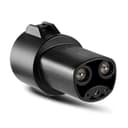
Lectron J1772 to Tesla (NACS) Adapter, 80A

The single most useful accessory a Tesla or NACS owner can keep in the trunk. Snap it onto any J1772 home charger and it plugs straight into a Tesla — so you can buy the charger that's actually the best value and let this bridge the connector. It's rated to 80A/240V and UL 2252 certified, so it isn't the weak link.

Strengths

  • Lets a Tesla or NACS car charge from any J1772 charger
  • Rated to 80A / 240V — never the bottleneck on a home circuit
  • UL 2252 certified and IP67-rated for water and dust

Trade-offs

  • One more thing to seat firmly and not lose
  • For AC home charging only — not a Supercharger or DC adapter
Max output80 A
PowerNot published
ConnectorNACS
InstallNot published
Cable lengthNot published
WarrantyNot published
WiFi + appNot published
CertificationsUL 2252 certified, IP67

Our charging-speed math. The adapter doesn't set the speed — the charger does. Rated to 80A, it simply passes through whatever your J1772 charger delivers (typically 40-48A / 9.6-11.5 kW at home).

Build note. Rated -22 to 122 degrees F; converts a J1772 connector to the Tesla/NACS (J3400) plug for AC home charging.

Specs read from the manufacturer spec sheet, on July 19, 2026. “Not published” means the brand does not state that figure.

#5Cheapest DC road adapter

Lectron Vortex Plug NACS to CCS Adapter

Lectron's older and cheaper road adapter, and the honest way to describe it is by what it does not have. Same headline numbers as the Vortex Plus — 500 amps, 1,000 volts, 500 kW — but Lectron's own page calls this one "UL2252 Compliant" rather than certified, holds the connection with a manual locking latch instead of an automatic dual interlock, and publishes neither an ingress-protection rating nor a warranty term for it. If the two are close in price on the day you look, there is no argument for this one.

Strengths

  • Same published electrical ceiling as the Plus: 500A / 1,000V / 500 kW
  • Usually the cheaper of Lectron's two NACS-to-CCS adapters
  • Light enough to live in a door pocket — Lectron gives it as about 2 lb

Trade-offs

  • "UL2252 Compliant" on Lectron's own page, not UL 2252 certified — the Plus is the certified one
  • A manual locking latch rather than the Plus's automatic dual interlock
  • No ingress-protection rating and no warranty term published for this model
  • DC only, Superchargers only, and only if your automaker has granted your car access
Max output500 A
Power500 kW
ConnectorNACS
InstallNot published
Cable lengthNot published
WarrantyNot published
WiFi + appNot published
CertificationsUL 2252 compliant (Lectron's wording; it does not claim certification)

Our charging-speed math. DC fast charging, so our 240V home arithmetic does not apply. Lectron publishes roughly 150 miles in about 15 minutes and states the real rate depends on the Supercharger generation and the car.

Build note. A NACS (SAE J3400) to CCS1 adapter published at 500A / 1,000V / 500 kW, weighing approximately 2 lb. Lectron's page states "UL2252 Compliant" and its FAQ says the Plug "adheres to UL 2252 design standards" — not that it is certified — and describes its retention as a "manual locking latch", explicitly contrasting it with the Vortex Plus's automatic dual interlock. The page publishes no ingress-protection rating, no warranty term and no dimensions. It states the adapter is designed exclusively for CCS1-equipped EVs with automaker-granted Supercharger access, and is not for Tesla vehicles, Tesla Destination Chargers, other CCS networks, or Level 1 / Level 2 AC charging of any kind.

Specs read from the manufacturer spec sheet, on October 18, 2026. “Not published” means the brand does not state that figure.

#6Best DC road adapter, if it fits the band

Lectron Vortex Plus NACS to CCS Adapter

The one adapter on this site that has nothing to do with home charging — it is for the road. It lets a CCS1 car whose maker has bought into the Tesla network plug into a Supercharger, at up to 500 amps and 1,000 volts. Lectron publishes it as the first NACS-to-CCS adapter certified to UL 2252, and it carries a mechanical interlock, which is the part that matters on a connector handling that much DC.

Strengths

  • 500A / 1,000V rating — it is not the bottleneck at a V3 or V4 Supercharger
  • Lectron publishes it as the first publicly available NACS-to-CCS adapter certified to UL 2252
  • Built-in interlock holds the connection during a high-voltage DC session

Trade-offs

  • Only works if your automaker has enabled Supercharger access for your car
  • Not compatible with Tesla vehicles, and not for AC charging at all
  • Costs multiples of an AC home-charging adapter
Max output500 A
Power500 kW
ConnectorNACS
InstallNot published
Cable lengthNot published
Warranty2 years
WiFi + appNot published
CertificationsUL 2252 certified (Lectron states it is tested by SGS)

Our charging-speed math. This is DC fast charging, so our 240V home math does not apply. Lectron publishes up to 150 miles in about 15 minutes, and states that the actual rate depends on the Supercharger generation and your car.

Build note. A NACS (SAE J3400) to CCS1 adapter published at 500A / 1,000V / 500 kW with a built-in interlock, certified to UL 2252. Lectron's FAQ describes it as an "automatic internal dual-locking mechanism (interlock) on both the NACS and CCS1 connections" and calls it automaker-approved, publishes an IP67 ingress-protection rating and a standard 2-year manufacturer warranty, and states the adapter is tested by SGS. Lectron states it is for CCS1 EVs with automaker-granted Supercharger access, that it works at V3 and V4 Superchargers but not older V2 units, and that it is not compatible with Tesla vehicles or with any AC charging station. Re-read 2026-10-18: the kW figure, the IP rating and the warranty term are published today and were null in this registry from the 2026-08-12 read.

Specs read from the manufacturer spec sheet, on October 18, 2026. “Not published” means the brand does not state that figure.

What each price band actually buys

BudgetWhat it buys on this siteTypical outputRange per hour (3.5 mi/kWh)
Under $50A J1772-to-NACS adapterNo charging on its ownUnlocks any J1772 charger
$150–$200A Level 1 (120 V) cord, 12–15 A1.44–1.8 kWabout 5–6 miles
$180–$200A NACS-to-CCS1 DC road adapterFast charging only, not at home—
$200–$300A real 40 A Level 2 portable9.6 kWabout 34 miles
$450–$500A 48 A hardwired wall charger11.5 kWabout 40 miles

Look at the fourth row. The jump from a Level 1 cord to a 40-amp portable is often less than a hundred dollars and multiplies your charging speed by about six. That is the single most important fact on this page, and it is why we do not pretend the under-$200 band is a great place to shop for a primary charger. It is a great place to shop for a second one, a backup, or an adapter.

The adapters are the bargain here

Two of the picks above are not chargers at all, and one of them is the highest-value purchase on the page.

The J1772-to-NACS adapter is rated to 80 amps and costs less than a set of wiper blades. If you drive a Tesla or any car with a native NACS port, it converts the entire installed base of J1772 home and public Level 2 chargers into chargers you can use. There is no other product on this site with that leverage per dollar. Our full review covers the heat and amperage questions.

The NACS-to-CCS1 adapters— the Lectron Vortex Plug and Vortex Plus — are a completely different proposition, and we need to be clear about it: they are DC fast-charging parts and they do nothing at home. Lectron states plainly that they are not for Level 1 or Level 2 AC charging of any kind, nor for Tesla Destination Chargers. They open Tesla Superchargers to a CCS1 car whose automaker has granted access. If your intent is overnight charging in a garage, neither of them is what you want. Our NACS adapter roundup sorts all four adapters by direction, which is the mistake this category generates most often.

How to choose between the three Level 1 cords

Most drivers: the 15-amp Lectron. It is the fastest 120-volt charging here, and the difference against a 12-amp cord is about a mile of range an hour, which over a twelve-hour night is twelve miles. One caution: 15 amps is the full rating of a standard household circuit, which means it should be on a circuit with nothing else on it, and on an old or shared circuit a 12-amp cord is the safer choice. Lectron publishes no warranty term for any of these cords, which we record as not published rather than guessing.

If you are on a time-of-use rate: the 12-amp Wi-Fi version. It schedules from an app, which on a tariff with a cheap overnight window is worth more than the extra amp. See charging on a time-of-use rate and chargers with a built-in timer.

For a Tesla or NACS car: the 12-amp NACS version, which saves you carrying the adapter. Though if you only own one charging cord, the J1772 version plus the adapter is the more flexible pair — it works on other people’s chargers too.

What you give up at this price, honestly

Speed, obviously— about 5 or 6 miles of range an hour instead of 34 or 40.

The ENERGY STAR listing. None of the Level 1 cords here carries one. If a utility rebate requiring ENERGY STAR certification is part of your plan, that rules them out; check the certified-product list for your exact model number before counting on the money.

A published warranty. Lectron publishes no warranty term for the Level 1 cords, which is a real gap on a product that lives in a trunk and gets stood on.

What you do not give up is safety.These are listed products, and price is not the safety signal — the certification is. What you should not buy at any price is an unlisted charger, and our guide to whether cheap EV chargers are safe shows how to tell the difference in a minute, including the phrases that only sound like certification.

One thing to avoid entirely: do not solve a reach problem at this price with an extension cord. Our extension cord guide explains why the added contact faces are the wrong place to save money, and why a charger plug gets hot explains what happens when that goes wrong.

If you were shopping for a gift

All of these make good presents, and we have a page written for the gifter rather than the buyer: EV gifts under $200. This page is the version for someone buying for their own car, where the honest comparison with a $250 Level 2 charger matters more than the wrapping.
Frequently asked questions

Can you buy a Level 2 EV charger for under $200?

Not on this site. The cheapest real 40-amp Level 2 charger in our registry sits a little above $200 most days. Under $200 buys a Level 1 (120-volt) cord at 12 to 15 amps, or an adapter. The jump to a full 40-amp portable is often under a hundred dollars more and multiplies charging speed by roughly six, which is why we point most buyers there.

Is a Level 1 charger enough for an EV?

For a daily drive under about 40 miles, usually yes. At 12 amps you get roughly 5 miles of range an hour and at 15 amps about 6, so a twelve-hour overnight plug-in returns 60 to 75 miles. It stops being enough with a long commute, a big battery you regularly run low, cold weather, or two cars sharing one cord. For a plug-in hybrid it is frequently all you ever need.

What is the best thing to buy for under $200?

If your car has a native NACS (Tesla) port and you do not own a J1772-to-NACS adapter, that adapter — it costs a fraction of everything else here and it makes every J1772 charger in the country usable. Otherwise, the 15-amp Lectron Level 1 cord, which is the fastest 120-volt charging on this page.

Will a NACS to CCS adapter let me charge at home?

No. Those are DC fast-charging parts. Lectron states that its Vortex adapters are not for Level 1 or Level 2 AC charging of any kind, nor for Tesla Destination Chargers — they are for Superchargers, and only for CCS1 cars whose automaker has granted access. They are on this page because they fall in the price band, not because they help in a garage.

Is 15 amps better than 12 amps on a Level 1 charger?

It is about one extra mile of range an hour, or roughly twelve over a long night. The caveat matters more than the gain: 15 amps is the full rating of a standard 15-amp household circuit, so it wants a circuit with nothing else on it. On an old or shared circuit, a 12-amp cord is the safer choice.

Do cheap EV chargers have worse safety certification?

Not necessarily, and the certification is the thing to check rather than the price. A charger listed by UL, Intertek (ETL) or CSA against UL 2594 has been tested to the same standard whatever it cost. What you should avoid at any price is a charger that names no laboratory, or that lists a component rather than the charger — 'UL-listed cable' is not a listing of the charger.

Why do products appear and disappear from this list?

Because the page filters on live prices. The retailer price for every product is checked daily, and anything the check puts at or above $200 is left off. One that dips back under reappears next time the page renders. We would rather drop a product than show a price that is no longer true.

Can I use a normal extension cord with a Level 1 charger?

It is the wrong place to economise. Every extra connection is a place for resistance and therefore heat, and the charging circuit is the most heat-stressed in the house because it runs near its limit for hours. If the cord does not reach, move the parking spot or get a proper outlet installed. Our extension cord guide covers the specifics.

Sources

  • U.S. DOE Alternative Fuels Data Center — Electric Vehicle Charging Stations — US DOE on charging levels: Level 1 (~1.9 kW, ~5 mi/hr), Level 2 (2.9-19.2 kW, ~7.2 kW typical residential, ~25 mi/hr), and DC fast charging (accessed July 19, 2026)
  • U.S. DOE Alternative Fuels Data Center — Charging Electric Vehicles at Home — US DOE on home EV charging: most owners charge overnight on Level 1 or Level 2, installs follow NEC Article 625, with example home-charging costs (accessed July 19, 2026)
  • NFPA — Using the Latest NEC for EV Charger Installations — NFPA on NEC (NFPA 70) Article 625: EV charging is a continuous load, so circuits are sized to 125% of load (the 80% rule) (accessed July 19, 2026)
  • PG&E — Electric Vehicle Charging — A US utility's own published install guidance: a Level 2 charging station averages $500-$700 and installation averages $400-$1,200 excluding the charger; Level 2 needs a professionally installed 240V outlet on a dedicated circuit (accessed July 20, 2026)
  • Lectron — Vortex Plug NACS to CCS adapter product page — Manufacturer page, fetched 2026-10-18: published as "500A / 1,000V / 500 kW", weighing approximately 2 lb, for CCS1-equipped EVs with automaker-granted Supercharger access (the FAQ names Ford, GM, Rivian, Hyundai, Kia, Genesis, Volvo, Polestar, Mercedes-Benz and Nissan). Two wordings decide the comparison on our page and both are Lectron's own: the features list says "UL2252 Compliant" and the FAQ says the Plug "adheres to UL 2252 design standards" — neither claims certification — and the FAQ describes its retention as a "manual locking latch", explicitly contrasting that with the Vortex Plus's automatic dual interlock. The page publishes NO ingress-protection rating, NO warranty term and NO dimensions. It states the adapter is not for Tesla vehicles, Tesla Destination Chargers, other CCS networks, or Level 1 / Level 2 AC charging (accessed October 18, 2026)
  • Lectron — Vortex Plus NACS to CCS adapter with interlock product page — Manufacturer page, fetched 2026-10-18: published as "500A / 1,000V / 500 kW", "UL2252 Certified" with the FAQ adding "it is UL 2252 certified and tested by SGS" (no file number is given), an "IP67 Ingress Protection rating", an "automatic internal dual-locking mechanism (interlock) on both the NACS and CCS1 connections" described as automaker-approved, and a "standard 2-Year Manufacturer Warranty covering defects in materials and workmanship". Compatibility is stated as CCS1 vehicles with automaker-approved Supercharger access, with the FAQ naming the Mustang Mach-E, F-150 Lightning, Chevrolet / Cadillac / GMC, R1T and R1S, IONIQ 5 and IONIQ 6, EV6 and EV9 and the GV60. Limits, in Lectron's words: it "will not work with older V2 Superchargers, nor will it work with Level 1 or Level 2 AC chargers", it is "not compatible with Tesla vehicles or AC charging stations", and "Tesla does not officially guarantee third-party adapter compatibility" (accessed October 18, 2026)
  • ENERGY STAR — Certified Electric Vehicle Supply Equipment (AC-Output), certified-product list — The certifier's own list of certified AC chargers, by model number, with the measured standby figures behind each certification. Queried 2026-10-04: Lectron's Nexus is certified twice over, once as LECHGNexusHWJ1772 (48 A, network capability 'No', 1.86 W in no-vehicle mode) and once as LECHGNexusHWJ1772-APP (48 A, network capability 'Yes', 3.02 W) — the same hardware with and without a radio. The plug-in pair is recorded the same way (LECHGNexusNEMA14-50J1772 at 1.88 W, the -APP version at 3.14 W). No ELEGRP or EVDANCE product appears anywhere on the list (accessed October 4, 2026)
  • UL Solutions — EV Charging Infrastructure Services — UL on EVSE safety certification: ANSI/UL 2594 is the Standard for Electric Vehicle Supply Equipment (accessed July 19, 2026)
  • FuelEconomy.gov — Electric Vehicles: Learn More About the Label — DOE/EPA on EV efficiency: kWh per 100 miles and MPGe, accounting for AC charging losses (accessed July 19, 2026)

Keep reading