Plug & Range

Best Portable EV Chargers Under $500

A portable charger plugs into an outlet you already own, needs no electrician on the day, and comes with you when you move. Under $500 that now includes a full 40 amps.

By Stephen V.Last updated How we pick

The verdict first. The Lectron 40A is the portable charger to buy under $500 for most people: a full 40 amps through a NEMA 14-50 plug, which is the most any charger may draw from that receptacle, with nothing to install and nothing to log into. The ELEGRP 40A is our budget pick and the cheapest real 40 amps in this registry — it publishes five current levels from 16 to 40 amps set on the unit, an IP67 body, a stated −21°F floor and ETL certification, which is a lot of published specification for the money. For a Tesla or any native-NACS car, the Lectron 40A NACS is the same idea with the Tesla plug already on the end.

Why “portable” is the interesting category at this price: the charger is rarely the expensive part of home charging. PG&E, a large California utility, publishes an average installation cost of $400 to $1,200 on top of the hardware. If a 240-volt receptacle already exists within reach of where you park — a dryer outlet, a welder outlet, an old air-conditioner circuit — a plug-in charger skips that entire bill. That is the reason a $250 portable can be the better buy than a $450 hardwired unit, and it has nothing to do with the hardware.

What you are capped at is 40 amps, and that cap is code rather than cost. A NEMA 14-50 is a 50-amp receptacle, EV charging is a continuous load, so a charger on it may draw no more than 80% — 40 amps, about 9.6 kW, roughly 34 miles of range an hourat the 3.5 miles-per-kWh reference figure this site uses throughout. That is our arithmetic, printed so you can re-run it. Forty-eight amps, about 40 miles an hour, requires a hardwired 60-amp circuit — see hardwired chargers under $500 if that is the route you want.

Every charger on this page appears only if the daily retailer check put it under $500 on the last build. If a price crosses the line the charger drops off by itself rather than sitting here with a number that has stopped being true, and where a price could not be verified that day the button reads “Check price on Amazon” instead of showing one.

How this is funded:we earn a commission if you buy through our links, at no extra cost to you. It never changes which product we recommend, and we’ll tell you when we’d skip one. Full disclosure.

Quick picks

Ranked on published specs, charging speed, electrical fit and value. Select a row to jump to the full write-up. We have not bench-tested these chargers — here is exactly what we do instead.

#ProductBest forPrice
1
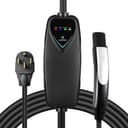
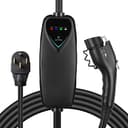
Lectron 40A Portable Level 2 Charger

Lectron 40A Portable Level 2 Charger

The least-expensive honest route into real Level 2 charging. Plug it into a NEMA 14-50 outlet, pull a true 40A / 9.6 kW, and unplug it to throw in the trunk for a trip. The trade-offs for the price are no app and a shorter warranty — both fair at this cost.

Best overall portable under $500
$279.99 · View on Amazon

Price as of November 12, 2026. #ad How we’re funded

2
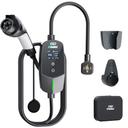
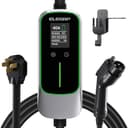
ELEGRP 40A Portable Level 2 Charger (ECP24-40A0-01)

ELEGRP 40A Portable Level 2 Charger (ECP24-40A0-01)

The cheapest charger in this registry that still publishes everything you would want to check: 9.6 kW, five current levels from 16 to 40 amps, an IP67 body with a stated -21°F floor, ETL certification and a 2-year warranty. There is no Wi-Fi and no app — you get a 1-to-12-hour delay timer on the unit instead — and for a lot of households that is the correct amount of charger.

Cheapest real 40 amps, and the budget pick
$209.99 · View on Amazon

Price as of November 12, 2026. #ad How we’re funded

3
Lectron Level 2 Tesla (NACS) Portable Charger, 40A

Lectron Level 2 Tesla (NACS) Portable Charger, 40A

The straightforward native-NACS answer for a Tesla owner who wants real Level 2 speed without hardwiring anything. Plug it into a NEMA 14-50, pull a full 40 amps, and unplug it when you move or travel. There is no app and no adjustable current — what you are buying is the Tesla plug on the end of a proper 40-amp portable charger, at a price well under a wall-mounted NACS station.

Best for a Tesla or NACS car
$279.99 · View on Amazon

$319.9913% off

Price as of November 12, 2026. #ad How we’re funded

4
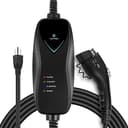
EVDANCE 24A NEMA 14-30 Portable Charger (EV-ACS2405U)

EVDANCE 24A NEMA 14-30 Portable Charger (EV-ACS2405U)

The charger a dryer outlet actually wants. The plug on the end is a NEMA 14-30, so it goes straight into a four-prong dryer receptacle with no adapter, and its maximum is 24 amps — exactly what a 30-amp circuit allows — so there is no setting that can ask that circuit for more. Its manual carries an Intertek ETL mark to UL 2594, and it steps down to 10 amps for a circuit you are unsure of. What the low price costs you is a one-year warranty and documentation that disagrees with itself in places worth reading carefully.

Best for a dryer outlet
$269.99 · View on Amazon

Price as of November 12, 2026. #ad How we’re funded

5
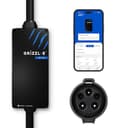
Grizzl-E Mini 40A Portable Charger (J1772)

Grizzl-E Mini 40A Portable Charger (J1772)

The only charger on our dryer-outlet page that can grow past one. It is a UL-certified 40-amp portable on a NEMA 14-50 plug, and United Chargers puts a NEMA 14-30P adapter in the box alongside 6-50P, TT-30P and 5-15P adapters — so it runs at 24 amps on your dryer outlet today and at 40 the day an electrician fits a 14-50. The catch is the one that matters most here: it ships set to 40 amps, United Chargers' current Mini manual says outright that the charger cannot detect a circuit's amperage limit, and turning it down before the first session is your job.

Best if your outlet could be anything
$349.99 · View on Amazon

$479.9927% off

Price as of November 12, 2026. #ad How we’re funded

6
Lectron Level 1 Charger, 15A

Lectron Level 1 Charger, 15A

The charger you buy when you can't install anything. It plugs into an ordinary 120V household outlet and pulls 15 amps — the top of what a standard circuit will give you — which makes it the fastest thing you can do with zero electrical work. It is genuinely slow next to a 240V unit, and we won't pretend otherwise. But for a plug-in hybrid, a short commute or a rented parking spot, slow-and-installed beats fast-and-impossible.

Best 120V backup to keep in the trunk
$159.99 · View on Amazon

$179.9911% off

Price as of November 12, 2026. #ad How we’re funded

The picks in full

#1Best overall portable under $500

Lectron 40A Portable Level 2 Charger

The least-expensive honest route into real Level 2 charging. Plug it into a NEMA 14-50 outlet, pull a true 40A / 9.6 kW, and unplug it to throw in the trunk for a trip. The trade-offs for the price are no app and a shorter warranty — both fair at this cost.

Strengths

  • A real 40A / 9.6 kW at a budget price
  • Plug-in and portable — no hardwiring, and it travels
  • ETL listed to the UL 2594 / UL 2231 safety standards

Trade-offs

  • No Wi-Fi or app on the base model — the smart version is a separate SKU
  • Shorter 16 ft cable and a 2-year warranty
  • The brand doesn't publish an outdoor/IP enclosure rating
Max output40 A
Power9.6 kW
ConnectorJ1772
InstallNEMA 14-50 plug
Cable length16 ft
Warranty2 years
WiFi + appNo
CertificationsETL listed (UL 2594 / UL 2231)

Our charging-speed math. At 40A (9.6 kW) and 3.5 mi/kWh it adds roughly 34 miles of range an hour.

Build note. A portable plug-in unit — no hardwiring — and the base model carries no Wi-Fi or app.

Specs read from the manufacturer spec sheet, on July 19, 2026. “Not published” means the brand does not state that figure.

#2Cheapest real 40 amps, and the budget pick

ELEGRP 40A Portable Level 2 Charger (ECP24-40A0-01)

The cheapest charger in this registry that still publishes everything you would want to check: 9.6 kW, five current levels from 16 to 40 amps, an IP67 body with a stated -21°F floor, ETL certification and a 2-year warranty. There is no Wi-Fi and no app — you get a 1-to-12-hour delay timer on the unit instead — and for a lot of households that is the correct amount of charger.

Strengths

  • Five current levels (16/20/24/32/40A) — it fits whatever circuit you have
  • IP67 with a published -21°F to 121°F range, and a carrying case in the box
  • 2-year warranty and full ETL certification at the bottom of the price band

Trade-offs

  • No Wi-Fi, no app and no energy monitoring — just an on-unit delay timer
  • Not ENERGY STAR listed, so it may not qualify for some utility rebates
  • 40 amps is the plug-in ceiling; a 48-amp unit needs hardwiring
Max output40 A
Power9.6 kW
ConnectorJ1772
InstallNEMA 14-50 plug
Cable length25 ft
Warranty2 years
WiFi + appNo
CertificationsETL certified

Our charging-speed math. Forty amps at 240V is 9.6 kW, and at 3.5 miles per kWh that is roughly 34 miles of range an hour. ELEGRP's own figure is 37 miles an hour, which assumes a slightly more efficient car than our reference.

Build note. ELEGRP publishes 240V, up to 9.6 kW, five selectable current levels of 16, 20, 24, 32 and 40 amps, a NEMA 14-50 plug, a 25 ft cable measured plug-end to connector, a J1772 connector, ETL certification with its PBE overheat protection, an IP67 rating with a -21°F to 121°F range, a 1-12 hour delayed start, a carrying case and a 2-year warranty.

Specs read from the manufacturer spec sheet, on August 19, 2026. “Not published” means the brand does not state that figure.

#3Best for a Tesla or NACS car

Lectron Level 2 Tesla (NACS) Portable Charger, 40A

The straightforward native-NACS answer for a Tesla owner who wants real Level 2 speed without hardwiring anything. Plug it into a NEMA 14-50, pull a full 40 amps, and unplug it when you move or travel. There is no app and no adjustable current — what you are buying is the Tesla plug on the end of a proper 40-amp portable charger, at a price well under a wall-mounted NACS station.

Strengths

  • Native NACS connector — nothing to seat, nothing to lose, no adapter
  • A real 40A / 9.6 kW from an ordinary NEMA 14-50 outlet
  • IP65 control box and IP55 handle, rated by Lectron for outdoor use
  • Plug-in and portable, so it moves with you and travels

Trade-offs

  • No Wi-Fi or app on this SKU — the smart version is a separate, dearer listing
  • No adjustable current, so it cannot be trimmed down for an unverified outlet
  • A J1772 car needs a NACS-to-J1772 adapter — buy a J1772 charger instead
  • Lectron does not publish a warranty term for this model
Max output40 A
Power9.6 kW
ConnectorNACS
InstallNEMA 14-50 plug
Cable length16 ft
WarrantyNot published
WiFi + appNo
CertificationsETL listed (UL 2594 / UL 2231), UL 2251 handle, FCC

Our charging-speed math. At 40A on 240V (9.6 kW) and our 3.5 mi/kWh reference, roughly 34 miles of range an hour. Lectron's own figure is up to 36 miles an hour, which assumes a slightly more efficient car than our reference.

Build note. Lectron publishes 240V, 40 A and 9.6 kW through a NEMA 14-50 plug on a 16 ft cable, a native Tesla (NACS) connector, an IP65-rated control box with an IP55-rated handle tested to 10,000-plus insertions, protection against overvoltage, overcurrent and short circuits, and ETL/FCC certification against UL 2594 and UL 2231 with a UL 2251 handle. This SKU has no Wi-Fi or app.

Specs read from the manufacturer spec sheet, on August 21, 2026. “Not published” means the brand does not state that figure.

#4Best for a dryer outlet

EVDANCE 24A NEMA 14-30 Portable Charger (EV-ACS2405U)

The charger a dryer outlet actually wants. The plug on the end is a NEMA 14-30, so it goes straight into a four-prong dryer receptacle with no adapter, and its maximum is 24 amps — exactly what a 30-amp circuit allows — so there is no setting that can ask that circuit for more. Its manual carries an Intertek ETL mark to UL 2594, and it steps down to 10 amps for a circuit you are unsure of. What the low price costs you is a one-year warranty and documentation that disagrees with itself in places worth reading carefully.

Strengths

  • Native NEMA 14-30 plug with a 24-amp maximum — it cannot be set above what the circuit allows
  • ETL listed (Intertek control number 5034626) to UL 2594 and UL 2231-2, per its user manual
  • Five current steps (10/12/16/20/24A) for an older or unverified dryer circuit
  • On-unit display of current, voltage, kWh and session time, plus a 1-12 hour delay timer

Trade-offs

  • One-year warranty, the shortest of the picks on our dryer-outlet page
  • EVDANCE's own pages disagree on the circuit it needs (a "20A circuit" on the store page, a "32A breaker" in the manual) — a 14-30 is a 30-amp receptacle
  • The 25 ft is total length: about 21.9 ft from control box to car and 3.1 ft from box to outlet, per the Amazon listing
  • EVDANCE says the plug-and-socket joint is not waterproof, and the connector needs its cap when stored
Max output24 A
Power5.76 kW
ConnectorJ1772
InstallNEMA 14-30 plug (four-prong dryer outlet)
Cable length25 ft
Warranty1 year
WiFi + appNot published
CertificationsETL listed (Intertek 5034626) to UL 2594, UL 2231-2 and CSA C22.2

Our charging-speed math. At its 24-amp maximum and 240V it delivers 5.76 kW, roughly 20 miles of range an hour at our 3.5 miles-per-kWh reference, or about 200 miles across a ten-hour overnight window. Dropped to 16 amps for an older circuit, it is about 13 miles an hour.

Build note. From EVDANCE's user manual for model EV-ACS2405U: 24A maximum at 240V (5.76 kW); current chosen before plugging into the car by holding the A button and stepping through 10, 12, 16, 20 or 24A; a 1.77-inch display showing real-time current, voltage, power, kWh, session time and temperature; a 1-12 hour delayed start; a Type 4 enclosure; a -22°F to 122°F operating range; 25 ft total length; an SAE J1772 connector; certification to UL 2231-2, UL 2594 and CSA C22.2 under an Intertek ETL mark (control number 5034626); and a 12-month warranty. The documentation is inconsistent, and we record the manual over the store page: the evdances.com spec table for this same product lists a "6-32A" adjustable range, a "Dedicated 20A Circuit" and a "J1772/CCS" connector, and the site banner advertises a 3-year warranty that the product page, the manual and the Amazon listing all put at one year. The manual pictures Wi-Fi and Bluetooth icons and EVDANCE sells a Wi-Fi version on its own store, but the Amazon listing we link does not state an app, so Wi-Fi is recorded as not published.

Specs read from the manufacturer spec sheet, on September 15, 2026. “Not published” means the brand does not state that figure.

#5Best if your outlet could be anything

Grizzl-E Mini 40A Portable Charger (J1772)

The only charger on our dryer-outlet page that can grow past one. It is a UL-certified 40-amp portable on a NEMA 14-50 plug, and United Chargers puts a NEMA 14-30P adapter in the box alongside 6-50P, TT-30P and 5-15P adapters — so it runs at 24 amps on your dryer outlet today and at 40 the day an electrician fits a 14-50. The catch is the one that matters most here: it ships set to 40 amps, United Chargers' current Mini manual says outright that the charger cannot detect a circuit's amperage limit, and turning it down before the first session is your job.

Strengths

  • Three-year warranty and a UL certification from an established North American brand
  • The NEMA 14-30P adapter comes in the box from the manufacturer, not as a third-party add-on
  • A DIP switch inside can cap it at 24 amps in hardware, and no Wi-Fi setting can exceed that cap
  • Runs at a full 40 amps on a NEMA 14-50 if the outlet is upgraded later

Trade-offs

  • Ships set to 40 amps and cannot detect the circuit — on a 14-30 it must be turned down before first use
  • Setting the hardware cap means unplugging it and removing the front cover to reach the switch
  • By a wide margin the most expensive pick, for capacity a dryer outlet will never let you use
  • The adapter adds a plug-and-socket joint that a native 14-30 cord does not have
  • The Amazon J1772 listing describes browser-based Wi-Fi settings, not the Grizzl-E Connect app the newer Mini Connect uses
Max output40 A
Power9.6 kW
ConnectorJ1772
InstallNEMA 14-50 plug, with 14-30P, 6-50P, TT-30P and 5-15P adapters included
Cable length24 ft
Warranty3 years
WiFi + appYes
CertificationsUL certified (United Chargers UL file E510712)

Our charging-speed math. On a NEMA 14-30 dryer outlet it must run at 24 amps: 24A at 240V is 5.76 kW, which at our 3.5 miles-per-kWh reference is roughly 20 miles of range an hour, or about 200 miles across a ten-hour overnight window. On a NEMA 14-50 at its full 40 amps (9.6 kW), it is roughly 34 miles an hour.

Build note. United Chargers publishes a 40A / 9.6 kW maximum on a 50A circuit with the output adjustable down to 7A at 240V (and 7-12A at 120V, which the charger detects automatically), a NEMA 14-50 input plug on an 18-inch lead, four NEMA 14-50R adapters in the box (5-15P, TT-30P, 14-30P and 6-50P), a UL Type 4 indoor/outdoor rating, a -22°F to 122°F operating range, a 6.9 x 3.1 x 2.4 in body weighing 9.8 lb, built-in GFCI, UL file E510712 and a 3-year warranty. Two lines decide how it belongs on a dryer outlet: both Mini manuals give the factory default maximum as 40A, and the current Mini Connect manual adds that the charger "can not detect the circuit amperage limit" (the automatic detection both manuals describe is of 120V versus 240V, not of the circuit's amperage). The limit can be lowered on the Wi-Fi settings page, or capped in hardware with a four-position DIP switch at 40, 32, 24 or 16A; the Wi-Fi setting can never exceed the DIP switch. On cable length, grizzl-e.com lists 25 ft for the current Mini Connect, while this Amazon J1772 listing and United Chargers' original Mini manual both say 24 ft, so we record the lower figure.

Specs read from the manufacturer spec sheet, on September 15, 2026. “Not published” means the brand does not state that figure.

#6Best 120V backup to keep in the trunk

Lectron Level 1 Charger, 15A

The charger you buy when you can't install anything. It plugs into an ordinary 120V household outlet and pulls 15 amps — the top of what a standard circuit will give you — which makes it the fastest thing you can do with zero electrical work. It is genuinely slow next to a 240V unit, and we won't pretend otherwise. But for a plug-in hybrid, a short commute or a rented parking spot, slow-and-installed beats fast-and-impossible.

Strengths

  • Works from any standard 120V outlet — no electrician, no install
  • 15A is the practical ceiling for Level 1, so it's the fastest version of the slow option
  • IP65 weather resistance and a 16 ft cable at a budget price

Trade-offs

  • Level 1 is genuinely slow — plan in overnights, not hours
  • No app or scheduling on this version
  • Lectron doesn't publish a warranty term for it
Max output15 A
Power1.8 kW
ConnectorJ1772
InstallNEMA 5-15 plug (standard 120V outlet)
Cable length16 ft
WarrantyNot published
WiFi + appNo
CertificationsETL listed (UL 2594 / UL 2231)

Our charging-speed math. 15A at 120V is about 1.8 kW, so at 3.5 mi/kWh it adds roughly 6 miles of range an hour — call it 60-plus miles across a 10-hour overnight, before charging losses.

Build note. Lectron publishes 120V / 15A / 1.8 kW through a NEMA 5-15 plug, a 16 ft cable and an IP65-rated body with over-voltage, over-current and short-circuit protection.

Specs read from the manufacturer spec sheet, on August 11, 2026. “Not published” means the brand does not state that figure.

Match the charger to the outlet you already have

This is the whole decision, and it is about your wall rather than the product.

Outlet you haveCircuitMax continuous chargeRange per hour (3.5 mi/kWh)
NEMA 14-50 (range / RV)50 A, 240 V40 A — 9.6 kWabout 34 miles
NEMA 6-50 (welder)50 A, 240 V40 A — 9.6 kWabout 34 miles
NEMA 14-30 (four-prong dryer)30 A, 240 V24 A — 5.76 kWabout 20 miles
TT-30 (RV pedestal)30 A, 120 V24 A — 2.88 kWabout 10 miles
NEMA 5-15 (any wall socket)15 A, 120 V12 A — 1.44 kWabout 5 miles

Read the row that matches your garage, then buy a charger whose plug fits it and whose maximum current does not exceed the number in the third column. Our outlet types guide has photos of each receptacle if you are not sure what you are looking at.

The one pick that covers several rows at once is the Grizzl-E Mini, which United Chargers ships with a NEMA 14-50 plug plus four adapters in the box — 14-30P, 6-50P, TT-30P and 5-15P — and a hardware DIP switch that caps the current at 40, 32, 24 or 16 amps. If you genuinely do not know what you will be plugging into, or you expect that to change, it is the most flexible charger here. It is also the most expensive, which is why it is not the top pick.

The warning that matters most on this page

A portable charger has no idea what circuit it is plugged into. United Chargers states it outright in the current Grizzl-E Mini manual — the charger “can not detect the circuit amperage limit”, and the automatic detection the manuals describe is of 120 volts versus 240 volts, not of the breaker size. The factory default on that unit is 40 amps.

So if you are plugging a 40-amp charger into anything other than a sound 50-amp circuit, turn the current down first and confirm it stayed down. On a 30-amp dryer circuit the correct setting is 24 amps. Our guide to what amps to set your charger to covers where the setting lives on each unit, and our 24-amp picks rank the chargers that hold that figure most reliably.

The second warning is about the receptacle itself, not the charger. A dryer outlet does 45 minutes with a cycling element; an EV does six to ten hours at near-maximum, nightly. Old or loose receptacles are the most common failure point in a home charging circuit, which is why a plug that gets hot is worth reading before you commit to a plug-in setup. If the receptacle is decades old, have an electrician replace it with a good one — it is a small job and it is the whole safety margin.

What you give up under $500, and what you do not

You do not give up safety.Every charger here publishes a listing from a nationally recognized laboratory — ETL for the ELEGRP and both EVDANCE models (Intertek control number 5034626, naming UL 2594 and UL 2231-2), UL file E510712 for the Grizzl-E. Price is not the safety signal; the listing is, and our guide to whether cheap chargers are safe explains how to read one in a minute.

You do not give up speed, within the plug’s limit. Four of the picks here are 40-amp chargers, the maximum for the receptacle.

You often give up the app.The Lectron 40A, the ELEGRP and the Lectron NACS publish no Wi-Fi at all. For plenty of households that is correct, because the car already schedules charging. The ELEGRP has an on-unit delay timer and the EVDANCE a published one-to-twelve-hour delay, which covers the main reason people want an app — see chargers with a built-in timer.

You give up the ENERGY STAR listing on several of them.The certified-product list we check records no ELEGRP or EVDANCE product at all. If a utility rebate requiring ENERGY STAR is part of your budget, that rules both out — check the certified list for your exact model number before counting on the money.

Where to go instead

If the budget is tighter than this, read our under-$200 page, which is blunt about what that money does and does not buy. If you want the full portable field without a price cap, start at best portable EV chargers. And if what you actually want is a permanent installation, our main home charger roundup ranks everything, hardwired included.
Frequently asked questions

Can a portable EV charger really do Level 2?

Yes. A portable charger on a 240-volt receptacle is a Level 2 charger — the word 'portable' describes the plug, not the speed. Four of the picks here deliver 40 amps, about 9.6 kW, which is roughly 34 miles of range an hour at our 3.5 miles-per-kWh reference. That is the maximum any charger may draw from a NEMA 14-50 outlet.

Why are portable chargers limited to 40 amps?

Code, not cost. A NEMA 14-50 is a 50-amp receptacle and EV charging is treated as a continuous load, so a charger on it may draw at most 80% of the breaker rating — 40 amps. Going to 48 amps needs a 60-amp circuit, and there is no standard household receptacle for that, so it has to be hardwired.

Do I need an electrician for a portable charger?

Not on the day, if a suitable 240-volt receptacle already exists and is in sound condition. That is the whole appeal: a published utility estimate puts installation at $400 to $1,200 on top of the hardware, and a plug-in charger on an existing outlet skips it. If the receptacle is old, loose or of unknown vintage, have it replaced — it is a small job and it is the main safety margin in the circuit.

Will a 40-amp portable charger work on a dryer outlet?

Only if you turn it down to 24 amps first and its plug fits, which for a four-prong 14-30 dryer outlet means an adapter or a receptacle change. A portable charger cannot detect the breaker it is on — United Chargers says so explicitly in the Grizzl-E Mini manual — so the setting is your responsibility. A native 24-amp 14-30 charger removes the risk entirely.

Which portable charger works with the most outlets?

The Grizzl-E Mini. United Chargers ships it with a NEMA 14-50 plug plus 14-30P, 6-50P, TT-30P and 5-15P adapters in the box, and a hardware DIP switch that caps the output at 40, 32, 24 or 16 amps. It is also the most expensive pick here, which is the trade.

Why do chargers appear and disappear from this list?

Because it filters on live prices. The site checks the retailer price for every product daily, and any charger the check puts at or above $500 is left off the page. One that dips back under reappears next time the page renders. Where a price could not be verified, the button reads 'Check price on Amazon' rather than showing a number.

Can I use a portable charger outdoors?

Each of the picks here publishes an outdoor rating — IP67 on the ELEGRP, UL Type 4 on the Grizzl-E Mini, a Type 4 enclosure on the EVDANCE. What is not rated for weather is the receptacle and the plug connection, which should be under cover or in a proper outdoor-rated box. Our guide on charging in the rain covers the four layers of protection involved.

Is a portable charger worth it if I am moving house soon?

That is one of its strongest arguments. A hardwired charger stays with the building; a plug-in one comes with you, and so does the money you spent on it. Our guide to taking a charger with you when you move covers the practicalities either way.

Sources

  • NFPA — Using the Latest NEC for EV Charger Installations — NFPA on NEC (NFPA 70) Article 625: EV charging is a continuous load, so circuits are sized to 125% of load (the 80% rule) (accessed July 19, 2026)
  • PG&E — Electric Vehicle Charging — A US utility's own published install guidance: a Level 2 charging station averages $500-$700 and installation averages $400-$1,200 excluding the charger; Level 2 needs a professionally installed 240V outlet on a dedicated circuit (accessed July 20, 2026)
  • ELEGRP — 40 A Level 2 EV Charger (NEMA 14-50) product page — Manufacturer page, fetched 2026-10-05: a NEMA 14-50 plug delivering up to 9.6 kW with “5 adjustable current levels (16/20/24/32/40A) to match your home capacity”, a 25 ft cable, a 1-12 hour delay timer, an IP67 charging station with an IP54 connector, a published range of -21 °F to 121 °F, ETL certification with ELEGRP's PBE overheat protection, a carrying case, and “up to a 2-year warranty”. The page states Tesla vehicles are compatible “using a NACS adapter (sold separately)”, and its own comparison table lists a separate 16 A sibling model on NEMA 6-20 (240 V) / NEMA 5-15 or 5-20 (120 V) plugs — the 32 A and 40 A models are both NEMA 14-50 only. ELEGRP's marketing figure is “up to 37 miles/h”, which assumes a more efficient car than our 3.5 mi/kWh reference (accessed October 5, 2026)
  • EVDANCE — EV-ACS2405U portable 24 A NEMA 14-30 charger user manual — Manufacturer manual for the exact model we link, read 2026-09-15 and re-fetched live 2026-10-05 (HTTP 200): 24 A maximum at 240 V (5.76 kW); current chosen before the connector is plugged into the car by holding the A button through 10, 12, 16, 20 or 24 A; a 1.77 in display of current, voltage, power, kWh, session time and temperature; a 1-12 hour delayed start; a Type 4 enclosure; a -22 °F to 122 °F operating range; 25 ft total length; an SAE J1772 connector; certification to UL 2594, UL 2231-2 and CSA C22.2 under an Intertek ETL mark (control number 5034626); and a 12-month warranty. Recorded for the conflicts as well as the specs: the manual states a “32A breaker” where EVDANCE's own store page says a “Dedicated 20A Circuit” and a “6-32A” range, and the manual pictures Wi-Fi and Bluetooth icons the Amazon listing we link does not claim (accessed October 5, 2026)
  • United Chargers — Grizzl-E Mini / Mini Connect User Manual and Installation Guide (Rev. 2.0, April 30, 2026) — Manufacturer manual: ships four NEMA 14-50R adapters (5-15P, TT-30P, 14-30P, 6-50P); the factory default maximum current is 40A; the Wi-Fi current slider runs from 7A up to the DIP switch setting, the DIP switch sets 40, 32, 24 or 16A, and "the charger can not detect the circuit amperage limit"; only 80% of the circuit rating may be used (accessed September 15, 2026)
  • United Chargers — Grizzl-E Mini product page — Manufacturer page (now listing the Mini Connect): up to 40 A / 9.6 kW, adjustable 7-40 A, NEMA 14-50 plug with four adapters included, Type 4 indoor/outdoor rating, -30 C to +50 C (-22 F to 122 F) operating range, 6.9 x 3.1 x 2.4 in enclosure, UL E510712, Wi-Fi (2.4 GHz) with the Grizzl-E Connect mobile app, 3-year default warranty, made in Canada; lists a 25 ft output cable where the Amazon J1772 listing states 24 ft (accessed September 20, 2026)
  • ENERGY STAR — Certified Electric Vehicle Supply Equipment (AC-Output), certified-product list — The certifier's own list of certified AC chargers, by model number, with the measured standby figures behind each certification. Queried 2026-10-04: Lectron's Nexus is certified twice over, once as LECHGNexusHWJ1772 (48 A, network capability 'No', 1.86 W in no-vehicle mode) and once as LECHGNexusHWJ1772-APP (48 A, network capability 'Yes', 3.02 W) — the same hardware with and without a radio. The plug-in pair is recorded the same way (LECHGNexusNEMA14-50J1772 at 1.88 W, the -APP version at 3.14 W). No ELEGRP or EVDANCE product appears anywhere on the list (accessed October 4, 2026)
  • UL Solutions — EV Charging Infrastructure Services — UL on EVSE safety certification: ANSI/UL 2594 is the Standard for Electric Vehicle Supply Equipment (accessed July 19, 2026)
  • FuelEconomy.gov — Electric Vehicles: Learn More About the Label — DOE/EPA on EV efficiency: kWh per 100 miles and MPGe, accounting for AC charging losses (accessed July 19, 2026)
  • U.S. DOE Alternative Fuels Data Center — Electric Vehicle Charging Stations — US DOE on charging levels: Level 1 (~1.9 kW, ~5 mi/hr), Level 2 (2.9-19.2 kW, ~7.2 kW typical residential, ~25 mi/hr), and DC fast charging (accessed July 19, 2026)

Keep reading