Step one: which Lightning do you have?
There is no shortcut here and no way to tell by looking at the truck. You need the model year and the battery. The model year is on the driver’s door jamb sticker and in the VIN; the battery is on the window sticker, in the FordPass app and on your paperwork.
Ford’s own published ceilings are:
| Model year and battery | Ford’s published onboard-charger ceiling | What that means for a charger |
|---|
| 2022–2023 Extended Range | 80A (19.2 kW) | An 80-amp charger is genuinely faster. Nothing else here is. |
| 2022–2023 Standard Range | 48A (11.3 kW) | Buy 48 amps. An 80-amp charger adds nothing. |
| 2024–2025 Extended and Standard Range | 48A (11.3 kW) | Buy 48 amps. An 80-amp charger adds nothing. |
That is the entire decision tree. If you are in the first row, keep reading the next section. If you are in either of the other two, skip ahead to What 48 amps gets you— and save yourself the price gap between an 80-amp charger and a 48-amp one, plus whatever an electrician would have charged to feed it.
If you have a 2022–2023 Extended Range: the 80-amp case
This is the only group of EV owners for whom the most expensive home charger on the shelf is the rational buy, so it is worth doing the arithmetic properly rather than taking the marketing number.
EPA publishes a 240-volt full-charge time and a consumption figure for every Lightning trim. For the 2025 Extended Range that is 14.6 hours and 47.9 kWh per 100 miles against a 320-mile range, which works out to roughly 153 kWh drawn at the wallfor a complete charge. That is more than the pack holds, because EPA measures at the wall and therefore includes everything lost in the charger, the cable and the car’s own conversion. Our arithmetic from there, shown so you can re-run it:
- At 19.2 kW (80 amps): about 8 hours from empty to full.
- At 11.5 kW (48 amps): about 13 hours.
- At 9.6 kW (40 amps): about 16 hours.
- At 7.2 kW— the Level 2 output Ford publishes for the Mobile Power Cord that came with the truck — about 21 hours.
In miles of range per hour of charging, using EPA’s own consumption figure for that truck: roughly 40 miles an hour at 80 amps, 24 at 48 amps, 20 at 40 amps and 15 on the cord in the frunk. For a vehicle this heavy those gaps are large in a way they simply are not on a sedan, and if you tow or run the pack down regularly they are the difference between plugging in after dinner and having a full truck at 2am rather than at 7am.
Now the part the 80-amp marketing leaves out.EV charging is a continuous load, so the National Electrical Code sizes the circuit at 125% of the charger’s output. 80 amps continuous therefore needs a 100-amp circuit. In most houses that is not a breaker and a run of cable — it is half of a 200-amp service, and plenty of homes will need a service upgrade or a load-management setup before an electrician will sign it off. Budget for that conversation before you budget for the charger. Our breaker-size guide works through the continuous-load rule, and load-managed chargers covers the alternative when the service genuinely cannot take it.
The honest version of the recommendation is therefore conditional. If an electrician can give you a 100-amp circuit at a sane price, the Grizzl-E Ultimate 80A is worth it on this truck. If the quote comes back with a service upgrade attached, buy the 48-amp charger, accept 13 hours instead of 8, and spend the difference on something else.
What 48 amps gets you — which is most Lightnings
For a Standard Range truck of any year, and for every 2024-or-later Lightning, Ford’s published ceiling is 48 amps and 11.3 kW. A 48-amp home charger sits just above it, which is exactly where you want to be: the truck takes what it can and the charger is never the limit.
Three consequences worth stating plainly:
- A 50-amp charger is not faster on this truck. It is held to the same 11.3 kW, and manufacturers who publish a circuit requirement for 50-amp output ask for 70 amps instead of 60. On a Lightning that is cost without benefit. The ChargePoint below is here for its adjustability, not its top end.
- An 80-amp charger is not faster either, for the same reason. If you have a 2024 or 2025 Lightning and someone is quoting you one, Ford’s own support page is the document to put in front of them.
- A 40-amp charger costs you about four miles of range an hour against a 48-amp one, and runs on a 50-amp circuit instead of a 60-amp one. On a truck that is a 16-hour full charge rather than 13, so it matters more than it would on a hatchback — but if you drive 40 miles a day it will never once inconvenience you.
Ford also publishes the output of its own equipment on the same page, which is a useful yardstick. The Mobile Power Cord that ships with the truck does “12A (2.4kW)” on a household outlet and “30A (7.2kW)” on 240 volts, and the Ford Connected Charger Station does “up to 48A (11.5kW)”. Ford’s own estimate for a 2025 extended-range truck on a 240-volt 30-amp charger is “23 hours from 0% to 100%” for the 131 kWh pack and “20 hours” for the 123 kWh one. If you are still charging on the bundled cord, that is the number you are living with, and it is the single strongest argument for a wall unit on this truck.
What the federal record shows, trim by trim
Ford gives a ceiling. The DOE/EPA vehicle records give a measured full-charge time for each individual trim, which is a different and complementary thing: it tells you how long the whole job takes rather than how fast the truck can theoretically drink.
The right-hand column is ours, not EPA’s and not Ford’s: EPA’s consumption figure times its range, divided by its charge time. That gives the average power drawn at the wall across a complete charge. It is an average rather than a peak, and because EPA measures at the wall it includes charging losses.
| Model year and trim | EPA 240V charge time | EPA kWh/100 mi | EPA range | Derived average power at the wall |
|---|
| 2025 4WD Standard Range | 11.9 hr | 49.4 | 240 mi | ~10.0 kW |
| 2025 4WD Extended Range (ER1) | 14.6 hr | 47.9 | 320 mi | ~10.5 kW |
| 2025 4WD Extended Range (ER2) | 13.7 hr | 47.0 | 300 mi | ~10.3 kW |
| 2025 Platinum 4WD | 14.6 hr | 50.7 | 300 mi | ~10.4 kW |
| 2025 PRO 4WD Extended Range (ER1) | 10.1 hr | 47.9 | 320 mi | ~15.2 kW |
| 2024 4WD (Standard Range) | 11.9 hr | 49.4 | 240 mi | ~10.0 kW |
| 2024 4WD Extended Range | 14.6 hr | 47.9 | 320 mi | ~10.5 kW |
| 2024 Platinum 4WD | 14.6 hr | 50.7 | 300 mi | ~10.4 kW |
Two things in that table deserve to be called out rather than smoothed over. The first is that every row except one lands between about 10.0 and 10.5 kW — comfortably inside what a 48-amp charger supplies, which is the arithmetic confirmation of Ford’s 48-amp ceiling for these years.
The second is the PRO Extended Range row, which does not fit. Its charge time is 10.1 hours against 14.6 for the otherwise identical ER1, and that works out to about 15.2 kW — above the 48-amp ceiling Ford publishes for 2025 trucks. We cannot reconcile that from published sources and we are not going to invent an explanation for it. What we will say is which source governs a purchase decision: Ford’s own statement about its own onboard charger. If you own a 2025 PRO and you want headroom in case the truck turns out to take more, the Grizzl-E Ultimate 80A can be set in hardware to 48 amps today and turned up later.
Note also that EPA has no record for a 2026 F-150 Lightning. We have not published a 2026 row because there is nothing to publish, and we are not carrying the 2025 figures forward under a 2026 label.
Connector, cable length and where the truck parks
The connector. Every Lightning Ford describes on the support page above charges on AC through a CCS1 inlet, whose upper round half isthe J1772 AC connector — which is why all five picks here are J1772 units. As with any EV caught in the industry’s connector change, the reliable instruction is to look at your own truck before you buy: a CCS1 inlet is a round socket with a second two-pin section beneath it, and a NACS inlet is a single small oval socket. If yours is NACS, the same chargers are still the right chargers — buy the NACS build where one exists, or put an 80-amp J1772-to-NACS adapter in the chain, which is the one adapter rated high enough not to become the bottleneck on an 80-amp install. Our J1772 vs NACS explainer covers the transition properly.
Cable length matters more on this truck than on any car.The Lightning’s charge port is on the driver’s side front fender and the truck is around 19 feet long, so backing into a garage can leave the port the full length of the vehicle away from the wall unit. Every pick here carries a 23 ft or 25 ft cable for exactly that reason — and the practical planning rule is to assume you get about 60% of the rated length once the cable routes along a wall and down to the port rather than flying straight through the air. Our long-cable roundup ranks on that spec alone, and where to mount the charger works through placement before you drill anything.
If it parks outside.Two of the picks here are built for that: the Grizzl-E units are cast aluminum with a UL Type 4 indoor/outdoor rating and a published operating range down to −22°F, which is the most specific cold-weather promise any manufacturer in this category puts in writing. See best outdoor chargers for the full field and cold-weather charging for what actually changes when it is freezing.
What we did not rank, and why
Ford’s own 80-amp wall unit.It is the obvious companion to a 2022–2023 Extended Range truck and it is the hardware Ford’s bidirectional home-backup system is built around. It is not ranked here for one reason only: every buy link on this site resolves to a retailer we can show a live price for, and Ford sells that unit through its own channel and its dealers. That is a sourcing limitation on our side, not a judgment on the product — if you want home backup from the truck, it is the unit to ask your dealer about and no third-party charger here replaces it.
Any claim about how fast your specific truck will actually charge. We own no Lightning and have run no test. Every number on this page is either Ford’s, EPA’s, or clearly labeled as our arithmetic on top of theirs.
Chargers without a named safety listing. The 80-amp corner of this market in particular has listings that never name a testing lab. Our guide to cheap chargers explains why that is the one spec we will not compromise on, and every pick here carries a UL or ETL file we can point at.
The verdict
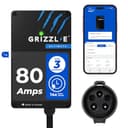
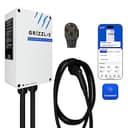
2022 or 2023 Extended Range, with an electrician who can give you a 100-amp circuit: the Grizzl-E Ultimate 80A. It is the only unit here that can use what your truck accepts, it is a cast-aluminum UL Type 4 case published down to −22°F, and its current is selectable in hardware at eight steps from 80 amps down to 16 — so it can go in on a smaller circuit now and be turned up after a panel upgrade. It is hardwire-only and it costs roughly twice a good 48-amp charger. Those are the honest trades.
Any other Lightning: the EVIQO 48A.It meets Ford’s published 48-amp ceiling exactly, carries a 25 ft cable and an IP66 / NEMA 4 enclosure, and is ENERGY STAR certified, which several utility rebate programs require. 48 amps hardwired needs a 60-amp circuit; that is the price of 48 amps from anyone.
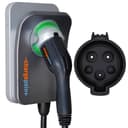
Panel already full: the ChargePoint Home Flex. Six published current settings from 16 to 50 amps mean it fits the circuit you can actually get today, with headroom if you upgrade later. You pay a brand premium for that flexibility and for the best app in the category.
Already have a NEMA 14-50 in the garage: the Grizzl-E Classic Connect. 40 amps is the hard ceiling on any plug-in charger, because code caps a continuous load at 80% of the receptacle’s rating. On a Lightning that is around 20 miles of range an hour instead of 24 — and no electrician.
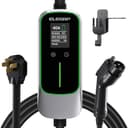
And keep the ELEGRP 40A in the back seat.A work truck ends up at job sites, in-laws’ driveways and campgrounds where there is a 14-50 receptacle and nothing else. A 25 ft portable with an IP67 rating costs a fraction of a wall unit and turns any of those into a charge.