One clarification first, because the name covers two different products. ChargePoint runs a large public charging network, and it also sells one home charger, the Home Flex. This page is about alternatives to the home charger— the box on your garage wall. If you are looking for a different public network or app, nothing here will help; what will is our guide to finding EV charging near you.
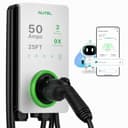
The verdict first. If you were drawn to the Home Flex for its adjustable amperage, the closest alternative is the EVIQO 48A, and it arguably beats it on that exact spec: EVIQO publishes app control from 6 to 48 amps in one-amp increments, plus a hardware DIP switch that caps the maximum at 16, 32, 40 or 48, where ChargePoint publishes six fixed steps. If what you wanted was the full 50 amps and a tougher shell, take the Autel MaxiCharger, which publishes the same 50-amp ceiling with an IP65 / NEMA 4X enclosure rated −40 to 131°F. And if you simply wanted a charger that works and cost less, our budget pick is the ELEGRP 40A, which does the job most Home Flex owners actually ask of theirs — 40 amps on a NEMA 14-50 outlet, dialable down to 16 — for a fraction of the money.
First, what the Home Flex is genuinely good at, because this page is not an argument against it. We rate it highly, it is the standing recommendation on this site for a household whose circuit may change, and it leads our 100-amp panel roundupfor that reason. ChargePoint’s own datasheet publishes: output adjustable in the app to 16, 24, 32, 40, 48 or 50 amps, up to 12 kW; a dedicated dual-pole breaker rated for 125 percent of the maximum load, with its own worked example of a 50-amp breaker for 40-amp output; a 23-foot cable; a NEMA 3R enclosure; a UL/cUL listing and ENERGY STAR certification; and a three-year warranty. It is sold both hardwired and as a NEMA 14-50 plug-in version, which is rarer than it sounds. The app is the most mature in this category, and the brand has been doing this longer than anyone else on this page.
So why look elsewhere? Four honest reasons, each of which maps to a pick below:
1. You pay a brand premium, and the electricity is identical. The Home Flex is consistently the most expensive J1772 charger in our registry apart from the Wallbox. Charging speed is set by amps, and amps are cheap: 48 amps is about 40 miles of range an hour at our 3.5 miles-per-kWh reference whatever the logo says.
2. The enclosure is the weakest published rating in this group.ChargePoint publishes NEMA 3R, which is a rain-and-sleet rating. Every alternative here publishes something higher — IP65 / NEMA 4X on the Autel, IP66 / NEMA 4 on the EVIQO and the Lectron, NEMA 4 on the Emporia, IP67 on the ELEGRP station. If your charger lives on an exposed wall rather than inside a garage, that gap is the one to weigh. Our outdoor and cold-weather roundup ranks the whole field on exactly that spec.
3. Fifty amps is mostly theoretical at home.Fifty amps of continuous load needs a 70-amp circuit, and most houses with an existing panel cannot spare one. In practice a great many Home Flex owners run theirs at 32 or 40 amps — which is precisely what the cheaper adjustable chargers on this page do, at their own full output.
4. It measures the charger, not the house.The Home Flex app reports what the charger delivered. It does not watch your panel: when we read ChargePoint’s own Power Management FAQ, the only station families named as supporting it were the commercial CT4000 and CPF50, and the residential Home Flex was not named anywhere on the page. If what you want is household energy data, that is an Emporia argument, not a ChargePoint one.
Nothing on this page disparages ChargePoint, and every comparison below is between figures each manufacturer publishes itself. We own none of these chargers and have bench-tested nothing.
The comparison, on published figures only
| Charger | Max current (circuit) | Published adjustable range | Enclosure | Cable | ENERGY STAR | Warranty |
|---|
| ChargePoint Home Flex | 50 A (70 A) | 16 / 24 / 32 / 40 / 48 / 50 A in the app | NEMA 3R | 23 ft | Yes | 3 years |
| EVIQO 48A | 48 A (60 A) | 6–48 A in 1 A steps, plus a 16/32/40/48 A DIP cap | IP66 / NEMA 4, −22 to 122°F | 25 ft + 40 in input lead | Yes | 3 years (4 extended) |
| Autel MaxiCharger Home | 50 A (70 A) | 16–50 A | IP65 / NEMA 4X, −40 to 131°F | 25 ft | Yes | 3 years |
| Emporia Level 2 | 48 A hardwired, 40 A on a 14-50 plug | Not published below 40 A | NEMA 4 | 25 ft | Yes | 3 years |
| Lectron Nexus J1772 | 48 A (60 A) | None published | IP66 | 23 ft | Yes (listed as LECHGNexusHWJ1772) | 3 years |
| ELEGRP 40A | 40 A plug-in (50 A) | 16 / 20 / 24 / 32 / 40 A on the unit | IP67 station, IP54 connector, −21 to 121°F | 25 ft | Not on the certified list | Up to 2 years |
The pattern in that table.ChargePoint’s advantages are the breadthof the adjustable range and the maturity of the app. Its disadvantages are the enclosure rating and the price. Two of the alternatives beat it on its own ground: the EVIQO on granularity (one-amp steps rather than six fixed settings) and the Autel on environmental envelope while matching the 50-amp ceiling. One rating caveat worth carrying across: ELEGRP publishes IP67 for the station and IP54 for the connector on the same product, so station and connector ratings are not interchangeable — a point our charging in the rain guide unpacks.
Which one replaces it for you
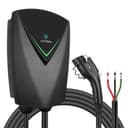
You wanted adjustable amperage because your panel is tight: the EVIQO 48A. Six to 48 amps in one-amp increments from the app is a finer control than ChargePoint’s six steps, the DIP switch gives you a hardware ceiling an app update cannot move, and it is the cheapest 48-amp ENERGY STAR charger in our registry. The honest trade: hardwired only, so an electrician and a 60-amp circuit, and a much shorter brand track record behind the app than ChargePoint’s.
You wanted the 50 amps and the charger lives outside:the Autel MaxiCharger. It matches the Home Flex’s 50-amp, 12-kilowatt ceiling and adds the widest published environmental envelope in our registry — IP65 / NEMA 4X, −40 to 131°F against ChargePoint’s NEMA 3R. Autel also publishes charger-to-charger dynamic load balancing with no extra hardware, which is a genuine answer to the panel question. Trades: 50 amps still needs a 70-amp circuit and a hardwired install, and the app ecosystem is younger than ChargePoint’s.
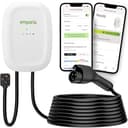
You wanted the app to tell you what charging costs:the Emporia Level 2. It is the one pick here from a company whose core product is a whole-home energy monitor, and the charger app reports energy rather than just status. It is 48 amps hardwired or 40 on a NEMA 14-50 plug, ENERGY STAR listed, with a 25-foot cable. Two honest trades: Emporia publishes no adjustable range below 40 amps, so it is a weaker answer than the EVIQO on a tight panel, and the house-level features — solar matching, PowerSmart load management — require the separately sold Vue monitor, which is a second line item on the receipt. Our Emporia versus ChargePoint comparison settles that matchup in detail.
You are tired of accounts, apps and firmware:the Lectron Nexus J1772. A full 48 amps with no Wi-Fi, no account and nothing to update, and it is on the ENERGY STAR certified list under its own model number with network capability recorded as “No” — the kind of proof a rebate administrator accepts. The trade is the opposite of ChargePoint’s: Lectron publishes no adjustable current range for this model, so it needs the full 60-amp circuit to be used at all, and your car has to do the scheduling. Our no-Wi-Fi roundup is the whole field on that basis.
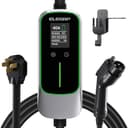
You just want a charger and the Home Flex looked expensive: the ELEGRP 40A, our budget pick. It plugs into a NEMA 14-50 outlet, publishes five current levels from 16 to 40 amps, an IP67 station, a stated −21°F floor, a 25-foot cable and ETL certification, with a 1-to-12 hour delay timer in place of an app. For a household that already has the outlet and lets the car handle scheduling, this is the same job done for a fraction of the money. Its one real omission is the ENERGY STAR listing: no ELEGRP product appears on the certifier’s own list, so check your utility rebate rules before you count on one. Everything else in this bracket is on our best EV chargers under $300 page.
Two reasons to stay with the Home Flex
Your circuit is genuinely unsettled.If you do not yet know whether you will end up on a 40-amp, 50-amp or 60-amp circuit — a panel upgrade pending, a second EV arriving, an electrician who has not quoted yet — six published steps from 16 to 50 amps in one unit covers more outcomes than anything else here, and the plug-in version means you can start on an outlet and hardwire later.
You want the longest commercial track record. ChargePoint has been building charging hardware and software longer than any other brand on this page, and a charger is a ten-year purchase whose app has to keep working for all ten. That is not a spec we can put in a table, and it is a legitimate reason to pay more. Our full ChargePoint Home Flex review is the long version, and most reliable EV chargers ranks the four durability facts manufacturers will actually put in writing.