What we ranked on, in order
1. A safety listing we can name.Every charger on this page carries a listing from a nationally recognized testing laboratory against ANSI/UL 2594, the standard for EV supply equipment — ETL for the ELEGRP, the Lectron units and the EVDANCE (Intertek control number 5034626, which is a number you can look up), and a UL file number, E510712, for the Grizzl-E. Price is not the safety signal and never has been; the listing is. Our guide to whether cheap EV chargers are safe shows how to read one in a minute, and which phrases only sound like certification.
2. Whether it fits the circuit you actually have. This is the spec that separates the picks here, because under $300 you are almost certainly plugging into something that already exists. A charger with selectable current can live on a circuit smaller than 50 amps; one without cannot. The ELEGRP publishes five levels (16, 20, 24, 32 and 40 amps), the Grizzl-E adjusts from 40 down to 16, and the EVDANCE steps through 10, 12, 16, 20 and 24. The two Lectron 40-amp units publish no adjustable range at all, which means they want a sound 50-amp circuit and nothing less.
3. Reach, then weather, then warranty.Cable length is the spec buyers regret most often: the ELEGRP, Grizzl-E and EVDANCE publish 25 feet, while both Lectron 40-amp units are 16. For an outdoor spot, the published enclosure rating matters more than the word “weatherproof” — and note that a rating can apply to the station and not the handle. ELEGRP publishes IP67 for the station and IP54 for the connector on the same product. Warranty terms at this price run from one year to two, and two of the picks publish no term at all.
The three things $300 does cost you
It costs you 48 amps, and that is mostly fine. Every pick on this page is a plug-in or portable unit, and a plug-in unit is capped at 40 amps by code rather than by cost: a NEMA 14-50 is a 50-amp receptacle, EV charging is a continuous load, so the charger may draw at most 80 percent of it. Forty-eight amps means hardwiring onto a 60-amp circuit with no receptacle in the middle, and nothing hardwired sells for under $300. The gap is about six miles of range an hour. If you want it, our best hardwired chargers under $500 is the next bracket up.
It usually costs you the ENERGY STAR listing, which can cost you a rebate.This is the single most expensive omission on this page and the one buyers discover last. Plenty of utility rebate programs will only pay out on an ENERGY STAR-certified charger, and when we query the certifier’s own certified-product list, no ELEGRP and no EVDANCE product appears on it anywhere. Grizzl-E publishes its UL file for the Classic Connect and no ENERGY STAR certification. If a rebate is part of how you are affording the charger, check your utility’s requirement before you buy a cheaper unit — a $150 saving that forfeits a $500 rebate is not a saving. Our best ENERGY STAR chargers page lists the ones that do carry it, and our rebates and tax credits guide explains where to look it up.
It often costs you the app.Of the picks here, only the Grizzl-E publishes Wi-Fi and a phone app. The ELEGRP gives you a 1-to-12-hour delay timer on the unit instead, the EVDANCE the same plus an on-unit display of current, voltage, kWh and session time, and the two Lectron 40-amp units nothing at all. For many households that is the correct amount of charger, because the car already schedules its own charging and will do it more reliably than a charger that needs an account. Where an app genuinely earns its place is wall-side energy measurement — knowing what the charging cost, not just when it happened. Our smart versus basic comparison works through that trade in full.
Match the charger to the outlet you already have
Under $300 the charger is rarely the expensive part of getting to Level 2. PG&E, a large California utility, publishes an average installation cost of $400 to $1,200 on top of the hardware. That number is the reason this bracket exists at all: if a sound 240-volt receptacle is already within reach of where you park, a cheap plug-in charger skips that entire bill, and the total job can come in under what the charger alone costs in the premium tier.
| What you already have | Most current a charger may draw | Range per hour (our math) | The pick here |
|---|
| NEMA 14-50 (range / RV outlet), 50 A 240 V | 40 A — 9.6 kW | ~34 miles | ELEGRP 40A, Grizzl-E Classic Connect, Lectron 40A |
| NEMA 14-30 (four-prong dryer), 30 A 240 V | 24 A — 5.76 kW | ~20 miles | EVDANCE 24A (native 14-30 plug) |
| NEMA 5-15 (any household socket), 15 A 120 V | 12–15 A — 1.4–1.8 kW | ~5–6 miles | Lectron Level 1 15A |
| Nothing within reach of the car | Decided by the electrician, not the charger | — | Price the install first — see the cost guide below |
The receptacle you plug into is also a wear item, and this is where a cheap charger can cost real money. A dryer runs 45 minutes with an element that cycles; an EV runs six to ten hours near the charger’s maximum, every night. If your outlet is old, has a loose grip on the plug, or warms up in the first week, deal with that before you blame the charger — our guide to an EV charger plug getting hot goes through it in check order.
The warning that matters most in this bracket
A portable charger has no idea what circuit it is plugged into. United Chargers states it plainly in the current Grizzl-E Mini manual — “the charger can not detect the circuit amperage limit” — and the factory default on that unit is its full 40 amps. The automatic detection these manuals describe is 120-volt versus 240-volt, not breaker size. So on anything other than a sound 50-amp circuit, set the current down first and confirm it stayed down: 24 amps on a 30-amp dryer circuit, 16 amps on an older or unverified one. That single step is the difference between a cheap charger being a bargain and being a fire report. Our guide to what amperage to set your EV charger to gives the numbers for each circuit, and EV charger breaker size derives them from the continuous-load rule.
How to choose between the picks
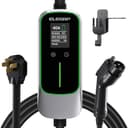
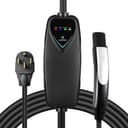
You have a 14-50 outlet and want the most charger for the money: the ELEGRP. Five current levels, 25 feet of cable, an IP67 body with a published temperature range, a carrying case in the box and ETL certification, at the bottom of the band. Its honest gaps are no app and no ENERGY STAR listing.
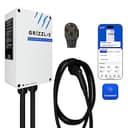
The charger will live outside, fully exposed:the Grizzl-E Classic Connect when the daily check has it under the line. A cast-aluminum UL Type 4 case published from −22°F to 122°F, 25 feet of cable, Wi-Fi, a named UL file and the longest warranty option in our registry — three years or five, chosen at checkout. It is a lot of charger to find inside this bracket, and it is the only pick here with an app.
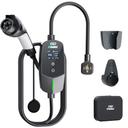
Your 240-volt outlet is a dryer receptacle:the EVDANCE 24A, because its plug is a native NEMA 14-30 and its maximum is 24 amps — exactly what a 30-amp circuit allows, so there is no setting that can ask that circuit for more than it has. The trade is a one-year warranty and paperwork that disagrees with itself in places we spell out on its card above. Our NEMA 14-30 dryer-outlet picks cover that circuit on its own.
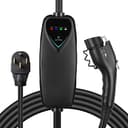
You drive a Tesla or another NACS car:the Lectron Level 2 Tesla 40A, which puts a native Tesla plug on the end of a proper 40-amp portable charger and removes the adapter from the chain entirely. No app and no adjustable current, so it needs a sound 50-amp circuit. If your household also has a J1772 car, buy a J1772 charger and a cheap adapter instead — our NACS adapter picks explain why that ends up cheaper and more flexible.
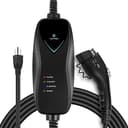
You cannot install anything at all:the Lectron Level 1 15A, into any household socket. Fifteen amps at 120 volts is about 1.8 kW, roughly 6 miles of range an hour, or 60-plus miles across an overnight before losses. That is genuinely slow and we will not pretend otherwise — but for a plug-in hybrid, a short commute or a rented space, slow-and-installed beats fast-and-impossible every time. Our do you actually need Level 2 guide is the honest version of that question.