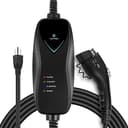
What the federal record says a 4xe actually draws
EPA publishes, for every plug-in hybrid sold in the US, how long a complete charge takes on 240 volts, how far the car goes on electricity alone, and how many kilowatt-hours it consumes per 100 miles in electric mode. Multiply the consumption figure by the electric range and you get the energy a full charge draws from the wall; divide by the charge time and you get the average power the car pulled.
The last two columns are ours, not EPA’s and not Jeep’s. Because EPA measures consumption at the wall, the energy figure already includes everything lost in the charger, the cable and the car’s own conversion — which is exactly what makes it usable for sizing a charger.
| 2026 model | EPA 240V charge time | EPA electric range | EPA kWh/100 mi | Derived energy at the wall | Derived average power |
|---|
| Wrangler 4dr 4xe | 2.4 hr | 22 mi | 68 | ~15.0 kWh | ~6.2 kW (about 26 A) |
| Grand Cherokee 4xe | 3.4 hr | 26 mi | 58 | ~15.1 kWh | ~4.4 kW (about 18 A) |
The 2025 Wrangler 4xe record carries identical figures to the 2026 one, so nothing here is new-model-year specific.
Roughly 26 amps is the whole story. That is the most either 4xe has been measured pulling from a wall, and it is less than a third of what the largest home charger on the market delivers. Everything below follows from it:
- A 24-amp charger (5.8 kW)covers the Grand Cherokee completely and comes within about 7% of the Wrangler’s measured rate. This is the size to buy.
- A 32-amp charger (7.7 kW)is the first standard size fully above both cars. If you want zero compromise, this is the ceiling worth paying for — and our 32-amp roundup ranks the units that enforce 32 amps in hardware rather than in an app.
- A 40-amp or 48-amp charger delivers exactly the same charge rate to a 4xe as a 32-amp one, because the car is the bottleneck in every case. A 48-amp install also needs a 60-amp circuit. On this vehicle that is money spent on nothing.
Here is the size of it in time, which is the number that should settle any argument with a salesperson. A full charge on a Wrangler 4xe is about 15 kWh at the wall. At 5.8 kW that takes about 2 hours 35 minutes. At the car’s own ceiling — which is what a 32-amp, 40-amp or 48-amp charger all deliver — EPA measures it at 2 hours 24 minutes. The difference between a 24-amp charger and a 48-amp charger on this car is about ten minutes.
The Grand Cherokee is slower, and we cannot tell you why
One honest loose end, because the table shows it and smoothing it over would be dishonest. The two 4xe models hold almost exactly the same usable energy — about 15 kWh at the wall each — but EPA measures the Grand Cherokee taking 3.4 hours against the Wrangler’s 2.4. That works out to about 4.4 kW for the Grand Cherokee against about 6.2 kW for the Wrangler.
Two explanations are available and we cannot choose between them from published sources: the Grand Cherokee may have a smaller onboard charger, or the two records may have been measured on different equipment. Jeep publishes nothing that resolves it, and we are not going to invent an answer.
Fortunately it does not change the recommendation at all. Both figures sit far below what even the smallest Level 2 charger here delivers, so a 24-amp unit covers the Grand Cherokee with room to spare either way. If you own the Grand Cherokee, read the 3.4 hours as your realistic overnight number and ignore the rest.
Do you need Level 2 at all? Often, no
This is the section that will save some readers the whole purchase, so it gets the arithmetic rather than a platitude.
A Level 1 cord on a standard 120-volt household outlet delivers roughly 1.4 to 1.8 kW depending on whether it is a 12-amp or a 15-amp unit. Against a 15 kWh charge that is:
- At 1.44 kW (12 amps): about 10 hours 25 minutes for a complete charge.
- At 1.8 kW (15 amps): about 8 hours 20 minutes.
Both of those fit inside a night. In miles of range per hour, using EPA’s own consumption figures, a household outlet adds roughly 2 miles an hour to a Wrangler 4xe and 2.5 to 3to a Grand Cherokee — low numbers that only matter because the battery only holds 22 to 26 electric miles in the first place. Plug in at 7pm, leave at 7am, and the pack is full.
So the test is simple. If you plug in every night and drive less than the electric range before plugging in again, Level 1 is sufficient and a Level 2 charger buys you nothing you will notice. Level 2 earns its place on a 4xe in three specific cases:
- You charge twice a day.Home at lunch, out again in the afternoon — a 2.5-hour top-up is a different proposition from a 10-hour one.
- You cannot leave it plugged in all night. Shared driveway, shared outlet, a cord you cannot run across a sidewalk.
- A full EV is next.A charger outlasts a car. If the 4xe is a stepping stone, buying for the next vehicle is rational — and that is the one case where pick 4 makes sense.
Our guide to charging a plug-in hybrid works through the general version of this decision, and best Level 2 chargers for plug-in hybrids covers the wider PHEV field if you are comparing the 4xe against other plug-in hybrids rather than choosing a charger for one you already own.
The dryer-outlet route, which is why pick 1 wins
A 4xe is the best case in the whole category for a NEMA 14-30 charger, and almost nobody tells you so.
A NEMA 14-30 is the four-prong 30-amp receptacle an electric clothes dryer uses. A 30-amp circuit carrying a continuous load is limited to 24 amps by the code’s 80% rule — and 24 amps is, as the table above shows, already more than a 4xe draws. So if there is a dryer outlet in the garage or within cable reach of it, you can have essentially full-speed charging for this car with no new circuit, no permit and no electrician.
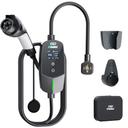
Two practical cautions. First, you cannot run the dryer and the car at the same time on one 30-amp circuit; either alternate manually or fit a proper outlet splitter with an interlock. Second, this corner of the market is full of listings that never name a testing lab, which is a line we will not cross — see our guide to cheap EV chargers for why. Pick 1 is here specifically because its own user manual carries an Intertek ETL mark and names the UL standards it was tested to, which most of its shelf neighbors do not.
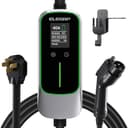
If you have no dryer outlet but do have a NEMA 14-50 — the 50-amp range/welder receptacle — pick 2 is the cheaper route and needs no new work either. And if you have neither, read Level 2 electrical requirements and breaker size for an EV charger before you get a quote, because on a 4xe the correct answer to “what circuit do I need” is a 30-amp one, and an electrician quoting a 60-amp circuit is quoting for a car you do not own.
Connector, weather and the Wrangler problem
The connector. All five picks here are J1772 units, which is the standard AC connector on every non-Tesla EV and plug-in hybrid. As with any vehicle, the ten-second check beats anything written down: go look at your charge port. A plain round socket is J1772. A round socket with a second two-pin section beneath it is CCS1, whose upper round half is J1772, so the same chargers fit. A single small oval socket is NACS, in which case add a J1772-to-NACS adapter or buy the NACS build. Our J1772 vs NACS explainer covers the difference.
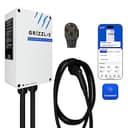
Weather, and where a Wrangler parks.Jeeps spend more of their lives outdoors than the average EV, and two of these picks are built for it: pick 2 publishes an IP67 rating, and pick 3 is a cast-metal UL Type 4 indoor/outdoor case with a published operating range down to −22°F, which is the most specific cold-weather promise any manufacturer in this category puts in writing. Most brands publish an enclosure rating and stop. Our best outdoor chargers page ranks the field on enclosure and published temperature range, and cold-weather EV charging covers what changes at the car when it is freezing — which on a plug-in hybrid matters less than on a full EV, because the engine is there.
Cable length.The 4xe charge port is on the driver’s side front fender on the Wrangler and the driver’s side front quarter on the Grand Cherokee, so this is one of the easier vehicles to reach — but the planning rule still holds: assume about 60% of a cable’s rated length is usable once it routes along a wall and down to the port. Three picks here carry 25 ft. Our mounting-height guide covers placement before you drill.
What we did not rank, and why
Every 48-amp charger on this site.Not on price — on the merits. The table at the top of this page is the entire argument: a 4xe cannot use them. If you want to see the field anyway because a full EV is coming, our 48-amp roundup is the page.
Any Jeep-branded or dealer-channel charger.Jeep’s own charging footnote reads “Requires purchase and professional installation. Contact dealer for details”, with no product, price or specification attached that we could reach. Every buy link on this site resolves to a retailer we can show a live price for, so there is nothing for us to rank. Ask your dealer what they are offering and compare it against the prices above — but do not let anyone sell you a 48-amp install for this vehicle.
Any onboard-charger rating for either 4xe.Jeep publishes none we could find. Every power figure on this page is EPA’s measurement or our clearly labeled arithmetic on top of it, and the one place the two EPA records disagree with each other is called out above rather than averaged away.
Any DC fast-charging claim.Jeep’s site carries a generic plug-in-hybrid paragraph mentioning DC fast charging as a category feature. That paragraph is not about the 4xe, EPA publishes no DC figure for either model, and we are not going to imply a capability we cannot source. Check your own owner’s manual.
The verdict
Start by not buying anything.If you plug in overnight and drive less than the electric range each day, the cord that came with the Jeep refills the pack in 8 to 10 hours and a Level 2 charger changes nothing you will notice. Pick 5 is on this list for the people whose original cord has gone missing or who want a second one with a real IP65 rating — not as an upgrade.
If you do want Level 2 and there is a dryer outlet in reach: the EVDANCE 24A. 24 amps is more than this car draws, it needs no new circuit, and its manual names the lab that tested it. The honest catches: you cannot run the dryer at the same time, it is a 1-year warranty against 3 from the bigger brands, and EVDANCE’s own store page contradicts its own manual in places — where it does, we recorded the manual.
If you already have a NEMA 14-50: the ELEGRP 40A portable, which is cheaper. Its 40 amps are wasted on a 4xe, but you are not paying for them — you are paying for a 25 ft cable and an IP67 rating at the lowest price here. No app, no adjustable current, nothing to configure.
If the Jeep lives outside: the Grizzl-E Classic Connect.A metal UL Type 4 body with a published −22°F floor, on a NEMA 14-50 plug so it comes with you when you move. Also 40 amps you cannot use on this car, and a real step up in price for the enclosure alone.
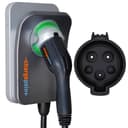
And only if a full EV is next: the ChargePoint Home Flex.This is the one pick here that is deliberately oversized. Its current is settable from 16 to 50 amps, so it can run at 24 for the 4xe today on whatever circuit you have and be turned up for a 48-amp car in three years. If the 4xe is the last plug-in you plan to own, skip it — you would be paying roughly double pick 1 for headroom you will never reach.