Plug & Range

32A vs 40A EV Charger: Which Should You Buy?

Eight amps separate them. On the road that is about seven miles of range an hour; in your panel it is a 40-amp circuit against a 50-amp one — and that second difference is the one that decides it.

By Stephen V.Last updated How we pick

A 32-amp charger delivers about 7.7 kW at 240 volts; a 40-amp charger about 9.6 kW. At our standard reference of 3.5 miles per kWh, that is roughly 27 miles of range an hour against roughly 34. Across a ten-hour overnight window the gap is about 270 miles against about 340 — and very few people drive either distance in a day. On speed alone, this is rarely a decision that matters.

What does matter is the circuit behind the charger. EV charging is a continuous load under the National Electrical Code, so a charger may use only 80% of its circuit: 32 amps needs a 40-amp circuit, 40 amps needs a 50-amp one. If your panel has room for 50 amps — or a NEMA 14-50 outlet already exists — buy for 40. If an electrician tells you 40 amps is the most the panel can spare, 32 is the correct charger, not a compromise.

That is why every pick below except one can run at either setting. The best answer to “32 or 40?” is usually a charger that does both, set to what your circuit allows today and turned up later if the circuit changes. We ranked on that flexibility, then on build and warranty. As always, the specs are the manufacturers’ own and we have not bench-tested the units.

How this is funded:we earn a commission if you buy through our links, at no extra cost to you. It never changes which product we recommend, and we’ll tell you when we’d skip one. Full disclosure.

Quick picks

Ranked on published specs, charging speed, electrical fit and value. Select a row to jump to the full write-up. We have not bench-tested these chargers — here is exactly what we do instead.

#ProductBest forPrice
1
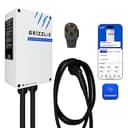
Grizzl-E Classic Connect

Grizzl-E Classic Connect

Grizzl-E retired the old no-app Classic and replaced it with this, and it kept the part that mattered: a metal case rated UL Type 4 for a spot with no shelter, published to keep operating down to -22F. What changed is that the electronics caught up — Wi-Fi, an app, and current you can dial from 40A down to 16A to fit a circuit you already have. It's the rugged pick that no longer asks you to give up scheduling to get it.

Best 40A charger you can turn down
$349.99 · View on Amazon

Price as of September 18, 2026. #ad How we’re funded

2
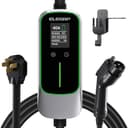
ELEGRP 40A Portable Level 2 Charger (ECP24-40A0-01)

ELEGRP 40A Portable Level 2 Charger (ECP24-40A0-01)

The cheapest charger in this registry that still publishes everything you would want to check: 9.6 kW, five current levels from 16 to 40 amps, an IP67 body with a stated -21°F floor, ETL certification and a 2-year warranty. There is no Wi-Fi and no app — you get a 1-to-12-hour delay timer on the unit instead — and for a lot of households that is the correct amount of charger.

Best budget with a true 32A setting
$209.99 · View on Amazon

Price as of September 18, 2026. #ad How we’re funded

3
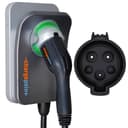
ChargePoint Home Flex

ChargePoint Home Flex

If you'd rather buy a charger once and be done, this is the safe call. You set the current in the app anywhere from 16 to 50 amps, so it fits whatever your panel can spare today and still has room to grow if you upgrade the circuit later. The app is the most polished of the bunch and the warranty is long.

Best if you will outgrow both
$549.00 · View on Amazon

Price as of September 18, 2026. #ad How we’re funded

4
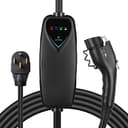
Lectron 40A Portable Level 2 Charger

Lectron 40A Portable Level 2 Charger

The least-expensive honest route into real Level 2 charging. Plug it into a NEMA 14-50 outlet, pull a true 40A / 9.6 kW, and unplug it to throw in the trunk for a trip. The trade-offs for the price are no app and a shorter warranty — both fair at this cost.

Best fixed 40A — on a 50A circuit only
$269.99 · View on Amazon

Price as of September 18, 2026. #ad How we’re funded

The picks in full

#1Best 40A charger you can turn down

Grizzl-E Classic Connect

Grizzl-E retired the old no-app Classic and replaced it with this, and it kept the part that mattered: a metal case rated UL Type 4 for a spot with no shelter, published to keep operating down to -22F. What changed is that the electronics caught up — Wi-Fi, an app, and current you can dial from 40A down to 16A to fit a circuit you already have. It's the rugged pick that no longer asks you to give up scheduling to get it.

Strengths

  • Metal case rated UL Type 4 indoor/outdoor, published from -22F to 122F
  • Current adjusts from 40A down to 16A, so it fits the circuit you already have
  • 25 ft cable — among the longest here — on a simple plug-in NEMA 14-50 install

Trade-offs

  • 40A caps its charging speed below the 48A units
  • Scheduling now runs through Wi-Fi and an account — the old Classic's nothing-to-update simplicity is gone
  • Grizzl-E publishes UL/cUL only for this model, not the ENERGY STAR listing the discontinued Classic carried
Max output40 A
Power9.6 kW
ConnectorJ1772
InstallNEMA 14-50 plug
Cable length25 ft
Warranty3 years
WiFi + appYes
CertificationsUL/cUL listed (file E510712)

Our charging-speed math. At 40A (9.6 kW) and 3.5 mi/kWh it adds roughly 34 miles of range an hour — more than enough to refill a daily commute overnight. Dial it down to 16A and you're at about 13.

Build note. A metal case rated UL Type 4 indoor/outdoor and published for -30C to +50C (-22F to 122F), with 2.4 GHz Wi-Fi and current adjustable from 40A down to 16A.

Specs read from the manufacturer spec sheet, on August 11, 2026. “Not published” means the brand does not state that figure.

#2Best budget with a true 32A setting

ELEGRP 40A Portable Level 2 Charger (ECP24-40A0-01)

The cheapest charger in this registry that still publishes everything you would want to check: 9.6 kW, five current levels from 16 to 40 amps, an IP67 body with a stated -21°F floor, ETL certification and a 2-year warranty. There is no Wi-Fi and no app — you get a 1-to-12-hour delay timer on the unit instead — and for a lot of households that is the correct amount of charger.

Strengths

  • Five current levels (16/20/24/32/40A) — it fits whatever circuit you have
  • IP67 with a published -21°F to 121°F range, and a carrying case in the box
  • 2-year warranty and full ETL certification at the bottom of the price band

Trade-offs

  • No Wi-Fi, no app and no energy monitoring — just an on-unit delay timer
  • Not ENERGY STAR listed, so it may not qualify for some utility rebates
  • 40 amps is the plug-in ceiling; a 48-amp unit needs hardwiring
Max output40 A
Power9.6 kW
ConnectorJ1772
InstallNEMA 14-50 plug
Cable length25 ft
Warranty2 years
WiFi + appNo
CertificationsETL certified

Our charging-speed math. Forty amps at 240V is 9.6 kW, and at 3.5 miles per kWh that is roughly 34 miles of range an hour. ELEGRP's own figure is 37 miles an hour, which assumes a slightly more efficient car than our reference.

Build note. ELEGRP publishes 240V, up to 9.6 kW, five selectable current levels of 16, 20, 24, 32 and 40 amps, a NEMA 14-50 plug, a 25 ft cable measured plug-end to connector, a J1772 connector, ETL certification with its PBE overheat protection, an IP67 rating with a -21°F to 121°F range, a 1-12 hour delayed start, a carrying case and a 2-year warranty.

Specs read from the manufacturer spec sheet, on August 19, 2026. “Not published” means the brand does not state that figure.

#3Best if you will outgrow both

ChargePoint Home Flex

If you'd rather buy a charger once and be done, this is the safe call. You set the current in the app anywhere from 16 to 50 amps, so it fits whatever your panel can spare today and still has room to grow if you upgrade the circuit later. The app is the most polished of the bunch and the warranty is long.

Strengths

  • Adjustable 16-50A fits a modest circuit now and a bigger one later
  • The most complete app here: scheduling, reminders and usage history
  • 3-year warranty and a generous 23 ft cable

Trade-offs

  • You pay a brand premium over value 48A units
  • Using the full 50A needs a 60A circuit most older panels can't spare
Max output50 A
Power12 kW
ConnectorJ1772
InstallHardwired (a plug-in NEMA 14-50 SKU is also sold)
Cable length23 ft
Warranty3 years
WiFi + appYes
CertificationsUL/cUL listed, ENERGY STAR

Our charging-speed math. Run it at the full 50 amps (about 12 kW) and, at a middle-of-the-road 3.5 miles per kWh, it puts back roughly 42 miles of range an hour. Turn it down to 40A to live on a 50A circuit and you're at about 34.

Build note. The headline feature is app-adjustable amperage — anywhere from 16A up to 50A, in software.

Specs read from the manufacturer spec sheet, on July 19, 2026. “Not published” means the brand does not state that figure.

#4Best fixed 40A — on a 50A circuit only

Lectron 40A Portable Level 2 Charger

The least-expensive honest route into real Level 2 charging. Plug it into a NEMA 14-50 outlet, pull a true 40A / 9.6 kW, and unplug it to throw in the trunk for a trip. The trade-offs for the price are no app and a shorter warranty — both fair at this cost.

Strengths

  • A real 40A / 9.6 kW at a budget price
  • Plug-in and portable — no hardwiring, and it travels
  • ETL listed to the UL 2594 / UL 2231 safety standards

Trade-offs

  • No Wi-Fi or app on the base model — the smart version is a separate SKU
  • Shorter 16 ft cable and a 2-year warranty
  • The brand doesn't publish an outdoor/IP enclosure rating
Max output40 A
Power9.6 kW
ConnectorJ1772
InstallNEMA 14-50 plug
Cable length16 ft
Warranty2 years
WiFi + appNo
CertificationsETL listed (UL 2594 / UL 2231)

Our charging-speed math. At 40A (9.6 kW) and 3.5 mi/kWh it adds roughly 34 miles of range an hour.

Build note. A portable plug-in unit — no hardwiring — and the base model carries no Wi-Fi or app.

Specs read from the manufacturer spec sheet, on July 19, 2026. “Not published” means the brand does not state that figure.

32A vs 40A at a glance

32 amps40 amps
Power at 240VAbout 7.7 kW9.6 kW
Range per hour (3.5 mi/kWh)About 27 milesAbout 34 miles
Ten-hour overnightAbout 270 milesAbout 340 miles
Circuit needed (80% rule)40 amps50 amps
Common outletHardwired, or adjustable unit on a larger outletNEMA 14-50 (the plug-in ceiling)

Check your car before you pay for amps

Every EV has an onboard charger that caps the AC power it will accept. If your car tops out at around 7.7 kW, a 40-amp charger fills it at exactly the same speed as a 32-amp one, and the extra circuit capacity buys you nothing. Plug-in hybrids, which typically have the smallest onboard chargers of any plug-in vehicle, often accept less than that. Our onboard charger limits guideshows where to find your car’s figure — it is the first number to look up, and it sometimes ends this comparison on its own.

When 32 amps is the right answer

Your panel cannot spare a 50-amp circuit. This is the most common reason, especially on older 100-amp services. A 40-amp circuit is a meaningfully smaller claim on the panel, and a load calculation that rules out 50 often allows 40. Our 100-amp panel roundup ranks the chargers that publish a range you can dial down.

Your car cannot use more. If the onboard charger is the limit, 32 amps is the whole speed you will ever see.

You are sharing a circuit plan with a second car. Two chargers at 32 amps are an easier fit on one service than two at 40; our two-EV roundup covers load sharing.

When 40 amps is worth it

A NEMA 14-50 outlet is already there. It is a 50-amp receptacle, which makes 40 amps the natural setting and adds no installation at all. Our NEMA 14-50 roundup covers the chargers built around it.

You drive long days, or recover big trips overnight.Seven extra miles an hour adds up over a short window — five hours of charging is roughly 34 more miles at 40 amps than at 32.

You are installing new anyway. If the panel has the room, running the larger circuit now saves a second electrician visit to upsize it later, and an adjustable charger can still be set lower in the meantime.

Why the picks mostly do both

The Grizzl-E Classic Connect publishes current adjustable from 40 amps down to 16, on a metal case rated UL Type 4. The ELEGRP publishes five fixed levels — 16, 20, 24, 32 and 40 — so 32 is a real setting rather than an approximation. ChargePoint’s datasheet lists 16, 24, 32, 40, 48 and 50 amps in its app, so the Home Flex covers this whole comparison and the hardwired tiers above it. The Lectron 40A is the exception: its output is fixed at 40 amps, which makes it an excellent budget charger on a proper 50-amp circuit and the wrong charger on anything smaller. Our ELEGRP versus Lectron comparison turns on exactly that difference.

Whatever you buy, set the charger to the circuit before the first session. An adjustable charger set to 40 amps on a 40-amp circuit is not a 32-amp install; it is an overloaded one.

Frequently asked questions

Is a 40-amp EV charger worth it over 32 amps?

Only if your car and your circuit can both use it. A 40-amp charger adds about seven more miles of range an hour than a 32-amp one at our 3.5 miles-per-kWh reference, but it needs a 50-amp circuit rather than a 40-amp one, and if your car's onboard charger tops out near 7.7 kW the extra amps do nothing. If you already have a NEMA 14-50 outlet or panel room for 50 amps, 40 is the natural choice.

What size breaker does a 32-amp EV charger need?

A 40-amp circuit. EV charging is treated as a continuous load, so the circuit is sized at 125% of the charger's draw — the same as saying a charger may use 80% of its circuit. A 40-amp charger needs a 50-amp circuit. An electrician sizes the wire and breaker together to your panel and your local code.

How much faster is 40 amps than 32 amps?

About 25% more power: 9.6 kW against roughly 7.7 kW at 240 volts, or about 34 miles of range an hour against about 27 at our 3.5 miles-per-kWh reference. Over a ten-hour overnight session that is roughly 340 miles against 270 — both far more than most people drive in a day.

Can I use a 40-amp charger on a 40-amp circuit?

Only if it can be turned down to 32 amps or less and you do that before the first session. A charger fixed at 40 amps must not be used on a 40-amp circuit. That is why adjustable chargers like the Grizzl-E, ELEGRP and ChargePoint here are the safer buy when you are not sure what circuit you will end up with.

Does my car charge faster with a 40-amp charger?

Only up to its onboard charger's limit. If your car accepts 7.7 kW or less, a 32-amp charger already delivers everything it can take, and a 40-amp charger will not change the charging time.

Sources

Keep reading