How to read this list
Two facts about the recipient decide which of these is right. The first is the plug on their car: the compact Tesla-style connector, now standardized as NACS, or the J1772 connector on nearly every other EV. Adapters go one direction only, so this is the detail to get right. The second is where they park: a household socket means a Level 1 charger is the only charger that works with no installation, and everything faster needs a 240-volt outlet or an electrician. Our J1772 vs NACS explainer and our outlet types guide cover both with pictures.
One housekeeping note: the sections below describe every candidate for this list. If a product is described here but missing from the table above, it is because today’s price check put it over the line — it is still a good product, it is just not an under-$200 one today.
The candidates, in gifter terms
The J1772-to-Tesla adapter
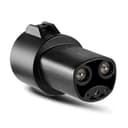
The most reliable small EV gift there is. It lets any Tesla charge from any of the far more common J1772 chargers — workplaces, hotels, friends’ garages — and most Tesla drivers own exactly one, the one that came with the car. Lectron’s is rated to 80 amps and UL 2252 certified, so it is not the weak link. Who it suits: every Tesla or NACS-port driver. Check before buying: only that the car is a Tesla or has a NACS port. Our adapter review has the specs.
The Lectron Level 1 charger
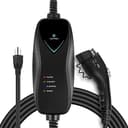
The gift for someone who cannot install anything. It plugs into an ordinary 120-volt household socket and pulls 15 amps — the top of what a standard circuit will give — which makes it the fastest thing you can do with zero electrical work. It is slow, about six miles of range an hour, and we say so; for a plug-in hybrid or a short commute it is a full battery every morning. It carries an ETL listing and an IP65 rating; Lectron does not publish a warranty term for it. Who it suits: renters, plug-in hybrid drivers, anyone with only a wall socket. Check before buying: J1772 car. Our Level 1 review explains why the 15 amps matter.
The Tesla-to-J1772 adapter
The mirror image of the first pick: it lets a non-Tesla car charge from a Tesla Wall Connector, Destination Charger or Mobile Connector, capped at 48 amps and SGS-certified to UL 2251. It solves one specific problem — “we couldn’t charge at your parents’ house” — and solves it permanently. It costs more than its twin because it is doing the electrically harder job. Who it suits: J1772 drivers with Tesla-owning family or friends. Check before buying:the host’s charger is an AC Tesla unit, not a Supercharger. Our Tesla-to-J1772 review covers it.
The Lectron Level 1 Wi-Fi charger
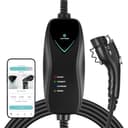
Level 1 charging with an app. It gives up three amps against the plain 15-amp unit and gets scheduling, live status and a kWh cap in return. On Level 1 that scheduling matters more than it sounds, because a trickle charge runs most of the night anyway and starting it when the cheap overnight rate begins is worth more than the amps traded away. Who it suits: a Level 1 driver on a time-of-use electricity rate whose car cannot schedule its own charging. Check before buying: J1772 car, and Wi-Fi that reaches the parking spot. Our Level 1 Wi-Fi review weighs it against the plain version.
The NACS-to-CCS Supercharger adapter
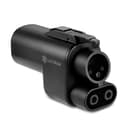
The one candidate here that is about the road rather than the garage. It lets a non-Tesla car with a CCS port use Tesla Superchargers, at up to 500 amps, provided the car’s maker has been granted network access for that model. Lectron publishes it as UL 2252 certified with a mechanical interlock. It sits right at the edge of this page’s budget and will drop off on days it lists above the line. Who it suits: only drivers of CCS cars with automaker-granted Supercharger access. Check before buying: this one, ask first — the access condition is model-specific, and our NACS-to-CCS review explains how to check it.
Just over the line, and worth stretching for
Two products on this site sit close enough to the cap that a small stretch, or a sale, brings them in — and both are a bigger change to the recipient’s week than anything above. The ELEGRP 40A portable is the cheapest charger in our registry that publishes everything we want to check, with a 25-foot cable and an IP67 body, and the Lectron 40A portable is the least expensive honest route into real Level 2 charging we know of. Both plug into a four-prong 240-volt outlet and need no electrician. If the recipient has that outlet, either one is the gift that ends charging as a chore; our new-owner gift list explains how to find out.
Under $200 things we would not give
An extension cord “for the charger”.It is the most common cheap EV gift and the one we would skip: EV charging pulls the same current for hours, and a cord’s connections are where that goes wrong. Our extension cord guide has the long version. Any charger or adapter without a published safety listing. Every candidate above publishes a UL or ETL listing; the cheapest listings on any marketplace often do not, and on a part carrying 40 amps for hours that is not the place to save. Our cheap chargers guide explains what to look for on the box.
On waiting for a sale
Adapters and Level 1 chargers are inexpensive already, so the absolute saving from a holiday discount is small, and the honest reason to buy now is that a verified price today beats a guessed price in November. If you would rather wait, our Black Friday & Cyber Monday deals hub records what has actually discounted in this category in past years and posts real deals when they go live.