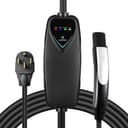
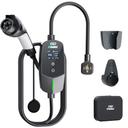
What we ranked on, in order
1. A safety listing we can name. Every charger here publishes a listing from a nationally recognized testing laboratory against ANSI/UL 2594, the standard for EV supply equipment: a UL file number, E510712, for the three Grizzl-E units, and ETL listings for the ELEGRP, the Lectron and the EVDANCE — the last with Intertek control number 5034626 printed in its own manual. A named file or control number is a stronger claim than the words “UL listed” printed on a box, and this bracket is where that distinction starts to matter. See are cheap EV chargers safe for the listings we reject.
2. Whether the current can be dialed down. At this price it can, on every pick, which is not true of every charger above it. The Classic Connect adjusts 40 amps down to 16. The Ultimate steps 40, 32, 24 or 16. The Mini is published adjustable from 40 all the way down to 7. The ELEGRP has five on-unit levels and the EVDANCE five steps to 24. That matters more than raw amperage for anyone whose panel is the constraint rather than the budget — our how many amps do I need guide sizes it from your own mileage.
3. The enclosure, because this is the bracket where metal appears. Two picks publish a UL Type 4 cast-aluminum body with a −30°C to +50°C (−22°F to 122°F) operating range. Below $300 you are generally buying a polycarbonate case with an IP number and no published temperature range at all. If the charger is going on an outside wall or in an unheated garage in a cold state, that is the single most important line on the spec sheet — see best outdoor and cold-weather chargers.
4. ENERGY STAR, because a rebate may require it. One pick here is certified: the Grizzl-E Ultimate 48A, which the certifier’s own list records as United Chargers model GRS-077-W-HW-25J48-A-GB, qualified 2026-06-30, at 48.00 A and 11.52 kW with a 24-foot cord — and whose record names the NACS-cable SKU among its additional model numbers, so the certification covers the exact unit we link. None of the others appears on the list, and no ELEGRP or EVDANCE product appears anywhere on it. Check your utility’s wording before you buy: EV charger rebates and tax credits explains where that requirement usually hides.
5. Then reach, warranty and what is left unpublished. Cable runs 25 feet on two of the Grizzl-E units and the ELEGRP, 24 on the Mini, 16 on the Lectron. Warranties run from one year (EVDANCE) through two (ELEGRP) to three, with Grizzl-E uniquely offering a three or five-year option at checkout on its own site. Lectron publishes no warranty term for the Tesla portable, and we record that as “Not published” rather than guessing.
What $400 buys, by the circuit you have
Everything in this bracket is still governed by the same rule: EV charging is a continuous load, so a charger may use 80 percent of its circuit’s rating. That is why the pick order below follows the circuit rather than the price.
| Your circuit | Max continuous current | Power | Range per hour (our math) | The under-$400 pick |
|---|
| Hardwired 60 A dedicated circuit | 48 A | 11.5 kW | ~40 miles | Grizzl-E Ultimate 48A (NACS cable) |
| NEMA 14-50 outlet (50 A, 240 V) | 40 A | 9.6 kW | ~34 miles | Grizzl-E Classic Connect, ELEGRP 40A, Lectron 40A Tesla |
| NEMA 6-50 welder outlet (50 A, 240 V) | 40 A | 9.6 kW | ~34 miles | Grizzl-E Mini (6-50P adapter in the box) |
| NEMA 14-30, four-prong dryer (30 A, 240 V) | 24 A | 5.76 kW | ~20 miles | EVDANCE 24A, or the Mini turned down |
The gap between the top and bottom rows is smaller than the spec sheets make it look. Forty-eight amps across a ten-hour overnight is about 400 miles of range; 24 amps is about 200. Both numbers are larger than a normal day of driving, which is why we rank a cheaper, better-built 40-amp charger above a faster one that forces a service upgrade. Our installation cost guide puts real numbers on the circuit itself, which is usually the larger half of the bill at this price.
How to choose between the picks
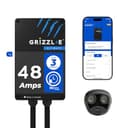
You want one charger that will not need replacing: the Grizzl-E Classic Connect. A cast-aluminum UL Type 4 case published from −22°F to 122°F, a 25-foot cable, 2.4 GHz Wi-Fi with an app, and current adjustable from 40 amps down to 16, all on a simple NEMA 14-50 plug that needs no hardwiring. Honest cons: 40 amps is its ceiling because of the plug, scheduling now runs through an account rather than the unit, and Grizzl-E publishes UL and cUL for this model but not the ENERGY STAR listing its older no-app Classic carries. Full detail in our Grizzl-E Classic review.
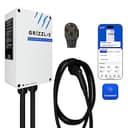
You drive a Tesla and are hiring an electrician: the Grizzl-E Ultimate 48A. The same metal case and published cold-weather floor with the ceiling raised to 48 amps, an OCPP radio on top of Grizzl-E’s own app — rare on a home charger — and an ENERGY STAR certification you can cite by model number. Cons, and the first is decisive for most readers: the live Amazon SKU is the NACS cable, so a J1772 car needs an adapter permanently in the chain; it is hardwire-only, so it stays with the house and is no use to a renter; and 48 amps needs a 60-amp circuit that many older panels cannot spare. See the Grizzl-E Ultimate review and Classic versus Ultimate.
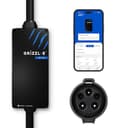
You do not know which outlet you will end up using: the Grizzl-E Mini. It ships on a NEMA 14-50 plug with 14-30P, 6-50P, TT-30P and 5-15P adapters in the box from the manufacturer rather than as third-party add-ons, and United Chargers publishes its output as adjustable from 40 amps down to 7 — so it runs on a dryer outlet today and at full speed the day a 14-50 is fitted. Cons that matter: it ships set to 40 amps and the manufacturer’s own Mini manual says the charger cannot detect a circuit’s amperage limit, so turning it down before the first session is your job; setting the hardware cap means removing the front cover; and you are paying for capacity a dryer circuit will never let you use. Our Grizzl-E Mini review is blunt about that trade.
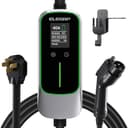
You want the least money for a real 40 amps: the ELEGRP 40A, our budget pick. Five selectable current levels from 16 to 40 amps, an IP67 station body with a published −21°F floor, a 25-foot cable, a carrying case and ETL certification. Cons: no Wi-Fi, no app and no energy monitoring — a 1-to-12-hour delay timer on the unit instead — no ENERGY STAR listing, and 40 amps is the plug-in ceiling. Note too that ELEGRP publishes IP67 for the station and IP54 for the connector, which are not interchangeable numbers. More of this end of the market on our under $300 page.
You drive a Tesla and already have a 14-50 outlet: the Lectron 40A Tesla portable. Native NACS on the car end, a full 40 amps and 9.6 kW from an outlet you already own, an IP65 control box with an IP55 handle that Lectron rates for outdoor use, and it unplugs and travels. Cons: no app on this SKU, no published warranty term, a 16-foot cable that is short next to the 25-foot cords here, and no published adjustable current — so there is no conservative setting for an outlet you cannot inspect. See the Lectron lineup ranked if you are shopping that brand specifically.
Your only 240-volt outlet is the dryer: the EVDANCE 24A. Its plug is a native NEMA 14-30, so nothing is adapted, and its 24-amp maximum is exactly what a 30-amp circuit allows — there is no setting that can ask that circuit for more, which is a safety feature disguised as a limitation. It has an on-unit display of current, voltage, kWh and session time. Cons: a one-year warranty, documentation that contradicts itself on the circuit it wants, and 25 feet that is total length rather than cable reach. See NEMA 14-30 chargers and the dryer-circuit splitter guide if the outlet is still doing laundry.
Two chargers we left off, and why
The Lectron 40A J1772 portable. It sits comfortably under this cap and it is a good charger — a real 40 amps, ETL listed, and the cheapest honest route into Level 2 if you already have the outlet. We left it off because the ELEGRP does the same job for less and publishes more: five current levels against none, an IP67 rating against no published enclosure figure, 25 feet of cable against 16. It is still our pick on portable chargers under $500, where cable length is weighed differently.
Anything at Level 1. A 120-volt cord costs well under this cap and adds roughly 5 to 6 miles of range an hour. That is the right purchase for some people — a plug-in hybrid, a short commute, a rented space — but it is not a $400 decision, and putting it on this page would pad the list rather than answer the question. Our under $200 page is where that argument belongs, and do you need Level 2 is the honest version of the question.