The three things to find out before you buy any of these
A charging gift goes wrong in exactly three ways, and all three are avoidable with information you can get from a casual question or a look in their garage.
Which plug is on their car.Nearly every non-Tesla EV sold in North America uses a connector called J1772. Teslas, and a growing number of new EVs from other brands, use the smaller connector Tesla designed, now standardized as NACS. Chargers and adapters are sold with one or the other on the car end, and the wrong one simply does not fit. If you cannot ask, a photo of the plug they use today settles it — our J1772 vs NACS explainer has both side by side.
What outlet they have where the car parks.A normal household socket means the only gift that works with no installation is a Level 1 charger. A large four-prong 240-volt outlet, the kind an electric dryer or an RV uses, means a plug-in Level 2 charger works the day it arrives. Nothing but a wall means a Level 2 charger comes with an electrician’s bill attached. Our outlet types guide has photos of each so you can match what you see.
Whether they already have a Level 2 charger. If there is a box on the garage wall with a cable coiled on it, they do. In that case buy for the road, not the garage: an adapter, or a portable unit for trips. Our road-tripper gift list covers that case.
The picks, in gifter terms
The one they would buy themselves: Emporia Level 2
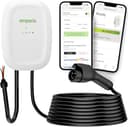
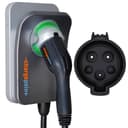
When drivers ask us where to start, this is usually the first charger we name, and that is what makes it the safest big gift on the list. It delivers the full 48 amps a home charger can reasonably use, carries an ENERGY STAR listing and a UL safety listing, has a 25-foot cable so it reaches a car parked at an awkward angle, and comes with an app that tracks what the charging actually costs. The gifter’s reason to pick it over fancier units is that it does not ask the recipient to pay for a brand name.
Why it lands:it turns an overnight charge from “maybe enough” into “full by morning” for basically any EV. Who it suits: a homeowner, or anyone with permission to install on the wall. Check before buying: the plug on the car (this is the J1772 version), and whether they have a 240-volt outlet. Emporia sells it for either a plug-in or a hardwired install; without an existing outlet, the hardwired route needs an electrician, and it is worth saying so in the card. Our full Emporia review has the spec table.
Level 2 with nothing to install: Lectron 40A portable
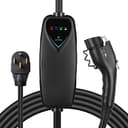
This is the gift for the driver who has a big 240-volt outlet in the garage and is still charging off a household socket because a wall charger felt like a project. It plugs into that outlet, pulls a genuine 40 amps, and unplugs to go in the trunk for a trip. There is no app and the warranty is shorter than the wall units above — both fair trades at the price, and neither is something a recipient tends to miss.
Why it lands: real Level 2 speed on the day it is unwrapped, with zero electrical work. Who it suits: renters, anyone with an RV-style outlet already in place, and drivers who move between two homes. Check before buying:that the outlet is a NEMA 14-50 — the four-prong 240-volt one — and that the car is J1772 (a Tesla driver wants the NACS version instead). Our Lectron 40A review covers the rest.
The stocking stuffer: J1772-to-Tesla adapter
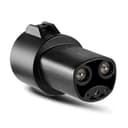
Every Tesla driver eventually meets a J1772 charger — at a friend’s house, a hotel, a workplace — and either has this adapter in the car or does not charge. It is small enough to wrap in a minute, rated to 80 amps and UL 2252 certified, so it is not the weak link in the chain. Most Tesla owners have exactly one, the one that came with the car, and losing it is a common story.
Why it lands: it removes a recurring small annoyance, and a spare is genuinely useful. Who it suits: any Tesla or NACS-port driver. Check before buying: only that the car is a Tesla or has a NACS port; a J1772 car cannot use it. Full details in our adapter review.
For the driver with only a wall socket: Lectron Level 1
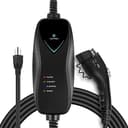
Not everyone can install anything — a rented parking spot, a condo, a detached garage with one outlet. This charger plugs into an ordinary 120-volt household socket and pulls 15 amps, the most a standard circuit will give, which makes it the fastest thing you can do with no electrical work at all. It is slow next to a 240-volt unit, and we will not pretend otherwise: roughly six miles of range an hour. For a plug-in hybrid or a short commute, that is enough to wake up full every morning.
Why it lands: it is charging where charging was impossible. Who it suits:renters, plug-in hybrid drivers, and anyone who has said “I can’t install a charger.” Check before buying: that the car is J1772, and that the socket they will use is a grounded outdoor-rated one if it is outside. Our Level 1 review explains why 15 amps matters here.
The splurge: ChargePoint Home Flex
If you want to buy the charger once and be done, this is the one. Its defining feature for a gifter is flexibility: the current is set in the app anywhere from 16 to 50 amps, so it fits whatever the recipient’s electrical panel can spare today and can be turned up later if that changes. The app is the most polished in the category and the warranty is three years. It costs more than the Emporia for a similar outcome, which is why it is the splurge rather than the default.
Why it lands: it is the charger most drivers have heard of and few have bought for themselves. Who it suits: a homeowner planning a hardwired install. Check before buying:J1772 or NACS — ChargePoint sells a factory-NACS versionfor Tesla drivers — and be clear that the standard unit is hardwired, so an electrician is part of this gift. Our Home Flex review has the full picture.
The other adapter: Tesla-to-J1772
The mirror image of the stocking stuffer, for the other kind of driver. It lets a non-Tesla car charge from a Tesla Wall Connector or Mobile Connector — the situation where a relative or a rental has a Tesla charger in the garage and the visiting car cannot use it. It is capped at 48 amps and SGS-certified to UL 2251. Two cautions: it is not for Tesla Superchargers, and it is more expensive than its J1772-to-Tesla twin because it is doing the electrically harder job.
Why it lands:it solves a specific, memorable problem (“we couldn’t charge at your parents’ place”). Who it suits: a J1772-car driver with Tesla-owning family or friends. Check before buying:that the recipient’s car is J1772 and that the charger they want to use is an AC Tesla unit, not a Supercharger. Our Tesla-to-J1772 review covers what it can and cannot do.
Gifts we would skip, and why
A charger for someone whose panel is full.If they have ever mentioned that an electrician quoted them a service upgrade, a 48-amp charger is not a gift, it is a reminder of an unsolved problem. The kinder move is a plug-in unit that can be turned down, or a conversation first — our 100-amp panel roundup explains the whole situation.
Extension cords for charging.They come up as a “practical” gift and they are the one accessory we would not give: EV charging pulls the same current for hours, and the connections on an ordinary cord are where that goes wrong. Our extension cord guide has the long version.
Anything without a safety listing. Every pick above is from a brand that publishes a UL or ETL listing for the product, and we note where a brand does not publish a warranty. The very cheapest chargers on any marketplace often skip the listing entirely. Our cheap chargers guide explains what to look for on the box.
On price, and on waiting for a sale
Every price on this page comes from a daily retailer check and carries the date it was verified, and when a price cannot be verified the button says “Check price on Amazon” instead of showing a number. If you are shopping in the run-up to the holidays, our Black Friday & Cyber Monday deals hub records what has actually gone on sale in this category in past years, which types of charger have been worth waiting for, and what has not moved much. We post real deals there when they go live and nothing before that.