What 16 amps actually buys, against the alternatives
| Setting | Circuit required | Power at 240 V | Range per hour (our math) | Across a 10-hour night |
|---|
| 12 A at 120 V (Level 1 cord) | 15 A household outlet | 1.44 kW | ~5 miles | ~50 miles |
| 16 A at 240 V | 20 A | 3.84 kW | ~13 miles | ~130 miles |
| 24 A at 240 V | 30 A (dryer circuit) | 5.76 kW | ~20 miles | ~200 miles |
| 40 A at 240 V | 50 A (NEMA 14-50) | 9.6 kW | ~34 miles | ~340 miles |
The jump that matters is the first one. Going from a 120-volt cord to 16 amps at 240 volts roughly triples the overnight figure, and it does it on a circuit small enough that an electrician can often add it without touching the service. Going from 16 to 40 amps triples it again, but needs five times the circuit and, in a full panel, a load calculation or a service upgrade first. Our panel capacity guide shows how to work out which of those you are, and Level 1 versus Level 2 has the arithmetic in full.
Where each charger keeps its 16-amp setting
This is the practical difference between the picks, and it is the thing spec sheets bury.
| Charger | Published levels | Where the setting lives | Install |
|---|
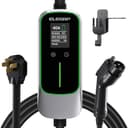
| ELEGRP 40A | 16 / 20 / 24 / 32 / 40 A | On the unit — no app, no account | NEMA 14-50 plug |
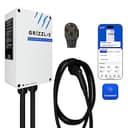
| Grizzl-E Classic Connect | 40 A down to 16 A | Hardware cap, plus the Grizzl-E Connect app | NEMA 14-50 plug |
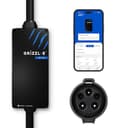
| Grizzl-E Mini | 40 A down to 7 A | Hardware cap behind the front cover | NEMA 14-50 plug, four adapters in the box |
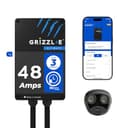
| Grizzl-E Ultimate 48A | 40 / 32 / 24 / 16 A | Hardware cap, plus app and OCPP | Hardwired, 60 A circuit for full output |
| ChargePoint Home Flex | 16 A up to 50 A | In the app, in software | Hardwired, or a plug-in NEMA 14-50 SKU |
An app-set cap is the easiest to change and the easiest to change by accident; a hardware cap behind a cover is the opposite. If the charger is going on a circuit someone else sized, or in a rental, the hardware cap is the safer design — and what amp to set your charger walks through doing it once, correctly.
How to choose between the picks
You want the least money for a correctly-set 16 amps: the ELEGRP 40A, our budget pick. Five on-unit levels from 16 to 40 amps, an IP67 station body with a published −21°F floor, 25 feet of cable, a 1-to-12-hour delay timer and a carrying case, all ETL certified. Cons: no Wi-Fi, no app and no energy monitoring; ELEGRP publishes IP67 for the station and IP54 for the connector, which are not interchangeable numbers; and the plug is NEMA 14-50 only, so a 20-amp circuit install means an electrician fitting a 14-50 outlet on it rather than reusing a small existing one.
The charger is going outside: the Grizzl-E Classic Connect. Cast aluminum, UL Type 4 indoor/outdoor, published from −22°F to 122°F, 25 feet of cable, Wi-Fi scheduling, and 40 amps adjustable down to 16. Most chargers at this price publish an IP number and no cold figure at all. Cons: 40 amps is its ceiling, scheduling runs through an account, and unlike the older no-app Classic it is not on the ENERGY STAR certified list. See best outdoor chargers if the wall is the deciding factor.
You want the lowest setting available: the Grizzl-E Mini. United Chargers publishes it adjustable from 40 amps all the way down to 7 — the lowest published floor in our registry — and it ships with 14-30P, 6-50P, TT-30P and 5-15P adapters from the manufacturer, so it can meet almost any outlet you have. Cons: it arrives set to 40 amps and the manufacturer’s own manual says the charger cannot detect a circuit’s limit, so the first thing you do is set it; the cap lives behind the front cover; and on a small circuit you are paying for capacity you will never use.
You are hiring an electrician and drive a Tesla: the Grizzl-E Ultimate 48A. It steps 40, 32, 24 or 16 amps, so the same unit that runs on a small circuit today can be re-capped to 48 amps the day the panel is upgraded — and it is the one charger here with an ENERGY STAR certification we can cite by model number. Cons: hardwire-only, so it stays with the house; the live Amazon SKU is the NACS cable, so a non-Tesla needs an adapter in the chain permanently.
You want the setting in software: the ChargePoint Home Flex. Anywhere from 16 to 50 amps, set in the app, with the most complete scheduling and history of anything here and a 3-year warranty. It is the charger to buy if 16 amps is a temporary answer and you expect the circuit to grow. Cons: you pay a brand premium over everything above it, using the full 50 amps needs a 70-amp circuit most older panels cannot spare, and a software-set cap is as easy to raise as to lower. Our Home Flex review has the detail.
Chargers we had to leave off this page
Three units in our registry are good chargers and cannot go on this list, because their manufacturers publish no adjustable current at all: the Lectron Nexus NACS 48A, the Lectron 40A Tesla portable and the Leviton EV40P, which Leviton specifies as a fixed 40-amp unit. The EVDANCE 24A is a near-miss worth naming: its published steps are 10, 12, 16, 20 and 24 amps, so it can run at 16 — but its native plug is a NEMA 14-30 and its ceiling is 24 amps, so it belongs on the NEMA 14-30 page rather than here. If none of the picks above fits your circuit, start with chargers for apartments, which is the other page on this site written around a circuit you cannot change.