What each app actually does
“Smart” covers a wide range, so here is the specific capability list from each manufacturer’s own page rather than the word.
| Charger | Radio | Set current from the app? | Access control | Open protocol | Energy / cost tracking |
|---|
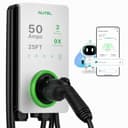
| Autel MaxiCharger Home | Wi-Fi, Bluetooth, Ethernet, CAN, RS485 | Yes, 16–50 A | App, AutoStart and RFID card (cards extra) | Not stated | Yes |
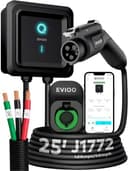
| EVIQO 48A | 2.4 GHz Wi-Fi | Yes — 6 A upward in 1-amp steps | App | Not stated | Yes, with cost |
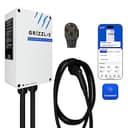
| Grizzl-E Classic Connect | 2.4 GHz Wi-Fi | App plus a hardware cap | Account-based | Not stated | Yes |
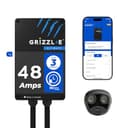
| Grizzl-E Ultimate 48A | 2.4 GHz Wi-Fi or Gigabit Ethernet | App plus a hardware cap | Account-based | OCPP | Yes |
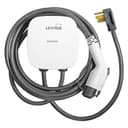
| Leviton EV40P | Wi-Fi | No — fixed 40 A, no published range | App | OCPP 1.6 | Yes |
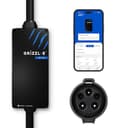
| Grizzl-E Mini | 2.4 GHz Wi-Fi | App plus a hardware cap | Account-based | Not stated | Yes |
Two columns there are the reason this page is not just a price filter. The EVIQO’s 1-amp app increments are the finest control in our registry at any price, which makes it the charger to buy if your circuit is genuinely marginal. And OCPP — an open protocol, so the charger is not locked to one company’s servers for its lifetime — appears on only two units under $500, the Grizzl-E Ultimate and the Leviton. That is the single most future-proof line on the table, and our OCPP chargers page explains why.
What $500 does not buy, even with an app
Real load management. Not one charger in this bracket does whole-house load management on its own. Autel publishes adaptive load management and dynamic load balancing but states that ALM “requires compatible additional hardware”. EVIQO describes no load management anywhere on its page. Leviton’s own EV40P page states none at all. If your panel is the constraint, that is the feature you are shopping for and it lives above this cap — see best load-management chargers.
A 50-amp install you can actually use. The Autel reaches 50 amps, but 50 amps continuous requires a 70-amp circuit, which many older panels cannot spare — so in practice most buyers will run it at 40 or 48. That is not a criticism of the charger; it is the reason the adjustable range matters more than the ceiling. Panel capacity is where to start.
Freedom from an account. Every charger here needs the manufacturer’s app to use its smart features, and two of them route scheduling through an account rather than the unit. If that is a dealbreaker — and for some readers it should be, because an account is a dependency with no warranty — buy a dumb charger and schedule in the car. Our chargers without Wi-Fi page is the honest counterargument to this whole list.
How to choose between the picks
You want the most charger and the most control: the Autel MaxiCharger Home. Fifty amps, 12 kW, output adjustable from 16, a 25-foot J1772 cable, IP65 / NEMA 4X, the widest published temperature range here at −40°F to 131°F, ENERGY STAR, three years, and — the thing nothing else in this bracket has — RFID-card authorization that works when the phone does not. Cons: hardwired, cards sold separately, full output needs a 70-amp circuit, and the load management needs hardware it does not ship with. Our MaxiCharger review has the rest.
Your circuit is marginal and you want to tune it: the EVIQO 48A. Forty-eight amps and 11.5 kW, with hardware DIP switches setting the maximum at 16, 32, 40 or 48 amps and the app then fine-tuning from 6 amps upward in 1-amp increments — two layers of control, the coarse one in hardware where it cannot be nudged. A 25-foot cable, IP66 / NEMA-4 rated −22°F to 122°F, UL / ETL / FCC / ENERGY STAR, three years extendable to four, and app scheduling with live energy and cost tracking. Cons: hardwired only, 48 amps needs a 60-amp circuit, and EVIQO’s own banner copy (“6-50A”) disagrees with its own FAQ — we cite the FAQ.
You want Wi-Fi for the least money: the Grizzl-E Classic Connect, our budget pick. The cheapest Wi-Fi charger in our registry and the only one here in cast aluminum: UL Type 4, published from −22°F to 122°F, 25 feet of cable, 40 amps adjustable down to 16, on a plug-in NEMA 14-50 install that needs no electrician if the outlet exists. Cons: 40 amps is its ceiling because of the plug, scheduling runs through an account rather than the unit, and unlike the older no-app Classic it is not on the ENERGY STAR certified list — which matters if a rebate names it.
You drive a Tesla and want an open protocol: the Grizzl-E Ultimate 48A. Forty-eight amps and 11.52 kW hardwired, native NACS cable on the Amazon SKU, the same cast case and cold-weather floor, OCPP alongside Wi-Fi or Gigabit Ethernet, and an ENERGY STAR certification recorded against model GRS-077-W-HW-25J48-A-GB. Cons: the NACS cable means a non-Tesla needs an adapter permanently in the chain, it is hardwire-only, and 48 amps needs a 60-amp circuit.
You want no hardwiring and a shared charger: the Leviton EV40P. Forty amps, 9.6 kW, a 25-foot cable, a NEMA Type 3R enclosure, an operating range of −30°C to 50°C, a long UL list and OCPP 1.6 compliance, with app-based access control — useful on a driveway or a duplex. Cons, and they are published by Leviton itself: no load management of any kind, no adjustable amperage range (it is specified as a fixed 40-amp unit), and a two-year warranty, the shortest here. See chargers with access control.
You want the app on something that travels: the Grizzl-E Mini. The only smart charger here you can unplug and take with you: 40 amps on a NEMA 14-50 plug with 14-30P, 6-50P, TT-30P and 5-15P adapters in the box, adjustable 40 down to 7 amps, Wi-Fi with the Grizzl-E Connect app, in the same cast metal as the rest of the line. Cons: it ships set to 40 amps and United Chargers’ own manual says it cannot detect a circuit’s limit, the hardware cap is behind the front cover, and it is the most expensive pick on this page.