What the amperage actually buys, hour by hour
At our 3.5 miles-per-kWh reference, before charging losses. Read the last column first: it is the one that decides this purchase, because almost nobody plugs in with an empty battery and needs it full by morning.
| Charger | Circuit required | Power | Range per hour | Across a 10-hour night |
|---|
| 80 A | 100 A dedicated | 19.2 kW | ~67 miles | ~670 miles |
| 50 A | 70 A dedicated | 12 kW | ~42 miles | ~420 miles |
| 48 A | 60 A dedicated | 11.52 kW | ~40 miles | ~400 miles |
| 40 A | 50 A (NEMA 14-50) | 9.6 kW | ~34 miles | ~340 miles |
Four hundred miles a night and six hundred and seventy miles a night are the same answer to any question a household actually asks. The gap only becomes useful if you are refilling a very large pack twice in a day, or splitting one circuit across two cars. That is the entire case for 80 amps, and it is why four of the five picks here are not 80-amp chargers.
The two ceilings above the charger
Your panel. Eighty amps continuous needs a 100-amp breaker on a dedicated circuit, plus conductors sized for it. A typical US house has a 100 or 200-amp service in total, so an 80-amp charger circuit is either impossible or requires a load calculation and often a service upgrade — the expensive kind of electrical work. Our panel capacity guide shows how to read what you have, and installation cost prices the work. If your panel is the constraint rather than your budget, load management is the cheaper answer: it lets a big charger share an existing service instead of demanding a new one.
Your car. The charger does not set the AC charging speed; the vehicle’s onboard charger does. Hand a car with an 11-kW onboard charger an 80-amp supply and it draws 48 amps, exactly as it would from a 48-amp charger. The federal fuel-economy records publish a 240-volt full-charge time for every EV sold in the US, which is the cleanest way to see where your own car caps out, and onboard charger limits explains how to read it. Check that number before you pay for amperage.
How to choose between the picks
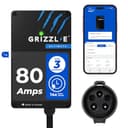
You have the service and the car: the Grizzl-E Ultimate 80A. United Chargers publishes it at 80 amps and 19.2 kW with a J1772 connector, adjustable in eight steps (80, 64, 56, 48, 40, 32, 24, 16), hardwire-only, a 25-foot cable, a cast-aluminum UL Type 4 enclosure published from −22°F to 122°F, UL file E510712, OCPP plus 2.4 GHz Wi-Fi and the Grizzl-E app, and ENERGY STAR on its own specification table. The adjustability is the quiet argument for it: the same box runs at 40 amps today and 80 the day the service is upgraded. Cons: hardwire-only, so it stays with the house; the warranty is a three or five-year purchase option rather than a term; and 80 amps is unusable without the circuit. Our Grizzl-E lineup page puts it against the rest of the brand.
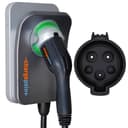
You want the ceiling in software: the ChargePoint Home Flex. Fifty amps and 12 kW, with the output set anywhere from 16 to 50 amps in the app — so one unit covers a modest circuit now and a bigger one later without touching hardware. The app is the most complete here (scheduling, reminders, usage history) and the warranty is three years, with a 23-foot cable and an ENERGY STAR listing. Cons: a brand premium over the Autel below, and the full 50 amps needs a 70-amp circuit most older panels cannot spare. Detail in our Home Flex review.
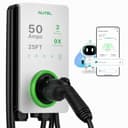
You want 50 amps for the least money: the Autel MaxiCharger Home, our budget pick. Autel publishes 12 kW / 50 amps with the output adjustable 16–50 A, a 70-amp circuit stated for full output, a 25-foot J1772 cable, IP65 / NEMA 4X, an operating range of −40°F to 131°F — the widest published range on this page — a three-year warranty, and app, AutoStart and RFID-card authentication. It is the cheapest route to a genuine 50 amps we can price. Cons: hardwired, RFID cards are sold separately, and its adaptive load management needs additional hardware Autel does not include. See the MaxiCharger review.
You are worried about the whole house, not just the charger: the Emporia Pro. Forty-eight amps and 11.5 kW hardwired, 25 feet of cable, ENERGY STAR, and the reason it is here — Emporia’s PowerSmart approach is built around watching household consumption rather than only the charging circuit, which is the feature that lets a big charger coexist with a panel that is already busy. Cons: it is one of the more expensive units on this page and 48 amps is its ceiling, so it does not answer the 80-amp question, it reframes it. More on that trade in load management chargers.
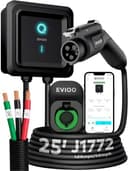
You just want the most amps per dollar: the EVIQO 48A. Forty-eight amps and 11.5 kW standard, with hardware DIP switches setting the maximum at 16, 32, 40 or 48 amps and the app fine-tuning from 6 amps upward in 1-amp increments — the most granular control here. A 25-foot cable, an IP66 / NEMA-4 enclosure rated −22°F to 122°F, UL / ETL / FCC / ENERGY STAR certification and a three-year warranty extendable to four. EVIQO also publishes a 50-amp output by changing internal DIP switches, which it says needs a 70-amp circuit. Cons: hardwired only, and the 48-amp output needs a 60-amp circuit. Our EVIQO 48A review has the detail.
What we left off, and the one thing to check first
We did not pad this page with 48-amp chargers to make a list of ten. Only one product in our registry is an 80-amp charger, and saying so is more useful than ranking nine units that are not. The four step-downs above are here because they are the realistic alternatives, each one adjustable so it fits the circuit you can actually build. If your reason for landing here was speed rather than amperage, start with the fastest home EV charger, which works the question from the car end, and best 48-amp chargers if you have already decided 60 amps is what your panel can give.