Where each alternative beats the Autel, and where it does not
| Charger | Output | Circuit needed | Connector | App required? | Beats the Autel on |
|---|
| Autel MaxiCharger Home | 50 A, 12 kW | 70 A for full output | J1772 | For smart features | — (−40°F range, RFID cards, 5 radios) |
| EVIQO 48A | 48 A, 11.5 kW | 60 A | J1772 | For smart features | Current control in 1-amp steps; 4-year warranty option |
| Lectron Nexus J1772 | 48 A, 11.5 kW | 60 A | J1772 | No app at all | Price; nothing to log into; IP66 |
| Grizzl-E Ultimate 48A | 48 A, 11.52 kW | 60 A | NACS (the Amazon SKU) | Optional | Native Tesla cable; OCPP; cast metal; 5-year option |
| Emporia Pro | 48 A, 11.5 kW | 60 A | J1772 | For smart features | Whole-home consumption awareness without extra hardware |
| Grizzl-E Ultimate 80A | 80 A, 19.2 kW | 100 A | J1772 | Optional | Raw output; eight selectable steps; OCPP |
Read the last column honestly: nothing here beats the Autel across the board. It keeps the widest published temperature range, the only RFID-card authorization in this group, and the most connectivity options. What the alternatives offer is a 60-amp circuit instead of a 70-amp one, and then one specific thing each.
The circuit arithmetic, since it is the point of this page
| Charger output | Breaker required | Power | Range per hour (our math) | Across a 10-hour night |
|---|
| 50 A | 70 A dedicated | 12 kW | ~42 miles | ~420 miles |
| 48 A | 60 A dedicated | 11.52 kW | ~40 miles | ~400 miles |
| 40 A | 50 A | 9.6 kW | ~34 miles | ~340 miles |
Fifty amps buys about two extra miles of range an hour over 48 — a four percent difference — in exchange for a circuit a step larger. For a household that is already at the limit of its service, that trade is clearly the wrong way round, and it is why four of the five picks here are 48-amp units. There is a second ceiling too: AC charging is capped by the car’s onboard charger, and most mainstream EVs stop around 11 kW, at which point 48 and 50-amp chargers deliver identical power. Check yours in onboard charger limits, and read panel capacity before you size anything. If the panel is genuinely full, load management is cheaper than an upgrade.
How to choose between the picks
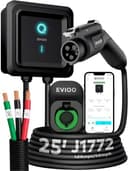
You want the Autel’s feature set on a 60-amp circuit: the EVIQO 48A. Forty-eight amps and 11.5 kW standard, with hardware DIP switches setting the maximum at 16, 32, 40 or 48 amps and the app then tuning from 6 amps upward in 1-amp increments — finer control than Autel’s 16–50 A range, and the coarse layer lives in hardware where it cannot be nudged. A 25-foot cable, IP66 / NEMA-4 rated −22°F to 122°F, UL / ETL / FCC / ENERGY STAR, app scheduling with live energy and cost tracking, over-the-air firmware, and a three-year warranty extendable to four. EVIQO also publishes a 50-amp output via internal DIP switches, which it says needs the same 70-amp circuit. Cons: no load management described anywhere on its page, no RFID, hardwired only, and EVIQO’s banner copy contradicts its own FAQ on the current range — we cite the FAQ. Our EVIQO 48A review and Autel versus Emporia go deeper.
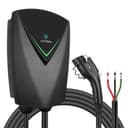
You want 48 amps for the least money, with nothing to log into: the Lectron Nexus J1772, our budget pick. The cheapest hardwired 48-amp J1772 charger in our registry: 11.5 kW, IP66 indoor/outdoor, a 23-foot cable with a wall-mount J-hook and plug holder, ETL listing to UL 2594 / UL 2231 / UL 2251, FCC, ENERGY STAR, a three-year warranty — and no app, Wi-Fi or account anywhere on the product. If the Autel’s appeal was the charger rather than the ecosystem, this is the honest substitute. Cons: Lectron publishes no adjustable current range, so it is a 60-amp circuit or nothing; there is no energy tracking and no access control of any kind.
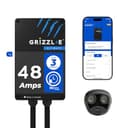
You drive a Tesla: the Grizzl-E Ultimate 48A. A native NACS cable on the Amazon SKU, so no adapter in the chain, plus 48 amps and 11.52 kW, a cast-aluminum UL Type 4 case published from −22°F to 122°F, UL E510712, OCPP alongside Wi-Fi or Gigabit Ethernet, and an ENERGY STAR certification recorded as model GRS-077-W-HW-25J48-A-GB whose additional model numbers cover the NACS SKU. The OCPP support is the thing the Autel does not publish. Cons: a non-Tesla then needs an adapter permanently in the chain, it is hardwire-only, and the warranty is a three or five-year checkout option rather than a stated term. See Autel versus Grizzl-E.
You want load management without buying extra hardware: the Emporia Pro. Forty-eight amps and 11.5 kW hardwired, 25 feet of cable and ENERGY STAR — and it is here for one reason, which is that Emporia’s PowerSmart approach is built around watching household consumption rather than only the charging circuit. That is the capability Autel’s own page says needs “compatible additional hardware” for ALM. Cons: it is among the more expensive units we stock, 48 amps is its ceiling, and it is hardwired. Compare in best load-management chargers.
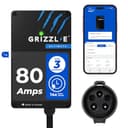
You actually have the panel for more: the Grizzl-E Ultimate 80A. Eighty amps and 19.2 kW with a J1772 connector, eight selectable steps from 80 down to 16, OCPP, 25 feet of cable and the same cast Type 4 enclosure. The adjustability is the real argument: the same box runs at 48 amps today and 80 the day the service is upgraded, which no other charger here can do. Cons, and they are large: 80 amps requires a dedicated 100-amp circuit, which usually means a service upgrade, and almost no car on sale can accept 19.2 kW over AC. Read the 80-amp page before committing.
When the Autel is still the right buy
Three cases, and we would rather name them than pretend this page settles the question. If your charger is going somewhere genuinely cold — an unheated garage in a northern state — Autel’s published −40°F floor is the widest envelope we can cite for any charger in our registry. If more than one person needs authorized access and you do not want to depend on a phone, Autel’s RFID-card authentication is the only card-based access control in this group. And if you have a 70-amp circuit available, or are building one anyway, 50 amps costs you nothing extra to use. For the head-to-heads, see Autel versus ChargePoint, Autel versus Emporia and Autel versus Wallbox, or read the MaxiCharger review in full.