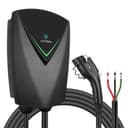
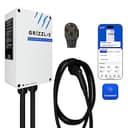
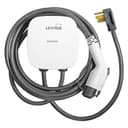
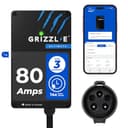
Match your HCS model to a pick
Left column: what Enphase publishes for the HCS unit. Right column: the pick above that meets or beats it, on the manufacturer’s own figures.
| HCS model (Enphase’s figures) | Output | The pick that matches it | What you get instead |
|---|
| HCS-40, HCS-D40 | 32 A, 7.7 kW | ELEGRP 40A, or the Grizzl-E Classic Connect | 40 A rather than 32, both adjustable down to 16 A |
| HCS-50, HCS-50PR | 40 A, 9.6 kW | Leviton EV40P, or the Grizzl-E Classic Connect | The same 40 A, on a plug rather than hardwired |
| HCS-60 | Residential-grade connector (amperage not published on the store listing) | Lectron Nexus J1772 | 48 A hardwired with a published 11.5 kW and an ENERGY STAR record |
| HCS-80 | 64 A, 15.4 kW | Grizzl-E Ultimate 80A | 80 A and 19.2 kW, selectable in eight steps down to 16 A |
One row deserves a caution rather than a recommendation. An HCS-80 at 64 amps needs an 80-amp circuit, and the Grizzl-E Ultimate 80A at 80 amps needs a 100-amp one — both are service-upgrade territory for most US homes, and almost no car on sale can accept either figure over AC. If you were replacing an HCS-80 because the house already has the circuit, that is a legitimate buy; if you were about to install one for the first time, read our 80-amp page first, because the honest answer there is 48 amps.
What Enphase sells under its own brand now
Worth knowing before you shop elsewhere, because it may be the right answer. Enphase’s current home line is the IQ EV Charger 2, published in three home variants: hardwired 48 A up to 11.5 kW with a J1772 connector, the same hardwired 48 A with a NACS connector, and a plug-in NEMA 14-50 40 A unit up to 9.6 kW. Enphase publishes “a 25 ft cable”, “UL certified, NEMA 4, surge protection, seismic and tilt sensor, ground fault”, a five-year limited warranty, management through the Enphase App, and access control that “prevents unauthorized use with app-based or RFID based access control”. Its store also carries 64 A and 80 A hardwired IQ SKUs.
Two of those are genuinely better than anything on our list: a five-year standard warranty beats every published term in our registry except Grizzl-E’s five-year option, and a seismic and tilt sensor is a feature nobody else here publishes. The reason the IQ line is not a pick on this page is narrow and we would rather state it than imply something worse: we rank what we can link to a live retail listing and price-check daily, and Enphase sells through its own store and its installer channel. If the five-year warranty is what you are buying, go and look at it — and then compare the terms on our warranty page, which lists every one we can verify.
How to choose between the picks
You want the no-app simplicity: the Lectron Nexus J1772. Forty-eight amps and 11.5 kW hardwired, an IP66 indoor/outdoor rating, a 23-foot cable with a J-hook and plug holder, ETL listing to UL 2594 / UL 2231 / UL 2251, FCC, ENERGY STAR, and a three-year warranty — with nothing to pair, no account and no app. It is the closest thing in our registry to a charger that just charges, and the certifier lists it twice, once with a radio and once without, so the no-radio build is a documented product rather than a marketing position. Cons: Lectron publishes no selectable current range for it, so it needs a dedicated 60-amp circuit or nothing, and professional hardwiring is required. Our Nexus J1772 review has the rest, and chargers without Wi-Fi covers the whole category.
You want metal and no electrician: the Grizzl-E Classic Connect. Cast aluminum with a UL Type 4 indoor/outdoor rating and a published range of −22°F to 122°F, UL file E510712, 25 feet of cable, 40 amps adjustable down to 16, and a NEMA 14-50 plug — so if the outlet exists the install is an afternoon. United Chargers also offers three or five years of warranty as a checkout option. Cons: 40 amps is its ceiling because of the plug, scheduling runs through an account rather than the unit, and it is not on the ENERGY STAR certified list even though its no-app predecessor was.
You are replacing an HCS-50 and want the same 40 amps: the Leviton EV40P. Forty amps, 9.6 kW — the HCS-50’s published figures exactly — a 25-foot cable, a NEMA Type 3R enclosure, an operating range of −30°C to 50°C, a long UL list (2594 / 2231-1 / 2231-2 / 2251 / 62 / 991 / 1998) and OCPP 1.6 compliance, with app-based access control. Cons, from Leviton’s own page: no load management of any kind, no adjustable amperage range at all, and a two-year limited warranty.
You are replacing an HCS-80: the Grizzl-E Ultimate 80A. Eighty amps and 19.2 kW against the HCS-80’s 64 amps and 15.4, a J1772 connector, hardwire-only, 25 feet of cable, a cast-aluminum UL Type 4 case published from −22°F to 122°F, UL E510712, OCPP plus Wi-Fi, and eight selectable steps from 80 amps down to 16 — so it can be capped to whatever circuit you have. Cons: 80 amps needs a dedicated 100-amp circuit, it is hardwire-only, and the warranty is a purchase option rather than a term.
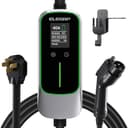
You want the least money: the ELEGRP 40A, our budget pick. Five on-unit current levels (16 / 20 / 24 / 32 / 40 A), an IP67 station body published to −21°F with an IP54 connector, 25 feet of cable, a 1-to-12-hour delay timer, a carrying case and ETL certification — and no app or account, in keeping with why you are on this page. Cons: no Wi-Fi, no energy monitoring, no ENERGY STAR listing, “up to” two years of warranty, and a NEMA 14-50 plug ceiling of 40 amps.
If you own an HCS already
Do not replace a working charger on the strength of a website outage. Enphase’s ClipperCreek page directs owners of an existing ClipperCreek charger to its 24/7 technical support line, and nothing we could read says any HCS model is discontinued or unsupported. An HCS-40 putting 7.7 kW into a car overnight is still putting 7.7 kW into a car overnight, which is roughly 27 miles of range an hour at our 3.5 miles-per-kWh reference — more than a normal day of US driving. The time to buy from this page is when something has actually failed, when you need more amperage than your unit can give, or when you want a charger you can still buy a second one of. Our EV charger not charging guide is the right first stop if the symptom is a charger that has stopped, because a good share of those faults are the breaker, the car or the app rather than the charger.